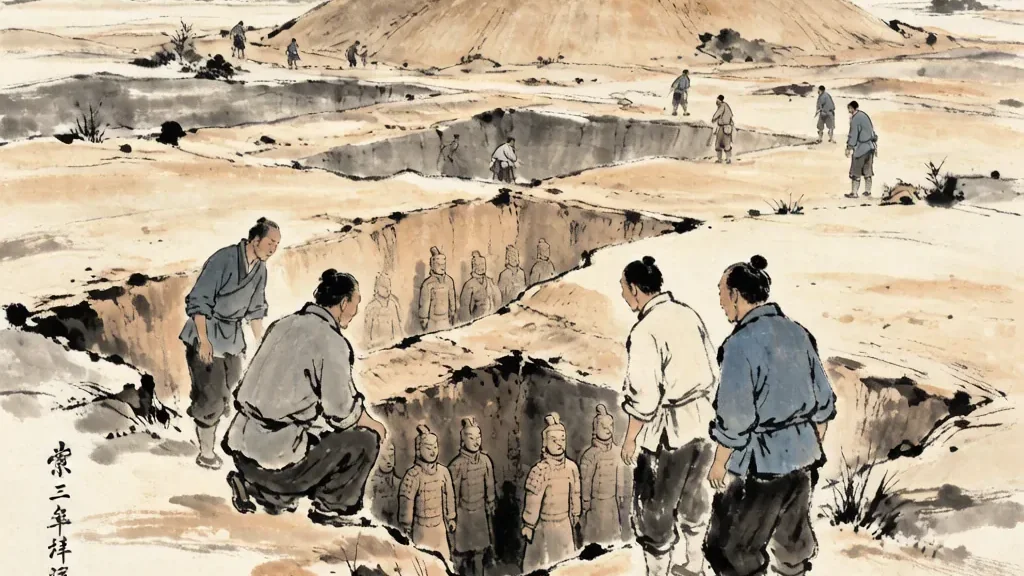
In the spring of 1974, a group of farmers digging a well near the city of Xi'an struck something hard. They had expected water. Instead, they found fragments of pottery and, beneath the dry Shaanxi soil, the head of a clay soldier. They had no idea that they had just made one of the most extraordinary archaeological discoveries in human history. Buried beneath their feet stood an entire army — over 8,000 life-size terracotta warriors, each with a unique face, arranged in battle formation, silently guarding the tomb of China's First Emperor for over two thousand years.
Qin Shi Huang: The Man Who Would Be God
To understand the Terracotta Army, one must understand the man who commissioned it. Qin Shi Huang (259–210 BCE) was a figure of terrifying ambition. He became King of Qin at age 13, conquered the other six Warring States by age 38, and unified China for the first time in history. He abolished the feudal system, standardized weights and measures, unified the writing system, built the first version of the Great Wall, and began an immense network of roads and canals. He also burned books, buried scholars alive, and ruled with an iron fist.
Above all, Qin Shi Huang was obsessed with immortality. He dispatched expeditions to find the legendary "Isles of the Immortals" in the eastern sea, consumed mercury-laced elixirs (which would eventually kill him), and ordered the construction of a tomb so vast and so magnificent that it would serve as his palace in the afterlife. The Terracotta Army was the vanguard of that tomb — an eternal bodyguard for a ruler who intended to reign forever.
The Mausoleum: A Microcosm of Empire
The tomb complex of Qin Shi Huang sprawls across approximately 56 square kilometers, an area larger than Manhattan. At its heart, beneath a 76-meter artificial mound, lies the emperor's burial chamber — a space that, according to the Han Dynasty historian Sima Qian, contains a map of the empire with rivers of flowing mercury, a ceiling inlaid with pearls to represent the stars, and deadly crossbow traps to deter grave robbers.
Sima Qian's account, written a century after the emperor's death, describes a project of staggering scale: "More than 700,000 conscripts from all parts of the empire labored unceasingly. They dug through three subterranean streams and poured molten copper for the outer coffin. Palaces and scenic towers for a hundred officials were constructed, and the tomb was filled with rare artifacts and wonderful treasures."
Modern remote sensing has confirmed that the burial chamber contains anomalously high levels of mercury — evidence that Sima Qian's account may be remarkably accurate. The central tomb has never been excavated, both out of respect and because archaeologists fear that opening it could destroy priceless artifacts before preservation techniques are ready.
The Army Emerges: Discovery and Excavation
When the farmers reported their find in 1974, Chinese archaeologists rushed to the site. What they found exceeded their wildest dreams. Pit 1, the largest of the excavated pits, measures 230 meters long and 62 meters wide — roughly the size of two football fields. Inside, arranged in precise military formation, stood thousands of terracotta soldiers: archers in the vanguard, infantry in the main body, charioteers on the flanks, all facing east — the direction of the states Qin had conquered.
Two additional pits were subsequently discovered. Pit 2 contains a more mixed force of cavalry, chariots, and infantry, seemingly a rapid-response unit. Pit 3, the smallest, appears to be the command center, with high-ranking officers and a ceremonial chariot. A fourth pit was found empty — the army, it seems, was never completed before the emperor's death.
The excavation continues to this day. Archaeologists work with extraordinary care, using delicate tools to remove the soil that has encased the figures for millennia. Each warrior emerges slowly, like a ghost from the earth, and the painstaking work of piecing together shattered fragments and restoring faded pigments will continue for decades to come.
Masterpieces of Craftsmanship
The warriors of the Terracotta Army are not identical mass-produced figures. Each one has a distinct face — different eyebrows, mustaches, noses, and expressions. Scholars have identified at least eight basic face shapes, which were then individually modified to create unique features. The warriors range in height from 1.72 to 1.95 meters, with generals being the tallest, reflecting their status.
The level of detail is astonishing. The soles of the soldiers' shoes are textured with tread patterns. The armor shows individual rivets and leather straps. Hairstyles indicate rank and unit — officers wear distinctive caps, cavalrymen have tight buns, and infantrymen display varied topknots. Even the horses are meticulously crafted, with flared nostrils, pricked ears, and muscular haunches that convey tension and power.
Originally, every figure was painted in vivid colors: pink faces, black hair, red tunics, green pants, purple scarves. The pigments were derived from natural minerals — cinnabar for red, malachite for green, azurite for blue, and an artificial pigment called Han purple for the distinctive purple tones. Tragically, when the warriors were first exposed to air after excavation, the lacquer beneath the paint dried and flaked away within minutes, taking the colors with it. Today, chemists work to develop preservation techniques that will allow future generations to see the warriors as they were meant to be seen.
Weapons of an Ancient Superpower
The warriors were equipped with real weapons — over 40,000 bronze items have been recovered, including swords, spears, halberds, crossbows, and arrows. The swords are particularly remarkable. After 2,200 years underground, they emerged still sharp, their blades coated with a thin layer of chromium oxide — a rust-proofing technique that would not be "invented" in the West until the 20th century.
The crossbows, too, represent advanced technology. Their trigger mechanisms were precision-cast in bronze and standardized to such a degree that parts from one crossbow could be swapped with another — an early form of interchangeable parts manufacturing that anticipated the Industrial Revolution by two millennia. The Qin war machine was built on standardized, mass-produced weaponry, and the Terracotta Army preserves this military-industrial complex in stunning detail.
Unsolved Mysteries
Despite decades of study, the Terracotta Army holds many secrets. The central tomb remains sealed, and no one knows what wonders — or horrors — lie within. The mercury rivers described by Sima Qian may be more than legend. The deadly traps may be real. And somewhere in the complex, archaeologists believe, may be the remains of the craftsmen and conscripts who built the tomb, executed and buried to preserve its secrets.
The identity of every warrior's face remains a mystery. Were they modeled on real soldiers? Individual craftsmen? Or are they idealized representations? Recent analysis suggests that the faces may have been based on actual Qin soldiers, making the army not just a symbol of imperial power but a haunting gallery of individual human beings, frozen in clay for eternity.
What is certain is that the Terracotta Army stands as one of the supreme artistic achievements of the ancient world. It is a monument to both the grandeur and the terror of absolute power — a ruler so mighty that he commanded an army to follow him into death, and a civilization so sophisticated that it could create such an army from the very earth.
The Lost Colors of the Army
When the warriors were new they were anything but gray. Every face, robe, and horse was painted in bright mineral pigments — cinnabar red, malachite green, azurite blue, and a synthetic purple found almost nowhere else in the ancient world. The paint was laid over a layer of lacquer, and that lacquer is the army's quiet tragedy: the moment a figure meets dry air, the lacquer shrinks and the colors flake away within minutes. Archaeologists now work inside humidity-controlled tents, softening the paint before a figure is fully exposed so that a little of the original color can be saved. The gray army we see today is thus an accident of chemistry, a faded ghost of what was once a brilliantly painted host.
The Army in the Modern World
Since its discovery the Terracotta Army has become a global icon, drawing millions of visitors each year to the museums built over the pits near Xi'an. In 1987 UNESCO named the mausoleum complex a World Heritage Site, calling it a masterpiece of human creative genius and a window into the power of the first unified China. The figures have traveled as loan exhibitions to museums around the world, and their faces appear on stamps, books, and souvenirs everywhere. Yet the site is also a workshop, where conservators race against time to protect what remains. The army's modern life is a balancing act between sharing a wonder with the world and shielding it from the very attention that threatens its survival.
❓ Frequently Asked Questions
📝 Chinese Vocabulary
- 兵马俑 (Bīngmǎyǒng) — Terracotta Army. Literally "Soldier and Horse Funeral Figures."
- 秦始皇 (Qín Shǐ Huáng) — Qin Shi Huang, the First Emperor of unified China.
- 陶俑 (Táoyǒng) — Terracotta figurine or pottery figurine, the material from which the warriors are made.
- 司马迁 (Sīmǎ Qiān) — Sima Qian, the great Han Dynasty historian who described the emperor's tomb.
- 西安 (Xī'ān) — Xi'an, the modern city near which the Terracotta Army was discovered (formerly Chang'an).
🎉 Fun Facts
- Each terracotta warrior weighs between 150 and 300 kilograms (330–660 pounds). The heaviest are the horses, which can weigh up to 400 kilograms each.
- The chromium plating on the Qin swords was applied using a technique that created a 10–15 micrometer protective layer. German scientists patented chromium plating in 1937 — over 2,100 years after the Qin Dynasty.
- No two faces are identical among the 8,000 warriors. Archaeologists have identified at least eight basic face molds, which were then individually hand-finished with unique features, expressions, and hairstyles.
- The Terracotta Army was discovered purely by chance in 1974, when local farmers sinking a well struck the head of a clay soldier beneath the soil.
- Each warrior was built from separately molded parts — legs, torso, arms, hands, and head — then assembled and fired like a vast terracotta puzzle.
- Pit 4 was found completely empty, a sign that the enormous project was still unfinished when the First Emperor died.