← Back to Historical Figures
Historical Figures
Genghis Khan (成吉思汗): The Mongol Emperor Who Conquered the World
✍️ by xiaoyu luo
🗓️ Updated Jul 29, 2026
Last updated: June 2024 · Reading time: 8 min
Born as Temüjin around 1162 CE on the windswept steppes of Mongolia, the man who would become Genghis Khan (成吉思汗, Chéngjísī Hán) rose from abject poverty and tribal warfare to forge the largest contiguous land empire in human history. At its height, the Mongol Empire stretched from the Sea of Japan to the Danube River, encompassing approximately 24 million square kilometers — roughly 16% of the Earth's total land area. Genghis Khan's conquests transformed the political, economic, and cultural landscape of Eurasia, and his legacy continues to resonate in the modern nations of China, Mongolia, Russia, Central Asia, and beyond. In China, Genghis Khan occupies a complex historical position: he is recognized as the founder of the Yuan Dynasty (albeit posthumously, under the temple name Taizu), and his unification of the Mongol tribes and subsequent conquest of northern China laid the foundation for Kublai Khan's establishment of the Yuan Dynasty in 1271.
From Temüjin to Genghis Khan: The Rise of a Conqueror
The early life of Temüjin was marked by violence, betrayal, and survival against overwhelming odds. His father, Yesügei, was a minor chieftain of the Borjigin clan who was poisoned by Tatar rivals when Temüjin was nine years old. The boy, his mother Hoelun, and his siblings were abandoned by their clan and left to survive on the steppe with nothing but their wits and a few animals. As a young man, Temüjin killed his half-brother Begter in a dispute over hunting spoils. In 1177, Temüjin was captured by the Tayichi'ud tribe and held in a wooden cangue, but he escaped with the help of a sympathetic guard. Temüjin's rise to power was built on a revolutionary principle: meritocracy over aristocracy. Unlike traditional Mongol leaders who distributed spoils based on clan affiliation, Temüjin promoted warriors based on ability and loyalty, creating a new elite bound to him personally. In 1206, at a great assembly (kurultai) of the Mongol tribes on the banks of the Onon River, Temüjin was proclaimed Genghis Khan — the meaning of the title is debated, with interpretations ranging from Oceanic Ruler to Universal Ruler.
The Mongol War Machine: Organization, Tactics, and Terror
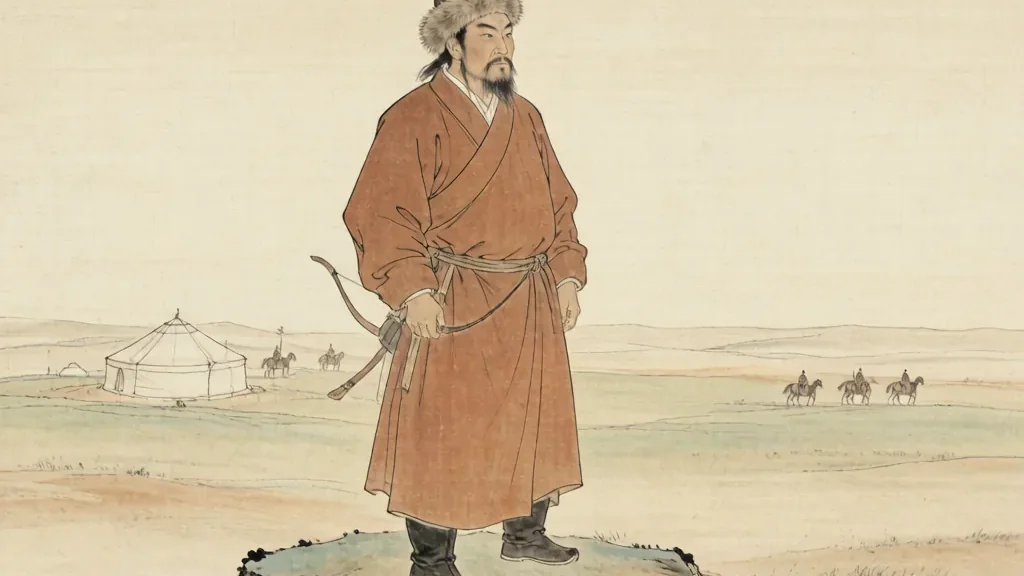
The Mongol military system that Genghis Khan created was arguably the most effective fighting force of the pre-modern world, combining extraordinary mobility, tactical flexibility, and psychological warfare. The foundation of Mongol military power was the decimal system: the entire army was organized into units of 10, 100, 1,000, and 10,000, with commanders at each level appointed by merit. Mongol armies could cover 100 kilometers in a day — three times the speed of contemporary European armies — and sustain themselves for weeks on mare's milk, dried meat, and, in extremis, by drinking their horse's blood. The Mongol composite bow, made from layers of horn, sinew, and wood, had a draw weight of 100-160 pounds and an effective range of 350 meters, outranging contemporary European longbows. Genghis Khan also pioneered the use of siege warfare, employing Chinese and Muslim engineers to construct catapults and battering rams. The most controversial aspect of Mongol warfare was the deliberate use of terror as a psychological weapon: cities that resisted were annihilated, their populations massacred, and the news of their destruction was spread by survivors deliberately released to warn the next city.
Genghis Khan's Campaigns in China: The Conquest of the Jin and Western Xia
Genghis Khan's military campaigns against the Chinese dynasties of the Western Xia and Jin spanned two decades and ultimately brought northern China under Mongol control. The first campaign against Western Xia, launched in 1209, resulted in the submission of the Tangut kingdom as a Mongol vassal state. The conquest of the Jin Dynasty, which controlled northern China, was a far greater challenge. The Jin fielded armies of hundreds of thousands, possessed formidable fortified cities, and had access to gunpowder weapons — the first time the Mongols encountered explosive devices in warfare. The Mongol campaign against the Jin began in 1211: at the Battle of Yehuling, a Mongol army of approximately 90,000 defeated a Jin force estimated at 300,000-400,000. However, the Mongols initially lacked the siege capabilities to capture major Jin cities like Zhongdu (present-day Beijing). It was only after incorporating Chinese siege engineers into their forces that the Mongols were able to reduce the Jin capital in 1215. Genghis also showed interest in Chinese philosophy — he reportedly summoned the Daoist sage Qiu Chuji to his camp in 1222 to discuss the secret of immortality.
Legacy: The Pax Mongolica and Genghis Khan's Place in Chinese History
Genghis Khan died in August 1227 during the final campaign against the Western Xia, under circumstances that remain mysterious. His body was returned to Mongolia and buried in an unmarked grave, the location of which remains one of history's great unsolved mysteries. The empire Genghis Khan created was divided among his sons and grandsons into four khanates — the Yuan Dynasty in China and Mongolia, the Chagatai Khanate in Central Asia, the Ilkhanate in Persia, and the Golden Horde in Russia. The Pax Mongolica — the period of relative peace and stability across Eurasia enforced by Mongol rule — facilitated an unprecedented exchange of goods, ideas, technologies, and people across the Silk Road. Chinese innovations including gunpowder, paper money, and printing technology spread westward, while Islamic astronomy, mathematics, and medicine entered China. In China, Genghis Khan's mausoleum in Inner Mongolia (actually a cenotaph) is a major tourist attraction and pilgrimage site. He was named Man of the Millennium by the Washington Post in 1995. Recent genetic research has suggested that approximately 0.5% of the world's male population — roughly 16 million men — may be direct descendants of Genghis Khan or his close male relatives.
❓ Frequently Asked Questions
Q: Who was Genghis Khan?
A: Genghis Khan (成吉思汗, c. 1162–1227) was the founder and first Great Khan of the Mongol Empire, which became the largest contiguous land empire in history. Born as Temüjin, he united the Mongol tribes and launched conquests across Asia.
Q: When did Genghis Khan live?
A: Genghis Khan lived from approximately 1162 to 1227 CE. He was born in the Khentii Mountains of what is now Mongolia and died during a military campaign against the Western Xia.
Q: What is Genghis Khan famous for?
A: Genghis Khan is famous for creating the Mongol Empire, which stretched from the Pacific Ocean to Eastern Europe. He revolutionized warfare with superior cavalry tactics, psychological warfare, and meritocratic leadership.
Q: What is Genghis Khan's legacy?
A: Genghis Khan's legacy is complex—he is both celebrated for unifying Mongolia and establishing the Silk Road's golden age, and remembered for the immense destruction of his conquests. His empire facilitated unprecedented cultural and commercial exchange across Eurasia.
Q: What is Genghis Khan's legacy?
A: Genghis Khan's legacy is complex—he is both celebrated for unifying Mongolia and establishing the Silk Road's golden age, and remembered for the immense destruction of his conquests. His empire facilitated unprecedented cultural and commercial exchange across Eurasia.
Q: How did Genghis Khan organize his empire?
A: He organized the army by the decimal system of tens, hundreds, thousands, and ten-thousands, led by commanders chosen for ability. A loyal personal guard, the kheshig, shielded his person, and after his death the realm was partitioned among his sons into separate khanates under a single Great Khan.
Key Terms
成吉思汗 (铁木真)
Chéngjísī Hán (Tiěmùzhēn)
蒙古 (Měnggǔ)Mongol, the people Genghis Khan united under his rule.
忽里台 (Hūlǐtái)The kurultai, the great assembly of chiefs that proclaimed Temujin Genghis Khan in 1206.
怯薛 (Kěxuē)The kheshig, Genghis Khan's personal imperial guard bound directly to him.
千户制 (qiān hù zhì)The decimal military system of units of a thousand that organized the Mongol army.
窝阔台 (Ögèdèi)Ögedei, Genghis Khan's son and chosen successor as Great Khan.
也速该 (Yěsùgāi)Yesugei, Genghis Khan's father, a minor chieftain poisoned when the boy was young.
萨满 (Sàmǎn)Shaman, the spiritual figure central to early Mongol religion and decision-making.
Fun Facts
- The Secret History of the Mongols (元朝秘史), the oldest surviving literary work in the Mongolian language, was written shortly after Genghis Khan's death and provides the most detailed account of his life, though it was lost in its original Mongolian form and survives only in Chinese phonetic transcription.
- Genghis Khan's Yassa (legal code) prohibited the kidnapping of women, the theft of livestock, and the pollution of running water — environmental regulations that were remarkably progressive for the 13th century and enforced by the death penalty.
- In 2004, a joint Mongolian-Japanese archaeological team claimed to have discovered Genghis Khan's palace complex at Avarga in eastern Mongolia, though his tomb has never been found despite numerous expeditions employing ground-penetrating radar and satellite imagery.
- After his death the empire was divided among his descendants into four khanates ruling lands from China to Russia.
- He promoted people by merit regardless of tribe, even placing former enemies and outsiders in high command.
- The Mongol relay stations he established let official messages cross the steppe in days, speeding both administration and trade.
The Kurultai and the Making of a Khan
Genghis Khan's authority rested on a political act as much as on conquest. In 1206, at a great kurultai on the banks of the Onon River, the leading Mongol and Turkic chiefs acclaimed Temujin as Genghis Khan, universal or oceanic ruler. This assembly gave his supremacy the consent of the tribes he had subdued, turning personal victory into legitimate kingship. The title's exact meaning is still debated by scholars, but its function was clear: it bound former rivals into one polity under one man. From that moment the scattered herders of the steppe became a people capable of campaigning across continents, and the kurultai remained the ceremony by which later khans took power.
Governance and the Law of the Steppe
Beneath the reputation for terror lay a working system of rule. Genghis Khan issued the Yassa, a code of law that punished theft, kidnapping, and the pollution of water, and that enforced loyalty to the khan above clan ties. He granted religious freedom to Muslims, Christians, Buddhists, and others, judging faith a private matter. Merit, not birth, decided rank, and able foreigners rose to govern conquered cities. This blend of strict law and pragmatic tolerance let a nomadic confederation administer settled civilizations from China to Persia. The order he imposed was harsh, but it was order, and it allowed the vast empire to function as something more than a trail of burned towns.
The Mongol Postal and Trade Network
To govern distance, Genghis Khan built the yam, a relay network of post stations across the steppe and along the trade roads. Mounted couriers changed horses at each station and carried orders, reports, and goods with startling speed, while travelers and merchants found food and shelter along the line. The system knit the empire together and, under the later Pax Mongolica, let merchants, missionaries, and ideas move safely from the Pacific to the Black Sea. Paper money, gunpowder, and printing traveled east to west, while astronomy and medicine moved the other way. The relay was the unseen infrastructure of Mongol power, a ribbon of stations that made a continent feel like a single realm.
Genghis Khan and the Khanates After Him
Genghis Khan's death in 1227 did not end his project but split it. His sons and grandsons divided the conquests into four major khanates: the Yuan in China and Mongolia under Kublai Khan, the Chagatai in Central Asia, the Ilkhanate in Persia, and the Golden Horde in Russia. Each pursued its own destiny, yet all traced their legitimacy to him, and all carried his model of mobile, merit-based rule. The Yuan dynasty he founded posthumously gave China its first non-Han conquest state and reopened the Silk Road at its height. His bloodline and his name thus shaped Eurasia for generations, and the question of his meaning, destroyer or unifier, still divides historians today.