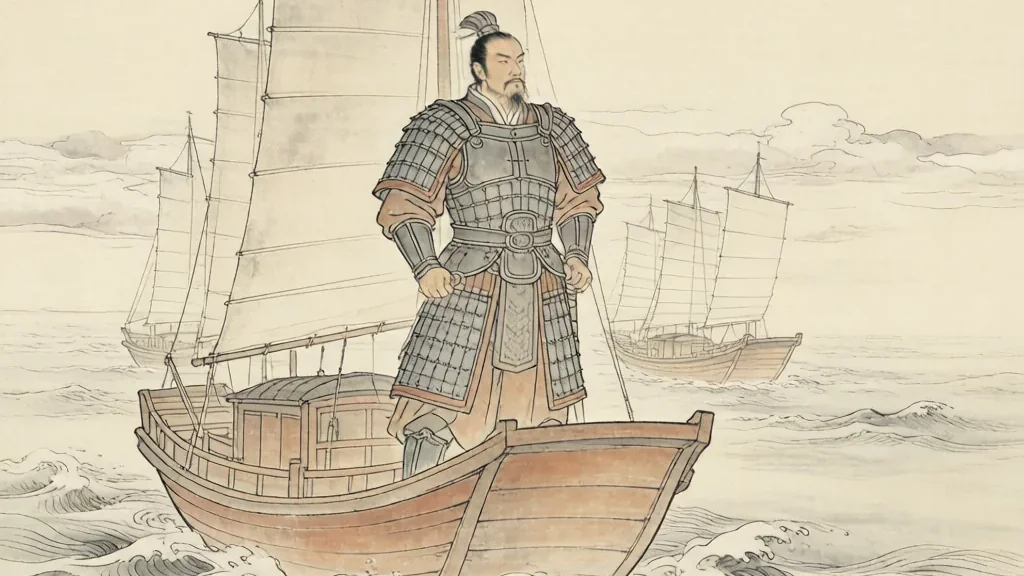
In the turbulent twilight of the Ming Dynasty, when Manchu armies swept across China and European colonial powers circled its coasts, one man stood at the crossroads of East and West with a sword in one hand and a compass in the other. Zheng Chenggong—better known to the Western world as Koxinga—was born of a Chinese pirate lord and a Japanese noblewoman, raised amid the clash of empires, and destined to become one of the most extraordinary military commanders in Asian history. His greatest triumph, the defeat of the Dutch East India Company and the liberation of Taiwan in 1662, would cement his legacy as a national hero revered in China, Taiwan, and Japan alike.
The story of Zheng Chenggong is not merely a tale of battles and sieges. It is a story of unwavering loyalty in an age of betrayal, of a son torn between two worlds who chose to define his own destiny, and of a military genius who understood that control of the sea meant control of nations. In an era when the Dutch, Portuguese, and Spanish carved up the Asian trade routes, Zheng Chenggong proved that an Asian power could not only resist European colonization but defeat it decisively on its own terms.
A Child of Two Worlds
Zheng Chenggong was born in 1624 in Hirado, a small island off the coast of Nagasaki, Japan. His father, Zheng Zhilong, was a legendary figure in his own right—a former interpreter and merchant who had built one of the largest private navies in East Asia. Fluent in Portuguese, Dutch, and Japanese, Zheng Zhilong controlled the lucrative trade routes between China, Japan, and Southeast Asia, commanding thousands of ships and tens of thousands of men. His mother, Tagawa Matsu, was a Japanese woman of samurai lineage, and her influence on the young Zheng Chenggong would prove profound.
At the age of seven, Zheng Chenggong was brought to his father's homeland in Fujian Province, where he received a rigorous classical Chinese education. Unlike his rough-and-tumble father, who had risen from the docks of Macau, the young Zheng immersed himself in the Confucian classics, the art of poetry, and the military strategies of Sun Tzu. He excelled in his studies and earned the rank of xiucai, the first degree in the imperial examination system, demonstrating that he was as much a scholar as he was the son of a warrior-merchant.
The young man who emerged from this unusual upbringing was a fascinating hybrid: a Confucian gentleman who could navigate the cutthroat world of maritime commerce, a Ming loyalist with Japanese samurai blood, and a military strategist who combined Chinese siegecraft with Western naval tactics. When the Ming Dynasty collapsed and the Manchu Qing armies swept south, this unique combination of qualities would be put to the ultimate test.
The Fall of the Ming and the Test of Loyalty
In 1644, Beijing fell to Li Zicheng's rebel army, and the last Ming emperor hanged himself on Coal Hill. The Manchu armies then poured through the Great Wall, claiming the Mandate of Heaven for the Qing Dynasty. Ming loyalists fled south, establishing a resistance government known as the Southern Ming in Nanjing, then Fuzhou. Zheng Zhilong, ever the pragmatist, saw which way the wind was blowing and decided to surrender to the Qing, believing he could negotiate favorable terms for himself and his family.
Zheng Chenggong was horrified. For him, the Confucian virtues he had studied all his life—loyalty to one's sovereign, righteousness in the face of adversity—demanded continued resistance against the foreign invaders. In a dramatic confrontation with his father, the young man reportedly tore off his Confucian scholar's robes and declared: "If my father chooses to be a loyal subject of the Qing, then I cannot be a filial son. From this day forward, I serve only the Ming!"
This break with his father was both ideological and deeply personal. When the Qing later took Zheng Zhilong prisoner (despite their promises of safe treatment) and used him to pressure Zheng Chenggong into surrendering, the son refused to betray his cause. His mother, Tagawa Matsu, had already committed suicide during the Qing invasion of Fujian rather than submit to the conquerors. With both parents lost, Zheng Chenggong became the undisputed leader of the Ming resistance at sea, adopting the title "Guoxingye" (Lord of the Imperial Surname), which Portuguese traders rendered as "Koxinga"—the name by which he would become known throughout the world.
Master of the Seas
From his base in Xiamen (Amoy), Zheng Chenggong built the most formidable naval force in East Asia. His fleet grew to include thousands of vessels, from massive war junks armed with cannon to swift attack boats designed for coastal raids. He established a sophisticated logistics system that could supply his armies for extended campaigns, developed intelligence networks that stretched across Southeast Asia, and trained his troops in both traditional Chinese weapons and modern firearms obtained through trade.
In 1659, Zheng launched his most ambitious campaign: a direct assault on the Qing capital of Nanjing with an army of over 100,000 men transported by a fleet of 3,000 ships. The campaign began brilliantly—Zheng's forces swept up the Yangtze River, capturing city after city, and laid siege to Nanjing itself. For a moment, it seemed that the Ming might actually be restored. But overconfidence proved fatal. Zheng allowed himself to be drawn into negotiations with the Qing defenders, giving them time to bring up reinforcements. In a devastating counterattack, the Qing forces broke the siege and shattered Zheng's army.
The defeat at Nanjing was the turning point of the campaign. Zheng retreated to Xiamen with his remaining forces, but the strategic situation had changed dramatically. The Qing were now consolidating their control over the mainland, and the Southern Ming resistance was collapsing. Zheng needed a new base—a place beyond the reach of Qing armies, where he could rebuild and continue the fight. His eyes turned toward Taiwan.
The Liberation of Taiwan
Taiwan at this time was partially controlled by the Dutch East India Company (VOC), which had established a fortified base at Fort Zeelandia near present-day Tainan. The Dutch had been there since 1624—ironically, the same year Zheng Chenggong was born—and used Taiwan as a hub for their lucrative trade between China, Japan, and Southeast Asia. For decades, they had profited from the island's strategic location, extracting taxes from Chinese settlers and indigenous communities while maintaining a heavily armed garrison.
In April 1661, Zheng Chenggong launched his invasion with a fleet of 400 warships carrying 25,000 soldiers. His knowledge of the local waters proved decisive—he navigated through the shallow channels of the Luermen sandbars, which the Dutch had considered impassable for large vessels, and landed his army north of Fort Zeelandia. The Dutch garrison, numbering barely 2,000 men, found themselves besieged in their own fortress.
The siege that followed lasted nine months and demonstrated Zheng's mastery of both Eastern and Western military tactics. He constructed siege lines, cut off Dutch supply routes, and employed psychological warfare to demoralize the defenders. When a Dutch relief fleet arrived from Batavia (Jakarta), Zheng's naval forces engaged and defeated them in a series of running battles. His troops captured the smaller Dutch fort of Provintia, tightening the noose around Zeelandia.
On February 1, 1662, the Dutch governor Frederick Coyett surrendered Fort Zeelandia to Zheng Chenggong. The terms were remarkably generous by the standards of the time: the Dutch were allowed to leave with their personal possessions and arms, and the VOC's remaining soldiers and officials were given safe passage to Batavia. It was the first time a European colonial power had been decisively defeated by an Asian force in a major military engagement, and it sent shockwaves through the colonial world.
Building a Kingdom and a Legacy
With Taiwan under his control, Zheng Chenggong set about transforming the island into a bastion of Ming loyalist culture and a base for continued resistance against the Qing. He established a Chinese-style administration, promoted agriculture and trade, and encouraged Chinese settlement on the island. His government introduced Chinese legal codes, Confucian education, and advanced farming techniques that dramatically increased rice production. The island became known as the "Kingdom of Tungning," a beacon of Ming civilization in exile.
Tragically, Zheng Chenggong's rule over Taiwan would be brief. In June 1662, just five months after his greatest triumph, he died of malaria at the age of 38. His death came at a moment of intense personal turmoil—he had just ordered the execution of his eldest son for an illicit relationship with his wet nurse, and the strain of command had taken a severe toll on his health. His last words reportedly expressed regret that he could not continue the fight to restore the Ming Dynasty.
Yet the kingdom he founded endured. Under his son Zheng Jing and grandson Zheng Keshuang, the Tungning Kingdom continued to rule Taiwan for another two decades, until the Qing Dynasty finally conquered the island in 1683. The institutions and cultural foundations Zheng Chenggong established played a crucial role in Taiwan's development as a Chinese society, and his legacy as a national hero transcended the political boundaries that would later divide China and Taiwan.
Today, Zheng Chenggong is honored in temples and shrines across the Taiwan Strait and in Japan. In mainland China, he is celebrated as a national hero who expelled foreign colonizers and reunified Chinese territory. In Taiwan, he is revered as the founding father who brought Chinese civilization to the island and whose temple in Tainan remains one of the most popular pilgrimage sites. In Japan, his birthplace of Hirado commemorates him as a native son who achieved greatness on the world stage. Few historical figures can claim such a broad and enduring legacy across three distinct cultures.
Zheng Chenggong's Global Significance
Zheng Chenggong holds a rare place in world history as the commander who inflicted the first decisive defeat of a European colonial power by an Asian force in a major engagement. When his fleet took Fort Zeelandia in 1662, it ended thirty-eight years of Dutch rule on Taiwan and sent shockwaves through the trading empires of Europe. His victory demonstrated that Asian states could resist and overcome well-armed Western colonization on their own terms, decades before similar reversals elsewhere. That a man of mixed Chinese and Japanese heritage, trained in both Confucian statecraft and Western naval tactics, achieved this only sharpens the significance. Today he is honored as a patriotic hero in mainland China, a founding father in Taiwan, and a native son in Japan, an extraordinary cross-cultural legacy few figures can claim.
The Tungning Kingdom After His Death
Zheng Chenggong did not live to consolidate his Taiwanese state. He died in 1662 at thirty-eight, and leadership passed to his son Zheng Jing, then to his grandson Zheng Keshuang. The Tungning Kingdom maintained Chinese administration, promoted agriculture, and kept the Ming-loyalist flame alive for two more decades. Its fleets continued to raid the southeastern coast of the mainland, keeping pressure on the Qing even as the dynasty consolidated power. In 1683, the Qing admiral Shi Lang defeated Tungning's forces and brought Taiwan under direct imperial rule for the first time. The kingdom's brief existence nonetheless laid the foundations of Chinese settlement and institutions on the island. Its story marks the beginning of Taiwan's integration into the Chinese polity, a development whose echoes still resonate in cross-strait relations today.
Why Koxinga Endures in Memory
Few historical figures are venerated across three cultures as Zheng Chenggong is. In mainland China he is celebrated as a national hero who expelled foreign colonizers and reunified Chinese territory, his image appearing on everything from textbooks to postage stamps. In Taiwan, his temple in Tainan remains a major pilgrimage site, and he is honored as the leader who brought Chinese civilization to the island. In Japan, his birthplace of Hirado remembers him as a native son of world stature, the child of a local woman who rose to command fleets across the seas. This tripartite memory reflects the genuinely hybrid nature of his life, and explains why his story is continually retold: he embodies loyalty, maritime mastery, and resistance against colonialism in ways each society can claim as its own.
❓ Frequently Asked Questions
📝 Chinese Vocabulary
- 郑成功 (Zhèng Chénggōng) — Zheng Chenggong, the Ming loyalist general known as Koxinga in the West
- 国姓爷 (Guóxìngyé) — "Lord of the Imperial Surname," the honorific title from which "Koxinga" is derived
- 台湾 (Táiwān) — Taiwan, the island Zheng liberated from Dutch colonial rule
- 明朝 (Míng Cháo) — The Ming Dynasty, to which Zheng remained fiercely loyal
- 赤崁楼 (Chìkàn Lóu) — Fort Provintia, the Dutch fort captured by Zheng during the siege of Zeelandia
🎉 Fun Facts
- Zheng Chenggong was born to a Japanese samurai-class mother and a Chinese pirate-admiral father, making him a literal child of two worlds—he spoke Chinese, Japanese, and some Portuguese.
- The defeat of the Dutch at Fort Zeelandia in 1662 marked the first time a European colonial power was driven out of an Asian territory by an Asian military force in a major siege.
- Zheng Chenggong's fleet at its peak numbered over 3,000 vessels, making it one of the largest naval forces in the world during the 17th century—rivaling even the Spanish Armada.
- Before becoming a commander, Zheng earned the xiucai degree in the imperial examination system, marking him as a genuine Confucian scholar as well as a warrior.
- Zheng died of malaria in June 1662, only about five months after his greatest victory, at the age of thirty-eight.
- The Tungning Kingdom he founded outlived him by two decades, until the Qing conquered Taiwan in 1683.