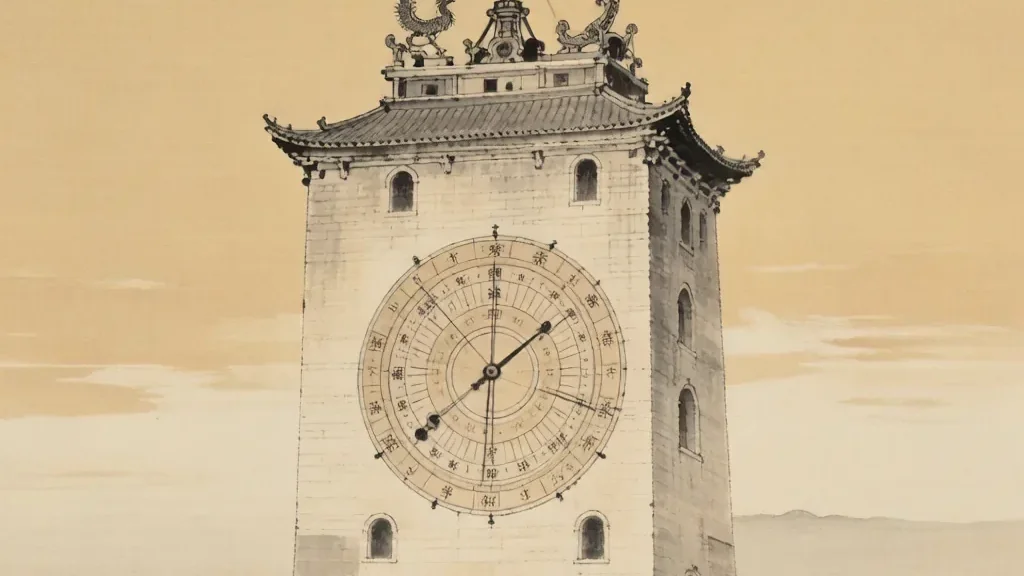
The astronomical clock stands among the supreme achievements of medieval Chinese engineering, uniting astronomy, horology, and mechanical design in a single towering instrument. The most famous example is the water-powered clock tower (水运仪象台) built for the Song court around 1088 CE by the polymath Su Song (苏颂), an eleven-metre wooden structure that displayed the heavens, struck the hours, and drove an armillary sphere and celestial globe from a single water-driven mechanism. Lost for centuries, it is now recognised as one of the earliest known devices to use a true mechanical escapement.
Early Chinese Interest in Clockwork Astronomy
Long before Su Song, Chinese astronomers sought instruments that could move in step with the heavens. The Han astronomer Zhang Heng (张衡) built a water-turned celestial globe in the second century CE, and the Tang monk Yi Xing (一行) with Liang Lingzan produced an escapement-driven armillary and clock in 725 CE. These predecessors established a tradition of linking water power to the rotation of the sky.
By the Northern Song, the state astronomical bureau maintained several mechanical models, but none matched the integration and scale of what Su Song would later attempt. The desire was both practical and ritual: accurate timekeeping regulated the calendar, ceremonies, and the cosmic ordering of the state.
Su Song and the Imperial Commission
Su Song (1020–1101) was a statesman, pharmacist, poet, and engineer who served as a high official under several Song emperors. In 1086 he was ordered to oversee the reconstruction of astronomical instruments that had fallen into disrepair or been lost during the relocation of the capital. He assembled a team including the engineer Han Gonglian (韩公廉).
The project culminated in a great clock tower completed about 1092 and installed in the capital Kaifeng. Contemporary records describe it as a landmark of precision, combining observation, demonstration, and timekeeping in one machine. Su Song later wrote a detailed illustrated manual so the design would survive even if the tower did not.
The Water-Powered Tower (水运仪象台)
The tower stood roughly eleven metres tall and was housed in a multi-storey wooden pagoda-like frame. At the top sat a rotating armillary sphere that opened to the sky for observation. Below it, a celestial globe turned in an enclosed chamber, reproducing the night sky indoors for officials who could not climb to the roof.
A central shaft ran down through the structure to a timekeeping deck where a rotating ring of wooden figurines emerged from small doors to announce the hours and quarter-hours by striking bells, gongs, and drums. The whole machine was animated by a continuous flow of water drawn up and released in controlled measure.
The Escapement Mechanism
The heart of the device was a constant-speed escapement: a heavy wheel locked and released tooth by tooth by a pair of opposed levers, the famous "stop-and-go" (tick-tock) action driven by a water-filled scoop. This is widely regarded by historians of technology as the world's first mechanical escapement of its kind, the ancestor of every later clock escapement in Europe and Asia.
By governing the release of energy in discrete beats, the escapement converted the uneven push of falling water into a steady rhythm. A feedback link kept the speed constant even as the water level in the upper tank changed, a sophistication unmatched in European horology for centuries.
The Armillary Sphere and Celestial Globe
The upper armillary (浑象/浑天仪) comprised nested bronze rings representing the celestial equator, ecliptic, and meridian, with a sighting tube for observing stars. It rotated once every twenty-four hours, mimicking the diurnal motion of the sky. The enclosed celestial globe below carried star positions so that the indoor model always matched the outdoor heavens.
Su Song's globe is said to have held more than 1,400 named stars grouped into the traditional Chinese constellations. Together the two instruments served both observers and ceremonial audiences, making the abstract calendar visible and tangible.
The Illustrated Manual: Xin Yi Xiang Fa Yao
After the tower was built, Su Song compiled Xin Yi Xiang Fa Yao (《新仪象法要》, "Essentials of the New Astronomical Instruments"), a technical treatise with dozens of detailed plates. The book records dimensions, gear ratios, the escapement linkage, and the exact arrangement of rings and figurines.
This manual is the reason modern scholars can reconstruct the machine. It is one of the most important sources we have for understanding pre-modern Chinese mechanical engineering, preserving knowledge that the physical tower itself could not.
Loss and Rediscovery
The original tower was captured and dismantled when the Jurchen Jin army took Kaifeng in 1127, and later attempts to rebuild it failed. For centuries the design survived only in Su Song's book. In the twentieth century, historians such as Joseph Needham and British horologist John Combridge built working models confirming the brilliance of the escapement.
Reconstructions in China, Japan, and Europe have shown that the mechanism genuinely works, vindicating the historical accounts and securing the astronomical clock's place in the global story of timekeeping.
Cultural and Scientific Legacy
The astronomical clock embodied a Chinese ideal in which the measurement of time was a sacred duty of government, linking the emperor's virtue to the harmony of heaven and earth. It also demonstrates that medieval China possessed the conceptual and practical tools—gears, chains, escapements, feedback control—usually credited only to later European craftsmen.
Today the water-powered clock tower is celebrated as a symbol of Song-era ingenuity, and its escapement is acknowledged as a foundational step in the long history of mechanical clocks that would eventually span the world.
❓ Frequently Asked Questions
Who built the famous Chinese astronomical clock?
The most celebrated example was designed by the Song official Su Song and completed around 1092 with the engineer Han Gonglian.
How was the clock powered?
It was driven by the controlled fall of water, regulated by a mechanical escapement that released motion in steady beats.
What made the device historically important?
It contained the earliest known true mechanical escapement, a principle at the heart of every later clock.
What did the tower actually show?
It carried a rotating armillary sphere on top, a celestial globe inside, and figurines that struck the hours below.
Why did the original clock disappear?
It was dismantled after the Jurchen capture of Kaifeng in 1127, and later rebuilds failed.
How do we know the design worked?
Su Song's manual preserved detailed drawings, and modern replicas have been built that run successfully.