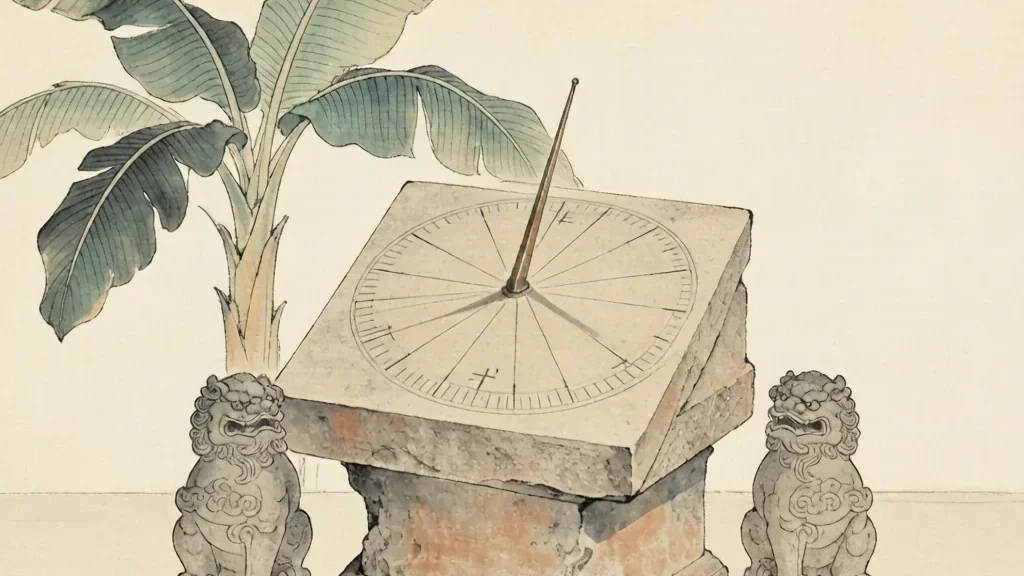
The sundial is one of humanity's oldest instruments for measuring time, and Chinese astronomers developed it into a precision tool of remarkable sophistication. The essential Chinese form was the "gnomon-and-gnomon-shadow" dial: a vertical staff (the guǐbiǎo 圭表) whose shadow fell along a calibrated north–south scale, and later the round "shadow clock" (rìguǐ 日晷) with a graduated dial and a triangular pointer. From the Shang period onward, Chinese timekeepers used the dial not merely to tell the hour but to determine the solstices, the length of the solar year, and the calendar itself. Combined with water clocks and, later, mechanical astronomical towers, the sundial anchored a tradition of exact celestial measurement that rivaled any in the world and directly supported the agrarian calendar on which Chinese civilization depended.
Early Gnomon Observation
The simplest Chinese timekeeping instrument was the gnomon: a vertical pole planted in level ground. The length and direction of its shadow tracked the sun through the day and the seasons. By the Zhou dynasty this had been formalized into the guǐbiǎo, a precisely vertical staff set in a carefully leveled base, with a graduated ruler (the guǐ) laid north–south to measure the shadow's length.
At the summer solstice the shadow is shortest; at the winter solstice it is longest. Measuring these extremes let astronomers fix the turning points of the year and, by counting the days between them over many years, refine the length of the tropical year with surprising accuracy.
The Gnomon Scale (Guǐbiǎo)
The standard imperial gnomon was tall and exact. Historical sources describe gnomon staves of eight chi (roughly 1.8–2.5 meters depending on the dynasty's chi) erected on a south-facing stone platform. The accompanying graduated scale, the guǐ, was carved in fine divisions so the shadow tip could be read to a fraction of an inch.
Because the sun's noon altitude changes with latitude, the gnomon-and-scale method also let travelers and surveyors estimate latitude from the solstice shadow length — a technique used in mapping and in the great geographical surveys of later dynasties.
The Round Shadow Clock (Rìguǐ)
To tell the time of day, the Chinese used the rìguǐ, a flat dial marked with hour lines and pierced or mounted with a triangular, inclined gnomon (the "needle") whose edge cast a shadow onto the graduated face. The dial was oriented to the local celestial meridian, and the moving shadow indicated the double hours (shíchen) into which the day was divided.
Some surviving rìguǐ are exquisite objects in jade, bronze, or lacquered wood, with the dial carved in compass-point and seasonal corrections so the clock read correctly across the year as the sun's path shifted.
Equal Hours vs. Seasonal Hours
An important refinement concerned the kind of hour being measured. A naive sundial divides daylight into equal parts, so "hours" lengthen in summer and shrink in winter — convenient for daily life but awkward for astronomy. Chinese engineers developed dials with curved, season-dependent hour lines so that the marked hours corresponded to equal solar time throughout the year.
This required understanding the sun's declination and its daily arc at different seasons, knowledge encoded directly into the geometry of the dial face. Such dials effectively solved the problem of converting apparent solar time to a uniform scale.
Sundials and the Calendar
In China the sundial was never only a clock; it was a calendrical instrument. Determining the exact moments of the solstices allowed court astronomers to set the official calendar, which governed when to plant, sacrifice, and levy taxes. Errors in the calendar were politically dangerous, so the gnomon observation was a state ritual performed at the Imperial Observatory.
The famous "Table of the Gnomon Shadow" tradition compiled century after century of solstice measurements, a uniquely long run of astronomical data that modern scholars still use to study Earth's changing orbit.
Combined with Water and Mechanical Clocks
Sundials could not work at night or in overcast weather, so they were paired with water clocks (clepsydras) and incense clocks for continuous timekeeping. In the astronomical towers of the Song engineer Su Song and others, dials, water-powered escapements, and star charts were integrated into clockwork that announced the hours visibly and audibly.
The sundial thus sat at the top of a hierarchy of time instruments: the authoritative standard by which the others were checked and corrected whenever the sun shone.
Famous Surviving Examples
Numerous stone and bronze sundials survive from the Ming and Qing dynasties, many still standing at the Beijing Ancient Observatory and in provincial observatories. Earlier forms are known from tomb models and from illustrations in astronomical treatises such as those accompanying the great calendars of the Tang and Yuan.
The Yuan astronomer Guo Shoujing improved gnomon practice dramatically by building an enlarged "high gnomon" (gaobiǎo) nearly four times taller than the old standard, reducing proportional reading error and sharpening the measurement of the solstice shadow.
Cultural Meaning
The sundial and gnomon entered Chinese thought as symbols of rectitude and the ordering of heaven and earth: the straight staff and its true shadow evoked the ideal of the upright ruler whose governance casts a correct "shadow" over the realm. Gardens of scholars and temples often displayed decorative sundials as emblems of cosmic harmony.
Time in China was conceived as a rhythm of heaven made legible on earth — and the humble shadow of a stick was the first text in which that rhythm could be read.
❓ Frequently Asked Questions
What is a Chinese sundial?
It is typically either a guǐbiǎo (gnomon plus graduated scale for solstice measurement) or a rìguǐ, a round dial with a pointer casting a shadow to show the time.
How did the sundial help the calendar?
By fixing the exact solstices from shadow lengths, astronomers could determine the solar year and set the official agricultural calendar.
Could sundials tell equal hours year-round?
Advanced dials used season-dependent curved hour lines so the marked intervals corresponded to equal solar time in every season.
Why pair sundials with water clocks?
Sundials do not work at night or when cloudy, so water and incense clocks provided continuous timekeeping and were checked against the dials.
Who was Guo Shoujing?
A Yuan-dynasty astronomer who built an enlarged "high gnomon" that greatly improved the precision of solstice-shadow measurement.
What were the traditional time units?
The day was divided into twelve double-hours called shíchén, marked by the moving shadow on a dial or by water and incense clocks.