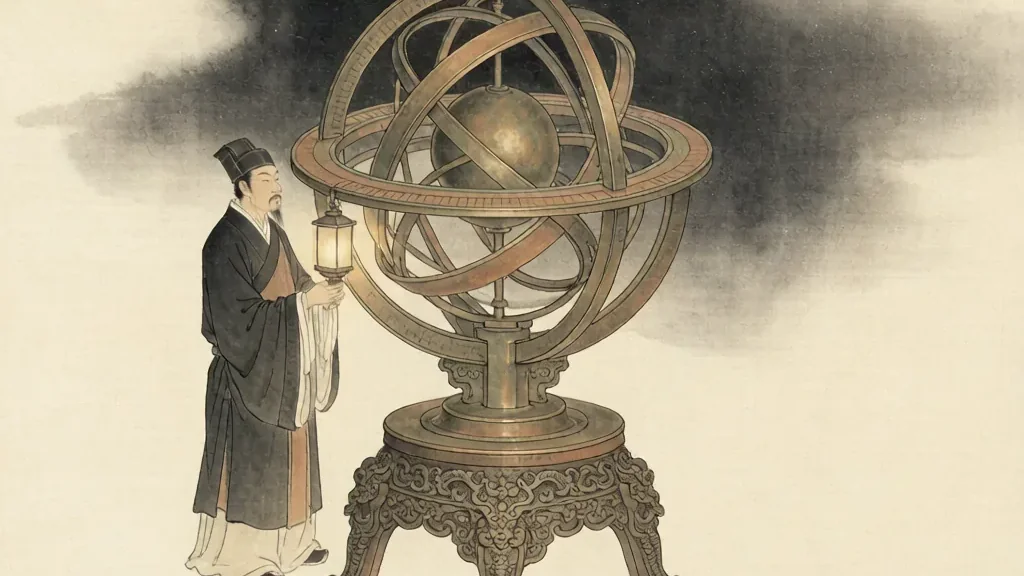
The hun tian yi (浑天仪), or armillary sphere, is one of the great instruments of Chinese astronomy: a model of the heavens built from concentric bronze rings representing the celestial equator, ecliptic, and horizon, often with a sighting tube at its centre. Developed in the Han dynasty and refined by astronomers from Zhang Heng to Guo Shoujing, it was both an observational tool and a cosmological statement of the "rotating heavens" (huntian) theory, in which the sky encloses the earth like the shell of an egg around its yolk.
What an Armillary Sphere Is
An armillary sphere is a skeleton globe: a set of graduated metal rings mounted on a common axis, each ring marking a great circle of the celestial sphere. The outermost rings show the horizon and meridian; inner rings show the equator and the path of the sun (the ecliptic); a central tube sights stars.
By rotating the rings and aligning the sighting tube, an astronomer could measure a star's position and the progress of the seasons with remarkable precision for the ancient world.
The Huntian Cosmology
The instrument expresses the huntian ("enveloping heaven") model, which held that the round heaven surrounds the spherical earth like an eggshell around the yolk. This view, debated against rival models in Han times, became the dominant framework for Chinese spherical astronomy.
The huntian theory gave meaning to the sphere: the rings were not abstract but a picture of the real structure of the cosmos, with the earth fixed at the middle.
Early Makers: Luo Xiaohong and Zhang Heng
The astronomer Luo Xiaohong (落下闳) is credited in Han sources with constructing an early armillary and helping reform the calendar. Later, Zhang Heng (张衡, 78–139 CE) built a famous bronze armillary and, importantly, a water-driven celestial globe (水运浑象) that turned in step with the heavens.
Zhang Heng's water-powered globe was a forerunner of later clockwork heavens and showed the Chinese commitment to making the model actually move like the sky.
Structure and Graduations
A great armillary was a feat of bronze casting and engraving. Its rings were divided into degrees, and the ecliptic ring could be shifted to account for the slow precession of the equinoxes, a subtlety Chinese astronomers tracked over centuries.
Large imperial spheres stood on massive stone or bronze mounts in the observatory, aligned to the local meridian, and were read with the aid of sighting rods and scales.
Later Masters: Yi Xing, Guo Shoujing
The Tang monk-astronomer Yi Xing (一行) and his colleague Liang Lingzan built an armillary with an early escapement around 725 CE. In the Yuan dynasty, Guo Shoujing (郭守敬) designed the simplified armillary (简仪), removing redundant rings to reduce obstruction and improve accuracy.
Guo Shoujing's instruments at the Dadu (Beijing) observatory represent the high point of pre-modern Chinese observational astronomy, combining giant sighting tubes with refined scales.
Observatories and State Astronomy
Armillary spheres belonged to the state astronomical bureau, whose duty was to keep the calendar and report portents. Imperial observatories in Chang'an, Kaifeng, and Dadu housed great spheres and globes as symbols of the emperor's harmony with heaven.
Because the calendar governed agriculture and ritual, the instrument was a political as well as a scientific object, watched closely by the court.
Legacy and Modern Survival
Replicas of historical armillary spheres stand today at observatories in Beijing and Nanjing, and the simplified armillary's design is studied as a triumph of instrument-making. The huntian model, though superseded by modern cosmology, shaped a millennium of Chinese sky-watching.
The hun tian yi remains a powerful emblem of China's long, continuous tradition of precise, systematic astronomy.
Reading the Sky
At the sphere, observers sighted the moon and planets against the graduated rings, noted eclipses, and tracked the slow drift of the equinoxes. These measurements fed the calendar and the astrological reports that the court required.
The instrument thus linked observation to administration: what the astronomer read on the bronze rings became the published calendar that told farmers when to plant and officials when to sacrifice.
Foundry and Engraving Craft
A great armillary demanded master founders to cast true, large rings and master engravers to divide them into fine degrees without slipping. The work was a state commission, paid for by the treasury and displayed as a token of imperial order.
The skill invested in a single sphere shows how seriously China took the measurement of heaven, treating the instrument as both precision tool and emblem of the ruler's harmony with the cosmos.
Replicas and Living Memory
Working replicas of historical armillary spheres stand at the Beijing Ancient Observatory and the Nanjing Purple Mountain Observatory, letting visitors see the instrument turn as its makers intended. Modern founders and astronomers collaborated to rebuild them from the old drawings.
These replicas keep the huntian tradition visible in the present, a link between today's space science and a very long Chinese habit of measuring the sky. The bronze sphere, though centuries old in design, still conveys the wonder of holding the heavens in a frame of rings.
More than a measuring tool, the armillary was a statement that the cosmos is orderly and knowable, a conviction that powered a thousand years of Chinese astronomy and still resonates in the country's long engagement with the sky.
Its bronze rings remain a meeting point of science, craft, and cosmology that is distinctly Chinese.
❓ Frequently Asked Questions
What is a hun tian yi?
It is a Chinese armillary sphere, a bronze model of the heavens made of graduated rings for observing stars.
What theory did it express?
The huntian or "enveloping heaven" view, that the round sky encloses the earth like an eggshell around the yolk.
Who were its famous makers?
Luo Xiaohong and Zhang Heng in the Han, Yi Xing in the Tang, and Guo Shoujing in the Yuan.
How was it used?
Astronomers rotated the rings and aligned a central sighting tube to measure star positions and the seasons.
What did Guo Shoujing change?
He designed the simplified armillary (jian yi), cutting redundant rings to improve accuracy.
Why did the state care?
The calendar and portents were imperial duties, so the sphere was both science and statecraft.