← Back to Ancient Science
🔬 Ancient Science
Ancient Chinese Shipbuilding (中国古代造船术) — Masters of the Seas
✍️ by xiaoyu luo
🗓️ Updated Jul 29, 2026
By Xiaoyu Land · 14 min read
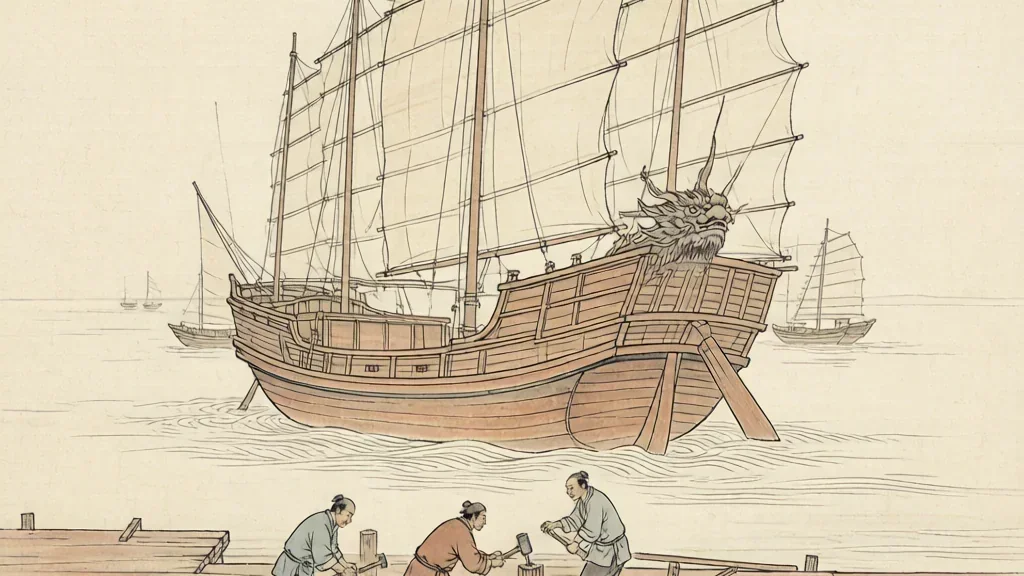
When Admiral Zheng He (郑和) sailed from the coast of China in 1405 at the head of the largest fleet the world had ever seen — over 300 ships crewed by nearly 28,000 men — he commanded vessels whose size and sophistication would not be matched by any European navy for centuries. The flagship 'treasure ships' (宝船, bǎochuán) of Zheng He's fleet were estimated to be over 120 meters in length, with nine masts, multiple decks, and a displacement of several thousand tons — dwarfing the caravels that Columbus would sail to the Americas nearly a century later. These magnificent vessels were not the product of a sudden breakthrough but the culmination of over a thousand years of Chinese shipbuilding innovation, during which Chinese naval architects developed technologies that would eventually spread throughout the world and form the foundation of modern maritime engineering. The story of Chinese shipbuilding is one of continuous invention: the watertight compartment, the balanced rudder, the paddle-wheel ship, the magnetic compass for navigation, and the sternpost rudder — each a revolutionary advance that transformed humanity's relationship with the sea.
The Watertight Compartment: An Innovation That Saved Countless Lives
Perhaps the single most important Chinese contribution to shipbuilding was the development of the watertight bulkhead compartment — a system of transverse walls dividing the hull into separate, sealed sections. Archaeological evidence suggests that this technology was already in use on Chinese river vessels by the second century CE, and by the Song Dynasty (960–1279 CE) it had become standard on ocean-going ships. The principle was elegantly simple: if the hull was breached in one compartment, water would fill only that section while the rest of the ship remained buoyant. This dramatically increased a vessel's survivability and was particularly valuable for warships and long-distance trading vessels operating far from safe harbors. The famous Venetian traveler Marco Polo, who visited China during the Yuan Dynasty in the late 13th century, was astonished by this technology and described it in detail in his travelogue: 'The vessels are built with thirteen watertight compartments, so that if the ship should chance to be damaged in any one part... the water cannot pass from one compartment to another.' The watertight compartment was not adopted in European shipbuilding until the late 18th century, and it became a standard feature of all modern ships — from naval destroyers to oil tankers — making it one of the most important and enduring Chinese contributions to global maritime technology.
The Balanced Rudder and the Sternpost Rudder
While the ancient Egyptians, Greeks, and Romans steered their ships with side-mounted steering oars — a method that was imprecise, physically demanding, and limited the size of vessels — Chinese shipwrights had developed the stern-mounted axial rudder by at least the first century CE. A pottery model of a Chinese ship from the Han Dynasty (206 BCE–220 CE), discovered in a tomb in Guangzhou, clearly shows a sternpost rudder, making it the earliest known representation of this technology anywhere in the world. The Chinese further refined this innovation by developing the 'balanced rudder' — a design in which a portion of the rudder blade extends forward of the pivot axis, partially balancing the force of the water against the blade and making the rudder dramatically easier to operate. This seemingly simple modification reduced the physical effort required to steer a large ship by up to 80 percent and enabled the construction of ever-larger vessels. The balanced rudder, combined with the sternpost mounting, gave Chinese ships a level of maneuverability that was unmatched until the modern era. European ships continued to use steering oars until the 12th century, when the sternpost rudder was introduced — almost certainly through contact with Chinese maritime technology via Arab traders operating in the Indian Ocean.
Paddle-Wheel Ships and Mechanical Propulsion
During the Tang Dynasty (618–907 CE), Chinese naval engineers achieved another world first: the paddle-wheel ship. Historical records describe vessels powered by human-operated treadmills that turned paddle wheels mounted on either side of the hull, providing propulsion independent of wind or current. These early mechanically propelled vessels were used primarily for naval operations on rivers and lakes, where their ability to maneuver in any direction regardless of wind conditions gave them a decisive tactical advantage. By the Song Dynasty, paddle-wheel ships had become a significant component of the imperial navy, with some vessels reportedly mounting as many as 24 paddle wheels and capable of remarkable speed. The largest of these warships could carry over 1,000 men and were equipped with trebuchet catapults and other weapons. The Song Dynasty navy's paddle-wheel fleet played a crucial role in defending the empire against invasions, and detailed plans for these vessels were captured by Jurchen and later Mongol forces, spreading the technology throughout East Asia. The paddle-wheel concept would not appear in European naval warfare until the 16th century, and steam-powered paddle wheelers would become the dominant form of mechanical ship propulsion in the 19th century.
Zheng He's Treasure Ships: The Pinnacle of Chinese Shipbuilding
The treasure ships of Zheng He's fleet represented the zenith of Chinese shipbuilding technology — vessels so large and sophisticated that some historians initially doubted the documentary evidence for their existence. Built at the Longjiang shipyard in Nanjing, which employed over 10,000 workers and covered an area of more than 50 hectares, these ships incorporated every advanced technology that Chinese naval architects had developed over the preceding millennium: watertight compartments, multiple decks, balanced sternpost rudders, sophisticated rigging systems with battened sails (which provided greater control and efficiency than the simple canvas sails used in Europe), and magnetic compasses for navigation. The ships were constructed using traditional Chinese joinery techniques that created incredibly strong yet flexible hulls without the use of iron nails — wooden dowels and precisely fitted joints allowed the hull to flex slightly in heavy seas without breaking. The treasure ships also featured sophisticated pumping systems, elaborate anchoring arrangements, and the capacity to carry enormous quantities of fresh water and provisions for extended voyages. While the exact dimensions of the largest treasure ships remain a subject of scholarly debate, even conservative estimates place them among the largest wooden ships ever constructed, rivaling or exceeding the great 19th-century tea clippers and windjammers.
❓ Frequently Asked Questions
Q: What is the history of Chinese shipbuilding?
A: Chinese shipbuilding dates back over 2,000 years. By the Song Dynasty (960–1279 CE), China had the most advanced shipbuilding industry in the world, producing ocean-going vessels with multiple masts and watertight compartments.
Q: What innovations did Chinese shipbuilders create?
A: Chinese shipbuilders invented the stern-mounted rudder (centuries before Europe), watertight bulkheads (for ship stability), fore-and-aft sails, and the paddle-wheel ship.
Q: How large were Chinese ships?
A: During the Ming Dynasty, Zheng He's treasure ships were enormous—approximately 137 meters long, with nine masts and multiple decks. They were the largest wooden ships ever built.
Q: Why was Chinese shipbuilding important?
A: Chinese shipbuilding enabled maritime trade, naval power projection, and the spread of Chinese culture across East and Southeast Asia. The treasure fleet voyages of Zheng He demonstrated unmatched maritime capability.
Q: How did Chinese shipbuilders achieve such seaworthiness without modern tools?
A: They relied on centuries of accumulated craft knowledge passed from master to apprentice, using standardized measurement systems and modular hull designs recorded in shipyard manuals. Iron nails, lime-caulked seams, and multiple watertight compartments gave the hull both strength and buoyancy. Skilled draftsmen laid out each vessel to a fixed plan, so ships could be rebuilt to the same reliable shape across generations.
Q: What materials and techniques were used to make hulls watertight?
A: Hull planks were joined with iron spikes and sealed with a mixture of lime, tung oil, and pounded fibers that expanded slightly when wet. Beneath the planking, transverse bulkheads divided the hold into separate compartments. Even if one compartment was pierced, the others stayed dry, a principle modern naval architects still use in damage-control design.
Key Terms
水密隔舱 (Shuǐmì Gécāng)
shuǐ mì gé cāng · 'watertight compartment' · 中国造船技术的重要发明 (Important invention of Chinese shipbuilding technology)
福船 (fú chuán)Fujian ship, a sturdy deep-hulled seagoing junk design of southeast China
沙船 (shā chuán)sand ship, a flat-bottomed vessel built for shallow coasts and rivers
宝船 (bǎo chuán)treasure ship, the large ocean-going flagship of Zheng He's fleets
龙骨 (lóng gǔ)keel, the central backbone timber of a ship's hull
舵 (duò)stern-mounted rudder used to steer a vessel
帆 (fān)sail, often made of woven matting on traditional junks
榫卯 (sǔn mǎo)mortise-and-tenon joinery, a nail-free woodworking method used in hulls
Fun Facts
- In 1973, archaeologists excavating a Song Dynasty shipwreck in Quanzhou harbor discovered a vessel with 13 watertight compartments — confirming Marco Polo's 13th-century description and demonstrating that this technology was fully mature by the Song era.
- The Longjiang shipyard in Nanjing, where Zheng He's treasure ships were built, was so large that it contained seven separate dry docks, each over 300 meters long. Remains of the shipyard can still be visited today.
- Chinese ships of the Song Dynasty were equipped with sophisticated firefighting systems, including pumps that could spray water onto the decks and bulkheads treated with fire-retardant materials — safety features centuries ahead of their time.
- Ming records describe Zheng He's largest treasure ships as more than 120 meters long, longer than a modern football field, though scholars still debate the exact measurements.
- Chinese mariners were among the first to navigate the open sea using the magnetic compass on a large scale, guided by written pilot books that recorded coastlines, currents, and star readings.
- Travelers such as Marco Polo and Ibn Battuta marveled that Chinese junks had several decks, private cabins, and watertight bulkheads that kept a damaged ship afloat.
Types of Traditional Chinese Vessels
Traditional Chinese shipbuilding produced several distinct vessel families suited to different waters. The Fujian ship, built along the southeast coast, had a deep rounded hull and many compartments, making it ideal for ocean voyages. The sand ship, by contrast, used a flat bottom so it could ride into shallow northern ports and river mouths without running aground. The treasure ships of the early fifteenth century combined these strengths at enormous scale, carrying hundreds of crew and tons of cargo across the Indian Ocean. Each type followed regional rules of proportion, so a shipwright in one port could recognize the lineage of a vessel from another. This variety let Chinese maritime trade reach from Korea and Japan to Southeast Asia, India, and East Africa using craft shaped precisely for the journey ahead.
Hull Construction and Caulking
A Chinese hull began with the keel, the long timber running the length of the bottom that gave the vessel its spine. Over this frame the shipwright fastened planks with iron nails and sealed every seam with a paste of lime, tung oil, and plant fiber. The result swelled tight in the water and resisted both leaks and rot. Inside, vertical bulkheads partitioned the hold into sealed rooms, a feature that made a punctured ship far less likely to sink. Builders also used mortise-and-tenon joints to lock planks and frames together without relying on metal alone. These methods were documented in shipyard regulations that specified standard lengths and beam widths, allowing large vessels to be produced consistently rather than as one-off experiments.
Navigation and the Mariner's Compass
Chinese navigators combined the magnetic compass with a rich tradition of pilot knowledge to cross open water with confidence. Compass needles were mounted in floating boxes or set in dampened sand so they held steady on rolling decks, and they were used both day and night when the stars were hidden. Pilot books recorded the bearing and timed runs between ports, noting landmarks, depths, and seasonal currents. Captains also read wind, wave shape, and bird flight to judge their position near land. This practical science of the sea supported regular trade routes that linked Chinese ports with the coasts of Southeast Asia, the Arabian Sea, and East Africa centuries before European fleets reached those waters. The same body of knowledge helped fishing crews and private merchants plan safe passages season by season.
Shipbuilding and Maritime Trade
Shipbuilding was the engine behind China's maritime trade, which for centuries moved silk, porcelain, tea, and copper coins across Asian waters in exchange for spices, timber, and gems. State-owned yards along the Yangtze and southeast coast built the vessels that carried tribute missions and official embassies, while private workshops supplied the merchant junks of coastal commerce. The scale of these industries meant that timber, iron, hemp, and tung oil were strategic goods managed by the government. Periods of strong naval investment, such as the early Ming voyages, projected Chinese presence across the Indian Ocean, whereas later restrictions shrank the fleet. The surviving wrecks, manuals, and models nonetheless show a tradition of shipbuilding that shaped the maritime world of East Asia for more than a millennium.