← Back to Ancient Science
🔬 Ancient Science
Zhaozhou Bridge (赵州桥) — The World's Oldest Open-Spandrel Arch Bridge
✍️ by xiaoyu luo
🗓️ Updated Jul 29, 2026
By Xiaoyu Land · 13 min read
Spanning the Xiao River (洨河) in Zhao County, Hebei Province, stands a bridge that has defied the expectations of engineers and the ravages of time for over 1,400 years. The Zhaozhou Bridge (赵州桥, Zhàozhōu Qiáo), also known as the Anji Bridge (安济桥, Ānjì Qiáo, 'Safe Crossing Bridge'), was designed and built between 595 and 605 CE by the master craftsman Li Chun (李春) during the Sui Dynasty. It is the world's oldest standing open-spandrel segmental stone arch bridge — a structure so elegantly conceived and so perfectly executed that it remains in use today, having survived more than ten major earthquakes, countless floods, and the passage of fourteen centuries. The American Society of Civil Engineers designated the Zhaozhou Bridge as an International Historic Civil Engineering Landmark in 1991, recognizing it as one of the greatest achievements in the history of structural engineering.
Li Chun: The Master Builder
Remarkably little is known about the life of Li Chun, the genius who conceived and built the Zhaozhou Bridge. His name survives in history only through a brief mention in the Tang Dynasty text 'Records of the Famous Monuments of the Empire' (大唐六典), which credits him as the designer of the bridge but provides no biographical details. Unlike the great architects of ancient Rome — such as Vitruvius, whose ten-volume treatise on architecture has preserved his name and methods — or the master builders of medieval Europe whose names adorn cathedrals, Li Chun left no written record of his design philosophy or engineering principles. What he did leave, however, was a structure of such remarkable design that it speaks eloquently across the centuries. The Zhaozhou Bridge demonstrates that Li Chun possessed a sophisticated understanding of structural mechanics, material properties, and hydraulic engineering that was centuries ahead of its time. His willingness to depart from the conventional semicircular arch — which had been the standard bridge form throughout the ancient world — and to adopt the more daring segmental arch with open spandrels suggests a mind of extraordinary originality and confidence. That he was able to execute this revolutionary design in stone, without the benefit of modern calculation methods or construction equipment, testifies to the depth of practical engineering knowledge that existed in Sui Dynasty China.
The Revolutionary Design: Open-Spandrel Segmental Arch
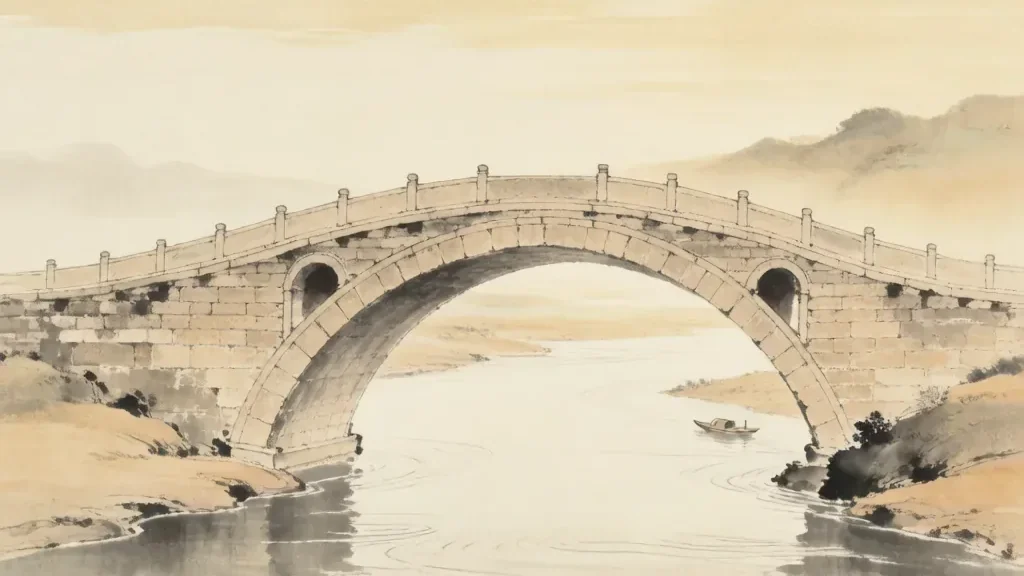
To understand why the Zhaozhou Bridge represents such a revolutionary advance in bridge engineering, one must appreciate the limitations of the traditional semicircular arch. A semicircular arch bridge requires tall abutments and a high roadway, making it impractical for spanning wide, low-lying rivers — the arch must rise to a height equal to at least half the span, creating a steep hump that is difficult for traffic to traverse. Li Chun's genius lay in two interconnected innovations. First, he employed a segmental arch — a flattened curve representing only a portion of a circle — rather than a full semicircle. The Zhaozhou Bridge's main arch has a span of 37.02 meters but rises only 7.23 meters, giving it a remarkably shallow profile with a rise-to-span ratio of approximately 1:5. This segmental form reduced the height of the roadway, made the bridge easier to cross, and required less material than a semicircular arch of equivalent span. Second, and even more innovatively, Li Chun pierced the spandrels — the triangular spaces between the arch and the roadway — with two smaller arches on each side. These 'open spandrels' served multiple purposes: they reduced the weight of the structure by approximately 15%, allowing the bridge to be built with less stone; they provided additional channels for floodwaters during the rainy season, reducing the hydraulic pressure on the bridge; and they created an appearance of lightness and grace that transforms what could have been a massive, heavy structure into something that seems almost to float above the river. The open-spandrel segmental arch would not appear in European bridge construction until the 14th century, and it did not become common until the 19th century — making Li Chun's design approximately 800 years ahead of its time.
Construction Techniques and Earthquake Resistance
The construction of the Zhaozhou Bridge employed sophisticated techniques that contributed to its extraordinary longevity. The bridge is built from 28 parallel arch ribs, each composed of individual limestone blocks precisely cut and fitted together with iron dovetail joints and molten iron poured into the gaps — a technique that created an exceptionally strong monolithic structure. The arch ribs are interconnected by iron tie rods and horizontal stone beams, creating a three-dimensional framework that distributes loads efficiently throughout the entire structure. This construction method has proven remarkably effective at resisting seismic forces: during earthquakes, the individual arch ribs can move slightly relative to one another, dissipating energy and preventing catastrophic failure. The bridge has survived at least ten recorded major earthquakes, including a devastating tremor in 1966 that destroyed many modern buildings in the region while leaving the 1,400-year-old bridge intact — a testament to the sophisticated understanding of structural dynamics that Li Chun and his builders brought to their work. The bridge's foundations are equally impressive: rather than driving piles into the riverbed, Li Chun laid the abutments directly on the natural rock strata, carefully shaping the stone to distribute the enormous thrust of the arch into the surrounding earth. This foundation has remained stable for over a millennium, even as the river has shifted its course and countless floods have scoured the riverbed.
Legacy and Influence
The Zhaozhou Bridge has inspired poets, painters, and engineers for centuries. It appears in classical Chinese poetry and paintings, and its image has been reproduced on Chinese postage stamps and currency. The bridge has been studied extensively by modern engineers, who have used computer modeling and structural analysis to understand the principles behind its remarkable durability. These studies have confirmed that Li Chun's design achieves a near-optimal balance between structural strength, material efficiency, and aesthetic beauty. The bridge's influence on later Chinese bridge construction was profound, and its design principles — the segmental arch, the open spandrel, the parallel-rib construction — became standard features of Chinese stone arch bridges. In the West, the open-spandrel arch bridge became one of the most important bridge types of the modern era, used for countless highway and railway bridges throughout the 19th and 20th centuries. When modern engineers build a graceful concrete arch bridge with open spandrels, they are following principles that Li Chun first demonstrated on the banks of the Xiao River fourteen centuries ago.
❓ Frequently Asked Questions
Q: Where is the Zhaozhou Bridge?
A: The Zhaozhou Bridge (赵州桥), also known as the Anji Bridge, is located in Zhao County, Hebei Province, China. It spans the Xiao River.
Q: When was the Zhaozhou Bridge built?
A: The Zhaozhou Bridge was built between 595 and 605 CE during the Sui Dynasty by the architect Li Chun. It is the oldest open-spandrel stone arch bridge in the world.
Q: What is unique about the Zhaozhou Bridge's design?
A: The bridge features a single 37-meter (121-foot) main arch flanked by two smaller arches on each side. This 'open-spandrel' design reduces weight and allows floodwater to pass through, making it remarkably strong.
Q: Why is the Zhaozhou Bridge important?
A: The Zhaozhou Bridge has survived over 1,400 years, including numerous floods and earthquakes. It remains in use today and is a milestone in the history of civil engineering.
Q: What is unique about the Zhaozhou Bridge's design?
A: The bridge features a single 37-meter (121-foot) main arch flanked by two smaller arches on each side. This 'open-spandrel' design reduces weight and allows floodwater to pass through, making it remarkably strong.
Q: How did Li Chun build such a long stone span in the seventh century without modern technology?
A: He used the open-spandrel arch, carving the main vault from a thin arc of wedge-shaped stones locked by gravity and a keystone, which needs far less material than a solid fill. Small side arches were cut into the spandrels to reduce weight and let floodwater pass. Local limestone was shaped and fitted so tightly that the joints needed almost no mortar, and the shallow rise of the arch kept the roadway gentle enough for carts. Clever geometry, not machinery, gave the bridge its remarkable span and durability.
Key Terms
敞肩拱桥 (Chǎngjiān Gǒngqiáo)
chǎng jiān gǒng qiáo · 'open-spandrel arch bridge' · 李春设计的赵州桥是世界现存最古老的敞肩石拱桥 (The Zhaozhou Bridge designed by Li Chun is the world's oldest standing open-spandrel stone arch bridge)
赵州桥 (zhào zhōu qiáo)Zhaozhou Bridge, the Sui-dynasty stone arch spanning the Xiao River
李春 (lǐ chūn)Li Chun, the engineer credited with building the bridge
安济桥 (ān jì qiáo)Anji Bridge, the bridge's formal alternate name meaning 'safe crossing'
拱 (gǒng)arch, the curved structure that carries the bridge's load
券 (quàn)arch ring, a course of wedge-shaped stones forming the vault
隋 (suí)Sui, the short-lived dynasty that built the bridge in the seventh century
洨河 (xiáo hé)Xiao River, the waterway the bridge was built to cross
Fun Facts
- The Zhaozhou Bridge has been in continuous use for over 1,400 years, carrying everything from horse-drawn carts to modern automobiles. It was only closed to vehicular traffic in the 1980s to protect it and is now preserved as a pedestrian monument.
- During a major restoration in the 1950s, engineers discovered that the bridge's arch stones were so precisely cut and fitted that in many places the joints between them were less than one millimeter wide — an astonishing level of precision for stonework performed without modern tools.
- A popular folk legend claims that the bridge was built in a single night by Lu Ban, the patron deity of Chinese builders and carpenters, who tested its strength by allowing the immortal Zhang Guolao to cross it with the sun and moon loaded on his donkey's back.
- The bridge's small side arches let floodwater rush through instead of pushing against a solid wall of stone, sparing the structure during violent summer floods.
- Its single main span of about thirty-seven meters was the longest stone arch of its kind anywhere in the world for more than a thousand years.
- Successive dynasties left repair inscriptions on the bridge, making it one of the best-documented cases of continuous maintenance across China's history.
The Open-Spandrel Innovation
What makes Zhaozhou Bridge revolutionary is its open spandrel. Most ancient arches were solid, filled with earth above the vault to make a road. Li Chun instead left four small arches cut into the shoulders of the main vault, a design now called open-spandrel. Each cut reduced the stone the bridge had to carry and lowered the thrust pressing on the foundations, so a lighter, thinner arch could span a wide river. The side arches also gave floodwater a path through the structure instead of against it. This was a bold departure from convention, achieved by calculation rather than by piling on more mass, and it anticipated principles that modern bridge engineers would rediscover more than a thousand years later.
Materials and Masonry Technique
The bridge is built from local limestone cut into precise wedge shapes and laid in radiating courses to form the vault. The stones were dressed so closely that the joints measured less than a millimeter in modern surveys, allowing the arch to stand largely on the friction and compression of the fitted blocks rather than on heavy mortar. A central keystone locks each ring, and the shallow curve of the arch keeps the deck low and the climb gentle for carts and travelers. Iron cramps helped tie stones where needed. This craft, careful cutting, tight fitting, and minimal filler, is why the structure has kept its shape across fourteen centuries of weather, traffic, and repair. That workmanship explains why the arch still looks clean and precise today.
Surviving Floods and Earthquakes
The Xiao River is prone to both summer floods and the occasional earthquake, and the bridge was shaped to survive both. Its open side arches act as relief channels, letting high water pour through and sharply cutting the force the current can exert on the stone. The low, broad profile also reduces wind and wave load compared with a tall solid embankment. Beneath, the foundations rest on firm ground that limits settlement. Repairs recorded under the Song, Ming, and Qing dynasties show that while floods damaged railings and approach roads, the main vault held, a record that explains why the bridge remained in use well into the twentieth century before being preserved as a monument. The pattern of steady care shows continuity rather than a single grand rebuild.
Zhaozhou Bridge in World Heritage
Today Zhaozhou Bridge is honored as a landmark of world engineering, studied by historians of technology and protected as a national treasure. Its open-spandrel principle is taught as a milestone in the long story of the arch, and replicas and models appear in museums from China to Europe. Scholars rank it among the most advanced stone bridges built before the modern age, and its survival offers rare physical proof of Sui-dynasty craft. For visitors, the bridge is both a working lesson in structural elegance and a link to the people who crossed it over the centuries. Its fame rests not on size alone but on a design idea whose wisdom still informs how we build spans today. Engineers still study its form when teaching the history of the arch.