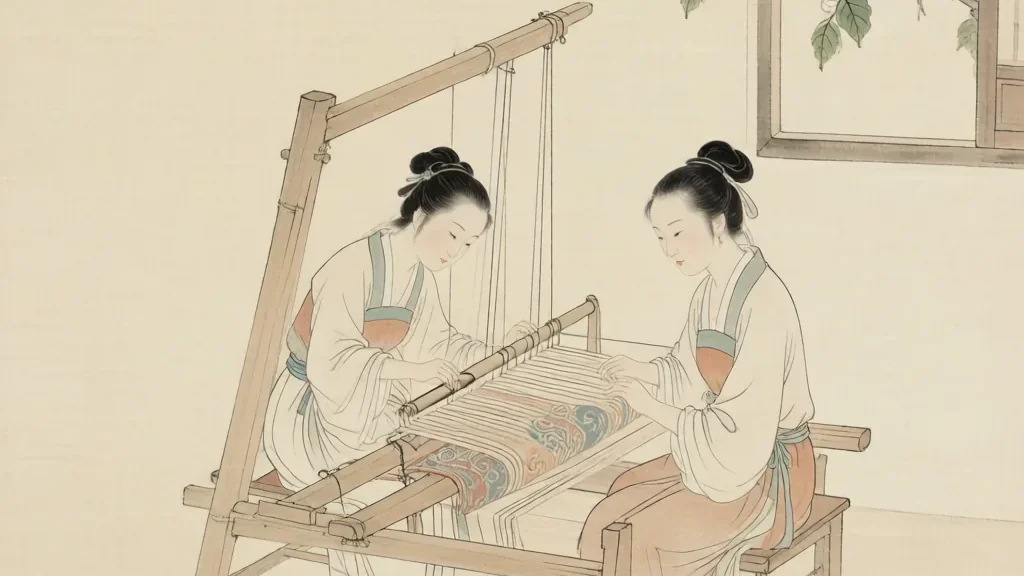
Silk is one of China's oldest and most famous technological achievements. For roughly three thousand years the Chinese alone knew how to breed silkworms, reel their cocoon filaments, and weave them into a cloth of singular sheen, strength, and softness. Legend attributes the discovery to the consort of the Yellow Emperor around 2700 BCE, but archaeology pushes organized sericulture — silk farming — back to the Liangzhu and Shang cultures. Silk was at once a luxury textile, a medium for painting and writing, a unit of currency and tribute, and the cargo that named the great overland and maritime routes the "Silk Road." The guarded secret of its manufacture slowly leaked westward over centuries, reaching the Byzantine world by the 6th century CE, but Chinese silks long remained the standard against which all others were measured.
The Legend of Leizu
Chinese tradition credits the invention of sericulture to Leizu (嫘祖), wife of the Yellow Emperor (Huángdì), who is said to have observed silkworms, learned to unwind their cocoons, and taught the skill to women of the realm. The tale fixes silk in the realm of female domestic craft, where it remained for millennia: raising silkworms and reeling and weaving silk were quintessentially women's work, overseen in palaces and farmhouses alike.
Whether or not a single discoverer existed, the association of silk with imperial consorts is telling. Throughout Chinese history empresses periodically performed the rites of sericulture in person, symbolically launching the spring silkworm season to affirm the state's interest in the industry.
Sericulture: Raising the Silkworm
True silk comes from the cocoon of the domesticated silkworm moth, Bombyx mori, which feeds almost exclusively on mulberry leaves. The Chinese perfected the annual cycle of hatching eggs, tending larvae on woven trays, and harvesting the whitish-yellow cocoons when the moths were about to emerge. To preserve the continuous filament, cocoons were plunged into hot water to kill the pupa before it could chew its way out and break the thread.
Mulberry cultivation and silkworm rearing became tightly linked rural industries. The labor was exacting: silkworms are sensitive to temperature, humidity, and disease, and a failed crop meant lost income. Yet a single cocoon can yield a filament hundreds of meters long, and several are reeled together to make a usable silk thread.
Reeling and Throwing
Once cocoons were softened, the outer floss was brushed away and the end of the filament found. Several filaments were gathered and reeled onto a bobbin to form raw silk. "Throwing" — twisting and doubling threads — produced yarns of different weights and strengths for warp and weft. The Chinese developed sophisticated reeling frames and multiple-ply threads that gave their silk both durability and luster.
Raw silk was then degummed to remove the protein (sericin) that binds the fibers, revealing the smooth, glittering filament underneath. This combination of steps — rearing, reeling, throwing, degumming — constituted a genuinely advanced biotechnological process centuries ahead of anything elsewhere.
Weaving and the Silk Loom
Chinese weavers used foot-treadle looms and, for patterned cloth, elaborate drawlooms that could produce figure-woven silks of astonishing complexity, such as the polychrome tapestry-like kesi (缂丝) and the patterned lampas known in the West as "samite." Pattern drafts were controlled by harness cords lifted according to a plan, a proto-programming of the weave.
The drawloom, with a separate "pattern master" pulling cords, allowed repeats of dragons, clouds, and floral medallions across vast lengths of cloth. Such silks were status objects: sumptuary laws in many dynasties restricted who could wear which patterns and colors.
Types of Chinese Silk
Over the centuries a rich vocabulary of silk cloths emerged. Plain tabby weave was chuān (绢); a crisp, wiry silk was shā (纱), often used for summer robes; damask-patterned silk was duàn (缎); gauze and gauze-embroidered forms were prized for their translucency; and the slit-tapestry kesi was reserved for the finest images and dragon robes.
Each type suited a purpose — ritual vestments, everyday court dress, tribute bolts, or painting surfaces. Monochrome silks sized with glue became the preferred ground for scroll paintings and calligraphy long before paper was universal.
Silk as Currency, Tribute, and Gift
In addition to clothing, bolts of silk served as a store of value and a unit of account; taxes and salaries were sometimes paid in silk, and it functioned as a kind of currency on the frontiers where metal coin was scarce. As tribute, silk cemented diplomatic relations: China sent bolts to Central Asian khanates, Korea, Japan, and Southeast Asian courts.
Silk also wrapped the dead and adorned the living. Han tombs such as Mawangdui have yielded extraordinarily preserved silk garments, painted silk banners, and even a complete T-shaped funerary banner depicting the cosmos and the deceased's journey.
The Silk Roads
So valuable was silk abroad that overland caravans carried it from Chang'an westward through Central Asia to Persia and the Roman Mediterranean, and maritime routes bore it to Southeast Asia, India, and East Africa. These networks — collectively the "Silk Roads" — moved far more than cloth, but silk was the prestige good that gave them their name in modern scholarship.
The trade was never simply commercial. It transmitted Buddhism into China, carried technologies westward, and knit together economies from the Han through the Tang and Yuan dynasties. Chinese silks have been excavated as far as Roman Egypt and the Siberian frozen tombs of the Scythians.
The Secret Leaks West
China guarded sericulture jealously, forbidding the export of eggs or living moths on pain of death. Yet the secret escaped. By the 4th–6th centuries, silkworm rearing had reached Khotan (in present-day Xinjiang) and then Persia. The decisive transfer came in the 6th century CE, when, according to the Byzantine historian Procopius, two monks smuggled silkworm eggs hidden in hollow canes to the court of the Eastern Roman emperor Justinian, founding a silk industry around the Mediterranean.
Even after the technique spread, Chinese silks retained a reputation for unmatched quality, and Chinese weavers continued to set fashions in pattern and color for centuries.
Modern Legacy
Silk remains a global luxury fiber, and China is still the world's largest producer. The traditional crafts survive in centers such as Suzhou (embroidery), Hangzhou (weaving), and the kesi ateliers that reproduce imperial dragon robes. Sericulture also underpins modern science: the silkworm is a model organism, and silk protein is researched for medical sutures, scaffolds for tissue engineering, and biodegradable materials.
From a Neolithic discovery to a biotechnology of today, silk illustrates how a single Chinese invention shaped economy, art, and culture across Eurasia for three millennia.
❓ Frequently Asked Questions
Who invented silk?
Chinese legend credits Leizu, wife of the Yellow Emperor, though organized sericulture is documented archaeologically from the Shang period onward.
How is silk made?
Silkworm caterpillars are fed mulberry leaves, their cocoons are softened in hot water, and the long filaments are reeled together, twisted, and woven.
Why was silk so valuable?
It combined rarity, sheen, strength, and softness unmatched by other fabrics, and China long monopolized its production.
How did silk-making reach the West?
The craft spread eastward from China to Khotan and Persia, then reached the Byzantine Empire in the 6th century via smuggled eggs.
What was the Silk Road?
The overland and maritime trade networks that carried Chinese silk and many other goods and ideas between China and Eurasia.
Is silk still made in China?
Yes; China is the largest silk producer, and traditional weaving and embroidery continue in Suzhou, Hangzhou, and elsewhere.