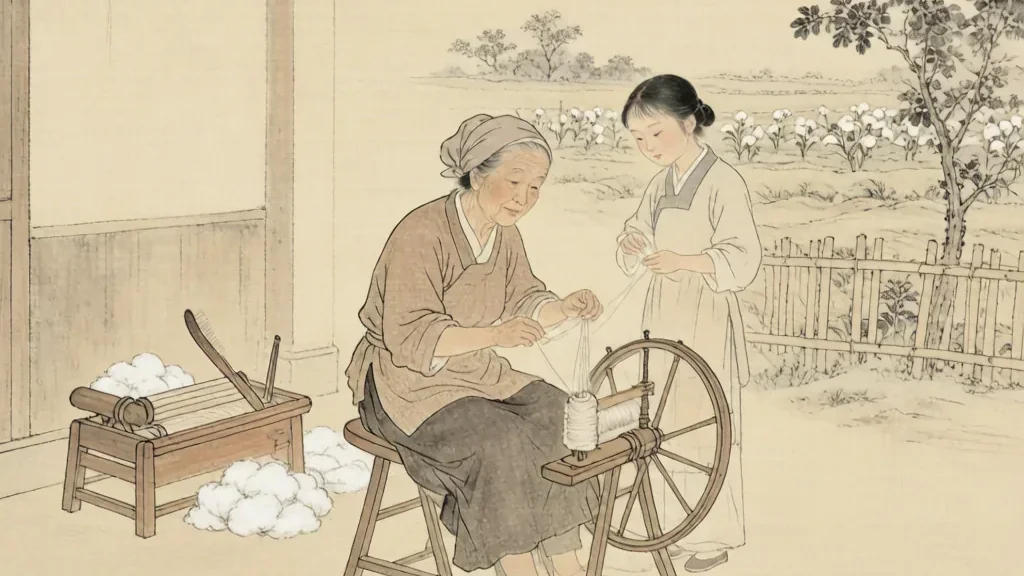
In the late thirteenth century, a poor village girl from the Yangtze delta traveled south to Hainan, lived among the Li people, mastered their cotton-weaving craft, and returned home to ignite a textile revolution. Her name was 黄道婆 (), honored as the "Mother of Cotton." At a time when northern China grew cotton but the sophisticated weaving happened far to the south, Huang Daopo bridged the gap, carrying improved tools and techniques to the Songjiang region near present-day Shanghai. Her story matters because it shows how the spread of a single crop and a handful of clever machines transformed the economic life of an entire region and, eventually, helped clothe the world.
A Life Between Two Worlds
Huang Daopo was born around 1245 in Songjiang, then a modest town in the lower Yangtze. According to legend, she fled a harsh family life as a young woman and reached Hainan Island, where the Li (黎) ethnic group had long practiced advanced cotton spinning and dyeing. She spent decades there, learning to cultivate, gin, spin, and weave cotton with a refinement unknown in her homeland. Sometime near the end of the thirteenth century she returned to Songjiang, by then an elderly woman, bringing not just skill but a determination to improve the crude local methods.
What makes her remarkable is that she is remembered not as a ruler or scholar but as a craftswoman and teacher. In a society that rarely recorded women's lives in detail, her reputation survived through oral tradition and local histories because her impact was impossible to ignore. After her death around 1330, the people of Songjiang built shrines to her, and weavers honored her as a patron spirit. Her memory was carried by the very cloth she taught others to make.
The Tools She Brought Home
The key to Huang Daopo's influence was mechanization. Before her reforms, Chinese cotton processing relied on slow hand methods: seeds were pulled from fiber by hand, and yarn was spun on a simple one-spindle wheel. She introduced or improved a set of devices borrowed and adapted from the Li. Most important was a foot-powered cotton gin, the 踏车 (), with a turning roller and a bowed string that efficiently stripped seeds from the lint, a task that had been painfully slow.
She also promoted a more efficient spinning wheel, said to carry three spindles at once so a single worker could produce three threads of yarn simultaneously, and she taught improved loom setups and the use of the stringed bow to fluff raw cotton. Combined with better weaving patterns and the famous blue-and-white resist-dyeing associated with the region, these tools let Songjiang turn out fine, even, and affordable cloth. The shift from one-spindle to multi-spindle spinning was, in effect, an early step toward industrial textile production.
How Cotton Reshaped the Yangtze Delta
Within a generation of Huang Daopo's teaching, the Songjiang area became the textile heartland of China. Cotton, which needs warm weather and was originally subtropical, spread northward as agronomists learned to cultivate it in the Yangtze and Yellow River basins. The delta's farmers began intercropping cotton with food grains, and whole villages specialized in ginning, spinning, or weaving. "Songjiang cloth" became a byword for quality and was traded across the empire.
This regional specialization anticipates the cottage-industry patterns of later centuries. Households spun yarn in winter and wove cloth year-round, selling surplus to merchants who distributed it through the great markets of Suzhou and beyond. The wealth generated helped transform the lower Yangtze into one of the most commercially developed regions of the premodern world. Cotton also improved everyday life: lighter and washable, it supplemented hemp and silk and eventually became the common person's everyday fabric.
From Local Craft to Global Commodity
Huang Daopo's innovations belonged to a wider current. Cotton had reached China from India and Southeast Asia over many centuries, and Chinese growers gradually domesticated it to local conditions. Once processing became efficient, demand exploded, and China developed one of the largest cotton-textile economies on earth long before the European Industrial Revolution. When European traders arrived in the sixteenth and seventeenth centuries, Chinese cotton and nankeen cloth were prized exports.
It is worth noting that the "industrial revolution" in textiles is often told as a purely Western story centered on England's spinning jenny. Huang Daopo's multi-spindle wheel reminds us that the impulse to multiply output per worker by mechanical means arose independently in China centuries earlier, within a craft tradition rather than a factory system. The difference was scale and power source, not ingenuity.
Remembering the Mother of Cotton
Today Huang Daopo is celebrated as a folk hero of innovation and as a rare honored woman in the long record of Chinese technology. Museums in Shanghai and Songjiang recount her story, and her tomb and former residence have been preserved as heritage sites. She embodies a distinctly Chinese ideal: that practical knowledge passed from hand to hand, and from one community to another, can be as world-changing as any decree from a throne.
Her legacy also speaks to cultural exchange. The techniques she carried came from the Li people of Hainan, a reminder that China's technological achievements were enriched by its many ethnic traditions. The Mother of Cotton thus stands at the meeting point of Han and Li craft, of south and north, and of the humble household loom and the vast networks of trade that clothed a continent.
The Li Origin of Her Craft
Huang Daopo's genius was rooted in exchange. The Li people of Hainan had refined cotton spinning, dyeing, and weaving over generations in a warm climate where the plant thrived, and their cloth was finer than anything then made in the Yangtze delta. When Huang lived among them, she absorbed not only the motions of the loom but the organization of the whole craft, from ginning seed to finishing patterns. Returning home, she adapted Li tools to local conditions rather than copying them blindly, which is why her story is as much about cultural borrowing as invention. The blue-and-white resist-dyeing of Songjiang later drew on the same cross-ethnic flow. Her legacy therefore reminds us that China's textile supremacy was woven from many traditions, with the Li contribution at its hidden foundation.
Spinning Wheels and the Path to Mechanization
The heart of Huang Daopo's revolution was the multi-spindle wheel. Where a single-spindle wheel let one worker make one thread at a time, her improved wheel turned three spindles together, tripling output per hour of labor. Combined with the foot-powered gin that stripped seeds and the bow that fluffed lint, the workshop became a small production line centuries before factories existed. This was mechanization in the craft sense: the same principle that later drove the Industrial Revolution, multiplying yield per worker through clever machinery rather than through harder hands. The difference from England's spinning jenny was scale and power source, not the underlying idea. Huang's wheel shows that the impulse to mechanize textile labor arose independently in China, within households rather than mills.
Cotton's Role in the Late Imperial Economy
Once Huang Daopo's methods took hold, cotton reshaped the Jiangnan economy for centuries. Farmers intercropped cotton with rice and wheat, and villages specialized in ginning, spinning, or weaving, selling surplus to merchants who fed distant markets. The region grew wealthy on this trade, and cotton cloth became a form of currency in tax and tribute, with official purchases supplying the northern capital. By the Ming and Qing dynasties, Songjiang was the undisputed textile capital, and Chinese nankeen and blue cloth reached markets as far as Europe. What began as one woman's teaching became a structural pillar of the late imperial economy, linking the household loom to imperial finance and to global trade. Cotton had turned from a southern curiosity into the common person's everyday fabric.
❓ Frequently Asked Questions
📝 Chinese Vocabulary
黄道婆 — : Huang Daopo, the "Mother of Cotton."
踏车 — : a foot-treadle cotton gin for removing seeds from lint.
棉 — : cotton, the fiber and plant.
纺织 — : spinning and weaving, the craft Huang Daopo advanced.
松江 — : Songjiang, the lower-Yangtze region that became China's textile heartland.
黎族 — : The Li, the Hainan ethnic group from whom Huang Daopo learned advanced cotton craft.
弹花弓 — : The bowed string used to fluff raw cotton fiber before spinning.
江南 — : Jiangnan, the lower Yangtze region that became China's textile heartland.
🎉 Fun Facts
- Huang Daopo is unusual in Chinese history for being honored as a technological hero even though she was neither a scholar nor an official.
- Her multi-spindle spinning wheel could produce three threads of yarn at the same time, a mechanical leap in productivity.
- The blue-and-white resist-dyed cotton of the Songjiang region was so prized it was exported to Europe in the early modern period.
- Local weavers built shrines to Huang Daopo after her death and treated her as a protective patron of their trade.
- Huang Daopo's reputation survived mainly through oral tradition and local gazetteers because, as a woman and a craftswoman, she was rarely recorded in official dynastic histories.
- The cotton-gin method she promoted cut the labor of removing seeds so sharply that whole villages could shift from part-time spinning to full-scale textile production.