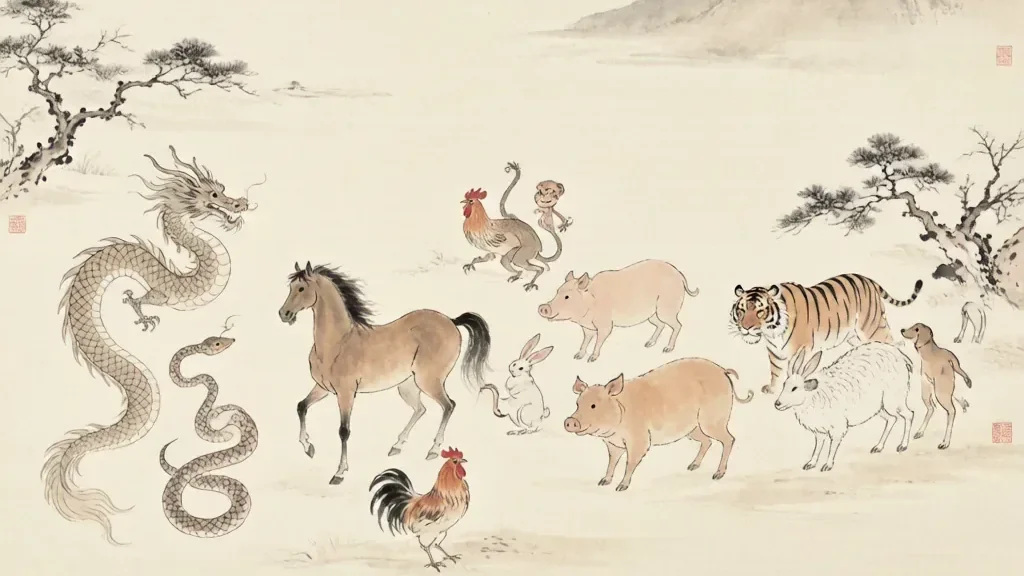
Animals occupy a vivid place in the Chinese writing system. Many of the oldest characters began as pictures of creatures — the horse, the fish, the bird, the silkworm — drawn so faithfully that their forms are still recognizable three thousand years later. Beyond these pictograms, animals shaped Chinese characters as components, as semantic clues, and as the raw material of metaphor. From the oracle-bone inscriptions of the Shang to the radical that still sits at the left of hundreds of modern characters, the creature world is woven into the very grammar of the script. To study animal-derived characters is to see how a farming and hunting civilization encoded its environment into writing.
Pictographs of Animals
The earliest clear animal characters are direct pictures. The Shang oracle-bone form of 马 (horse) shows a bristly mane and legs; 鱼 (fish) is drawn as a fish with tail and fins; 鸟 (bird) displays a beak, head, and wing; 鹿 (deer) captures the antlers. These are pictographs, the first of the six traditional categories of character formation. Because the Shang recorded divinations about weather, harvest, hunting, and sacrifice, animals appear constantly on the bones and shells, and their written images were standardized into the script.
What is striking is how conservative these forms are. The modern 鱼 still echoes the rounded body of its oracle-bone ancestor, and 马 still carries a suggestion of the mane. The picture did not vanish so much as it was streamlined by thousands of years of brush and chisel.
The Animal Radicals
As the script grew beyond what could be drawn, animals became semantic building blocks. The radical 犭, a compressed form of 犬 (dog), marks words for wild beasts and ferocity: 狼 (wolf), 狐 (fox), 猛 (fierce). The radical 鸟 (bird) heads a huge family of bird names, while 鱼 (fish) does the same for aquatic creatures. The "insect" radical 虫, broader than our word, once covered snakes, insects, and worms alike. These radicals let writers signal "this word belongs to the animal kingdom" before the phonetic part even indicated the sound.
Such radicals are not merely decorative; they are a classification system. By sorting creatures into dogs, birds, fish, and worms, the script mirrors the same categorical instinct seen in the Er Ya's natural-history chapters.
Cultural and Symbolic Animals
Certain animals rose above mere vocabulary to become symbols. The dragon (龙) and phoenix (凤) stand for imperial and auspicious power; the tiger (虎) wards off evil; the crane (鹤) signals long life. These characters carry layers of meaning built up through literature and art. The horse (马) appears in idioms about striving and noble service; the ox (牛) represents patient labor and, in the zodiac, a sign of the year. When such a character is used, it may evoke an entire cultural association rather than the animal alone.
The Twelve Zodiac Characters
The Chinese zodiac gives twelve animal characters a special currency: 鼠 (rat), 牛 (ox), 虎 (tiger), 兔 (rabbit), 龙 (dragon), 蛇 (snake), 马 (horse), 羊 (goat), 猴 (monkey), 鸡 (rooster), 狗 (dog), 猪 (pig). Each marks a year in the sixty-year cycle and appears on calendars, greetings, and charms. Children learn to write their "year animal" early, and the characters double as a gentle introduction to the writing system. The zodiac thus keeps animal characters in daily, affectionate use.
Animals in Compound and Phonetic Characters
Many characters use an animal component not for meaning but for sound. In the phonetic-compound 妈 (mother), the 马 (horse) supplies the pronunciation while 女 (woman) gives the sense — a reminder that an animal shape can be borrowed purely for its sound. Conversely, characters like 鲜 (fresh), built from 鱼 and 羊 (fish and sheep), once painted a vivid scene of savory food. The interplay of picture, meaning, and sound around animal parts shows the script's flexibility.
Mythical and Hybrid Beasts
Not all animal characters depict real creatures. The dragon 龙, the qilin 麒麟, and the tortoise-dragon 鳌 belong to myth. The phoenix 凤 and the nine-tailed fox 狐 (in later lore) blur the line between observed nature and imagination. These characters prove that the writing system absorbed legend as readily as livestock, recording a people's dreams alongside its facts.
Animals in Modern Usage and Learning
Today animal characters remain a favorite teaching tool. Picture-based mnemonics — "the bird has an eye in 鸟" — help learners remember forms, and children's books abound with animal strokes. Calligraphers still treat animal characters as exercises in liveliness, since a horse or tiger demands energetic brushwork. The creature kingdom, inscribed at the birth of Chinese writing, is still one of its most approachable doors.
Animals in Idioms and Daily Phrases
Animal characters anchor a huge share of Chinese idioms (成语) and everyday phrases, where the creature stands for a trait rather than the beast itself. 马马虎虎 (horse-horse-tiger-tiger) means "so-so" or careless; 对牛弹琴 (playing the qin to an ox) describes wasting words on someone who cannot appreciate them; 狐假虎威 (the fox exploiting the tiger's might) warns of a bully borrowing another's power. The dragon and tiger appear together in 龙腾虎跃 to praise vigor, while 画蛇添足 (drawing legs on a snake) cautions against ruining something by excess. These phrases keep animal characters in living speech far beyond the farm or the zoo.
Because the characters are so visual, they also help learners remember the idioms: a mental picture of an ox unmoved by music makes the phrase stick. Children meet animal idioms early, and calligraphers love writing them for their bold, energetic forms. In this way the creature kingdom that entered writing as literal pictures three thousand years ago still shapes how modern Chinese thinks, jokes, and warns — proof that a pictograph can outlive the animal it depicted.
Animal Characters as a Teaching Gateway
Because animal forms are concrete and memorable, they make an ideal entry point for newcomers to the script. A learner who meets 马, 鱼, and 鸟 as pictures rather than abstract signs quickly grasps the pictographic principle that underlies so much of the writing system. Teachers often introduce radicals through the animal families — dog, bird, fish, insect — because the groupings are intuitive and the characters recur constantly in real texts. The emotional pull helps too: people remember a character associated with a creature they like, and the zoo of the script becomes a friendly place to start rather than a wall of mystery.
❓ Frequently Asked Questions
Which Chinese characters are based on animals?
The oldest are pictographs such as 马, 鱼, 鸟, and 鹿 that began as pictures of creatures, plus many later characters built with animal radicals.
How do animal radicals work?
Radicals like 犭 (dog), 鸟 (bird), and 鱼 (fish) signal that a character belongs to an animal category, giving a semantic clue before the sound is shown.
Why are animals so common in early writing?
Shang society depended on farming, hunting, and animal sacrifice, so creatures featured constantly in the divinations inscribed on oracle bones.
What are the twelve zodiac animal characters?
They are 鼠牛虎兔龙蛇马羊猴鸡狗猪, one for each year of the traditional twelve-year cycle.
Can an animal part be used only for sound?
Yes; in phonetic compounds like 妈 the horse 马 contributes pronunciation while the woman radical 女 carries the meaning.
Do mythical beasts count as animal characters?
Indeed, creatures like the dragon 龙 and phoenix 凤 are well-established characters with deep cultural symbolism.