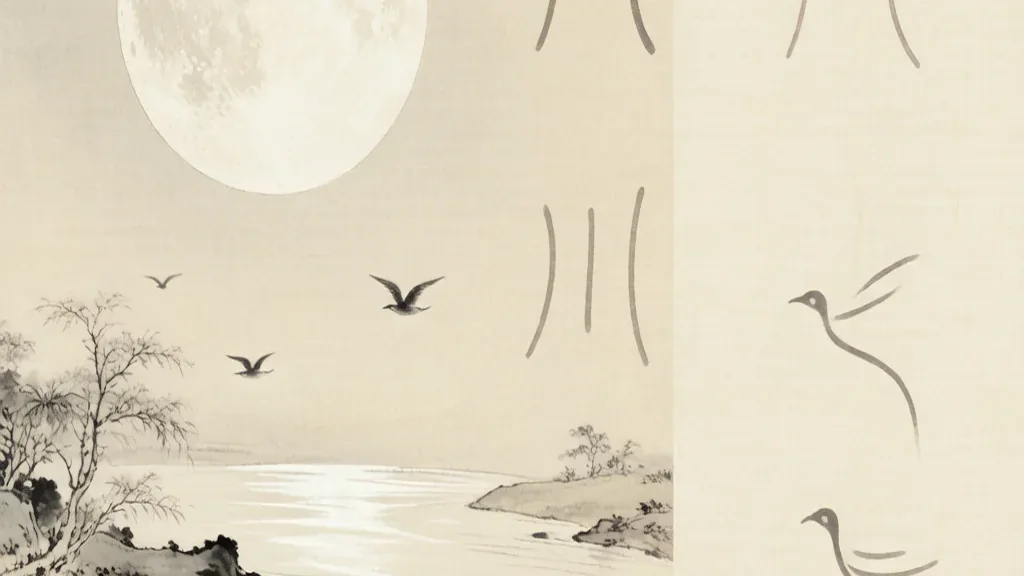
Few inventions have shaped civilization as profoundly as writing, and among the world's great scripts, Chinese characters stand alone in their unbroken lineage from ancient pictures. Pictographs (象形字, xiang xing zi) characters that began as literal drawings of the objects they represent form the oldest stratum of the Chinese writing system. When Shang dynasty scribes incised turtle plastrons and ox scapulae with images of the sun the moon mountains and rivers they were translating visual perception into permanent communicable symbols. Understanding pictographs is not merely an exercise in historical linguistics it is a window into how the human mind first learned to freeze the flowing world into fixed marks.
The Sun and the Moon: Celestial Pictographs
The character for sun r i began as a circle with a single horizontal line through its center a remarkably close visual analogy to the sun as seen through the atmospheric haze of the Yellow River valley. Over three millennia the circle squared off as brush strokes replaced incised lines but the essential form remains recognizable. Similarly the moon yue started as a crescent shape often with a small interior mark suggesting the moon's surface features. These two characters appear together in the word ming meaning bright which literally depicts the sun and moon shining together a poetic construction that reveals how the early Chinese understood the sources of light.
The evolution of r i and yue from pictographs to standardized components illustrates a central principle of Chinese writing even the most ancient forms are not merely fossilized pictures but living elements that continue to generate new meanings. Today r i appears as a radical in hundreds of characters related to time light and celestial phenomena from shi time to qing clear sky. The pictorial origin though abstracted through millennia of stylistic change still animates the system from within.
Mountain Water and the Natural World
The pictograph for mountain shan originally depicted three peaks rising from a horizontal base a miniature landscape etched into bone. The character for water shui began as a sinuous line with droplets on either side evoking the flow of a river with splashing currents. Rain yu shows a horizontal heaven line with descending streaks capturing the visual essence of precipitation. These nature pictographs are among the most stable in the script their modern forms still clearly related to their ancient prototypes.
What makes these pictographs remarkable is their economy of line. The Shang scribes did not attempt photorealistic depiction they abstracted the essential perceptual features of each object and reduced them to a minimal set of strokes that would remain recognizable across different hands and contexts. This principle of economical representation capturing the thing by its most distinctive outline became a foundational aesthetic of Chinese calligraphy and visual culture.
Human Body: Eye Mouth Hand Heart
The human body provided some of the most productive pictographic sources. The eye mu was a horizontal eye with a pupil a form that still faintly echoes in the modern character. The mouth kou was an open square suggesting the oral cavity. The hand shou showed a palm with extended fingers. The heart xin depicted the cardiac organ with its chambers a character that would go on to serve as the semantic radical for hundreds of emotion related words.
These body part pictographs are especially important because they became the building blocks for more complex characters. The eye mu combines with water shui to form lei tears. The mouth kou appears in compounds too numerous to count. The hand shou modifies the meaning of thousands of action verbs. The heart xin underlies the entire vocabulary of Chinese emotional and psychological life from xiang to think to ai to love.
Animals in Bone and Bronze
Shang dynasty scribes delighted in depicting animals. The horse ma shows a horse with mane and tail a character that has undergone dramatic simplification but retains its equine essence. The tiger hu bares its teeth and stripes in the oracle bone script. The deer lu displays antlers with specificity that suggests close observation of nature. The fish yu includes scales and a tail fin while the bird niao is unmistakably avian with its crest and spread wing.
These animal pictographs are not merely decorative they served crucial functions in Shang divinatory practice. Kings asked about hunting expeditions and the animals named on the bones deer boar tiger rhinoceros were real presences in the landscape of ancient China. The precision of the pictographs reflects the practical knowledge of a people who lived in close contact with the natural world.
The Limits of Drawing
Despite their foundational importance pure pictographs constitute only a small fraction of the Chinese character set perhaps five percent or less. The reason is simple only concrete visible objects can be drawn. Abstract concepts like love justice causation and number resist pictorial representation. This limitation forced the Chinese writing system to evolve beyond pictography toward more sophisticated methods of meaning making including ideographs compound ideographs and the phonetic compound system that now dominates the script.
Yet every Chinese character no matter how complex or abstract ultimately rests on the foundation laid by the pictographs. The radicals that organize the dictionary the semantic components that hint at meaning the calligraphic strokes that define aesthetic beauty all trace their ancestry to those first pictures. When a modern Chinese reader writes r i or shan they are participating in a tradition that stretches back to the Bronze Age when a scribe first scratched the outline of the sun or the mountain into bone.
Pictographs as Building Blocks
Although true pictographs are few, their importance is out of proportion to their number because so many became the seeds of later characters. The tree sign, for instance, sits inside forest and grove and serves as the radical for a large family of wood and plant words, so learning one picture unlocks many. The eye pictograph combines with water to form tears, and the heart pictograph underlies the whole vocabulary of emotion, from thought to love. In this way the earliest drawings did not vanish when the script grew abstract; they migrated inward, becoming the components that organize the dictionary and hint at meaning. Every complex character, no matter how abstract, ultimately rests on a foundation laid by the pictographs, which is why the radicals that guide readers still trace their ancestry to those first Bronze Age pictures.
Reading Pictures Across Three Thousand Years
One of the most striking facts about Chinese writing is how recognizable its old pictures remain. The Shang scribe who drew the sun as a circle and the moon as a crescent would still recognize the modern forms, even though the stroke has been straightened and standardized beyond the original sketch. Nature signs such as mountain, water, and tree preserve their essential outline, and body-part pictographs like eye and mouth still echo their prototypes. This continuity means a reader today can often see the logic of a three-thousand-year-old sign at a glance, a rarity among the world's scripts. The persistence is not accidental; it reflects a conservative habit of mind that valued keeping the visual root of a word even as the writing system matured into something far richer than pictures.
The Aesthetic of Economy
The pictographs teach a principle that shaped all later Chinese visual culture: capture a thing by its most distinctive outline and no more. The Shang scribes did not attempt photorealistic depictions; they abstracted the essential features of each object into a minimal set of strokes that would stay recognizable across different hands. This economy of line became a foundational aesthetic of calligraphy, where meaning is conveyed through controlled, suggestive strokes rather than detailed illustration. The same restraint appears in Chinese painting and seal carving, arts that prize the suggestive over the literal. In this sense the pictographs were the first lesson in a lasting visual philosophy: say much with little, and let the viewer complete the picture, a habit of economy that the script never lost.
❓ Frequently Asked Questions
Chinese Vocabulary
象形字 — : Pictographs characters that depict objects through visual resemblance.
甲骨文 — : Oracle bone script the earliest known form of Chinese writing.
日 — : Sun a primary pictograph that also serves as a radical for time related characters.
山 — : Mountain a pictograph showing three peaks.
目 — : Eye a pictograph of a horizontal eye with a pupil.
月 — : Moon, a celestial pictograph shown as a crescent in its earliest form.
水 — : Water, a pictograph of flowing lines with droplets, later the water radical 氵 in many characters.
木 — : Tree, a pictograph of a trunk with branches that reappears inside forest and wood compounds.
Fun Facts
- The character for horse in oracle bone script is written sideways showing a horse in profile a convention shared with Egyptian hieroglyphs.
- Only about 500 to 600 characters in the entire Chinese lexicon are classified as pure pictographs yet these few appear in nearly every written sentence.
- Some pictographs have changed so much that their origins are nearly invisible the character for big originally depicted a human figure with outstretched arms not an abstract concept of size.
- Pictographs are the root stock of the script: the tree sign reappears inside forest and many wood compounds, so one picture unlocks later words.
- The eye pictograph combines with water to form tears, showing how a drawn picture seeded abstract compounds.
- The heart pictograph became the semantic radical for hundreds of emotion words, underlying the vocabulary of Chinese emotional life.