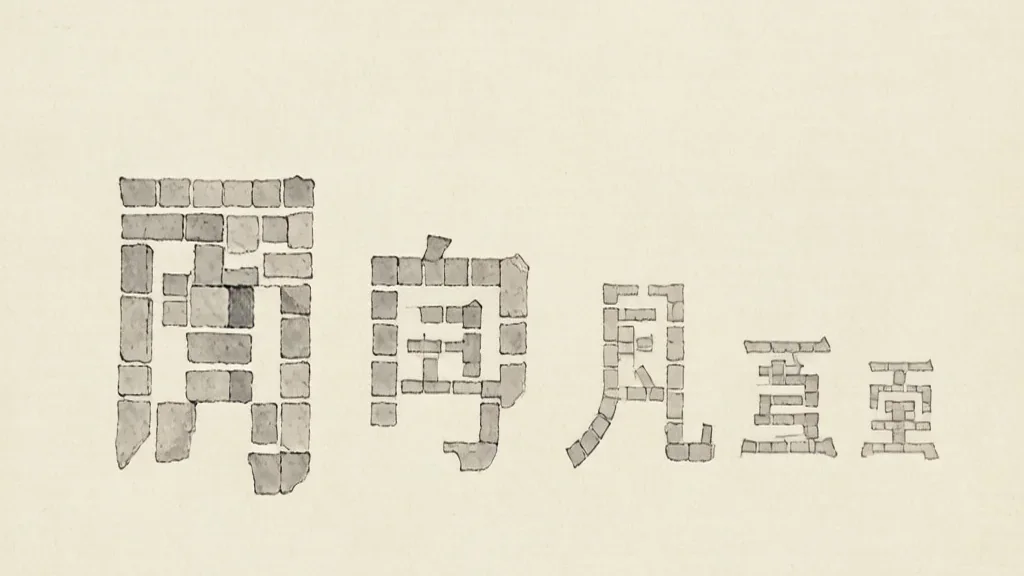
Character frequency is the study of how often each Chinese character appears in real texts, and it is one of the most practical fields in the whole enterprise of Chinese literacy. Unlike an alphabet of a few dozen letters, the Chinese script has tens of thousands of characters, yet a curious fact dominates the data: a small set covers the overwhelming majority of everyday writing. Knowing which characters are common lets educators choose what to teach first, lets font and keyboard designers allocate resources, and lets learners prioritize. Frequency analysis turns an apparently infinite script into a manageable core plus a long tail of rarities.
The Zipf-like Shape of the Data
Chinese character usage follows a steep "long tail." A handful of characters — 的, 一, 是, 不, 了 — account for a large share of any ordinary text, and coverage rises quickly as you add more. Studies of modern corpus data show that roughly the 1,000 most frequent characters cover about ninety percent of typical writing, and 2,500 to 3,500 characters cover nearly all common material. Beyond that, frequency falls off sharply; the rarest characters may appear only in classical texts, technical jargon, or personal names. This shape is what makes the script teachable despite its size.
The Modern Common-Character Lists
Governments and educators have formalized these findings in lists. The mainland's "General Standard Chinese Characters" table organizes about 8,000 characters by tier, while the "Commonly Used Characters" list of 2,500 (plus an extended 1,000) targets basic literacy. Taiwan and Hong Kong publish their own lists for traditional characters. Textbooks are sequenced so that a student finishes the highest-frequency characters first, building reading fluency fast. These lists are the practical fruit of frequency research.
How Frequencies Are Measured
Modern measurement uses large text corpora — newspapers, books, websites, subtitles — counted by computer. Each character's occurrences are tallied across billions of words, then ranked. Early work in the twentieth century used hand counts and smaller samples, but digital corpora made the counts far more reliable. Researchers must decide which genres to include, since a medical journal and a children's book yield different rankings; most standard lists blend balanced sources to approximate general literacy.
Frequency and Learning Priority
For learners, frequency is the compass. Studying the top 1,000 characters first yields immediate reading payoff, whereas learning rare characters early is inefficient. Many graded readers and flashcards are ordered by frequency for exactly this reason. A student who masters the 2,500 common characters can read most newspapers with a dictionary for the rest. Frequency thus converts the abstract goal "learn Chinese" into a concrete sequence: common first, rare later.
Frequency in Dictionary and Font Design
Publishers use frequency to decide which characters a basic dictionary should contain and in what order to present them. Font makers ensure the common core is beautifully hinted at every size, while rare characters may receive less polish. Input-method developers order candidate lists by frequency so the character you most likely want appears first. Even the "common characters" subset of Unicode is informed by such studies, ensuring software supports what people actually write.
Frequency Versus Mastery
High frequency does not mean easy, nor low frequency unimportant. The character 的 is ubiquitous but learned early; a rare character in your own name or field matters intensely to you. Moreover, frequency shifts with register: classical poetry favors characters absent from news prose, and legal text piles up rare terms. A balanced literacy therefore pairs frequency-based core learning with targeted study of the special vocabulary of one's domain. Frequency guides, but does not replace, judgment.
The Long Tail and Rare Characters
The tail of the distribution holds tens of thousands of characters recorded in big dictionaries but seldom seen. Many are variant forms, obsolete graphs, or names of plants, places, and people. They matter for reading inscriptions, genealogies, and classical literature. Frequency studies help distinguish the truly dead from the merely dormant, and remind us that the Chinese script is less a closed set than a living museum in which old characters wait for the right context to reappear.
Why It Matters in the Digital Era
Frequency analysis underpins nearly every modern language tool: autocomplete, machine translation, optical character recognition, and text prediction all weight common characters more heavily. As Chinese spreads online, the data only grows richer, refining the rankings. The ancient script, counted billions of times by machines, turns out to obey statistical laws as orderly as its calligraphic ones — a quiet marriage of tradition and data.
Frequency and the Myth of "Thousands to Learn"
A common fear among beginners is that Chinese requires memorizing tens of thousands of characters. Frequency data dissolves that fear: functional literacy arrives with a few thousand, and the truly common core is far smaller. Knowing the top five hundred characters already unlocks much signage and simple text; the much-quoted "three thousand for fluency" is a practical, not mystical, number. The long tail of rare graphs can be met gradually or skipped entirely for everyday purposes. Frequency thus reframes the script from an impossible mountain into a staircase, where each step yields usable reading — a message every discouraged learner needs to hear.
Frequency and Character Simplification
Frequency data also informed the great simplification of the mid-twentieth century. Reformers prioritized the common characters, reasoning that streamlining the most-used graphs would yield the largest gain in literacy for the least disruption. Rare characters were left largely alone, since few people met them. This pragmatic focus — fix the frequently seen, leave the archive intact — explains why simplified and traditional forms differ most in everyday words and barely at all in obscure ones. Frequency thus shaped not only how characters are taught but which forms survived reform, a quiet reminder that statistics can leave a permanent mark on the shape of a civilization's writing.
For the curious reader, frequency lists are also a cultural map. The most common characters — particles, pronouns, everyday verbs — reveal what a society talks about most: family, eating, going, saying, not wanting. Rare characters cluster around ritual, bureaucracy, and nature, the specialized vocabularies of an agrarian empire. To read a frequency table is thus to read a civilization's priorities compressed into a ranking. The humble count of how often a graph appears turns out to be a mirror of what a people valued enough to write again and again.
❓ Frequently Asked Questions
What is character frequency?
It is how often each character appears in real texts, measured by counting occurrences across large corpora and ranking them.
How many characters do I need to read most text?
About 1,000 cover ninety percent of ordinary writing, and 2,500 to 3,500 cover nearly all common material.
How are frequencies measured today?
Computers tally characters across billions of words from balanced sources like news, books, and websites, then rank them.
Why does frequency matter for learners?
Studying high-frequency characters first gives fast reading gains, so textbooks and flashcards are ordered by frequency.
Are rare characters useless?
No; they matter for names, classical texts, and technical fields, even though they sit in the long tail of daily use.
How does frequency shape technology?
Autocomplete, prediction, OCR, and input candidates all weight common characters more heavily, guided by frequency data.