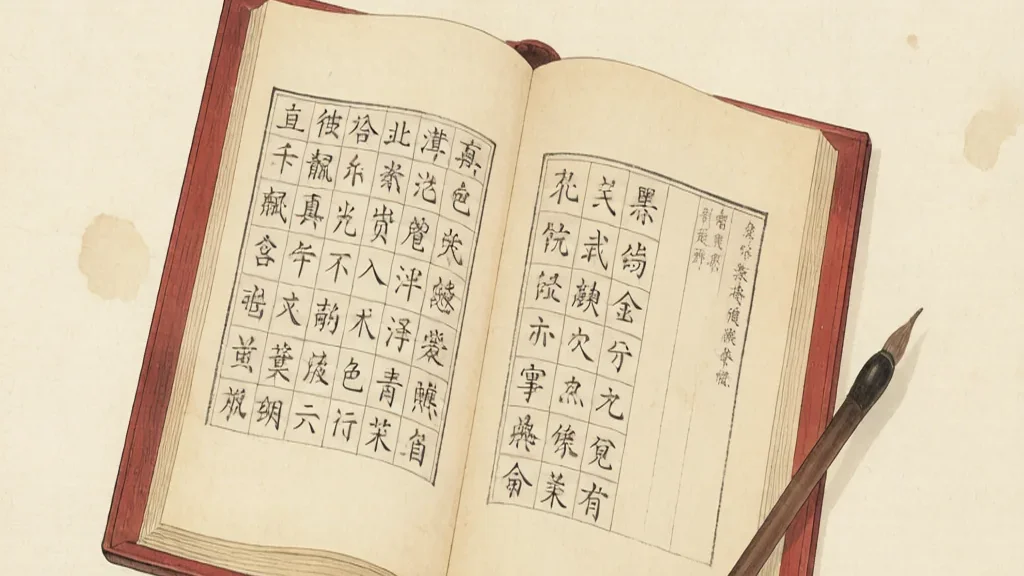
A Chinese character dictionary is a different kind of reference work from an alphabetically ordered Western dictionary. Because the script has no natural letter order, lexicographers had to invent ways to sort tens of thousands of characters — by radical, by number of strokes, by pronunciation, and, in the digital age, by component. Over two millennia, Chinese dictionaries grew from the classified glosses of the Er Ya to the radical-based Shuowen Jiezi, and finally to the monumental Kangxi Dictionary that still sets the standard for character counts. The history of these dictionaries is the history of how Chinese civilization organized its own vast written heritage into something searchable.
The Earliest Lexicography
The roots lie in the Er Ya, the Warring States-to-Han glossary that grouped words by topic rather than by form. It taught meaning but not how to look a character up. The next leap came with the Shuowen Jiezi of Xu Shen (c. 100 CE), the first dictionary arranged by written structure: it gathered characters under 540 radicals based on shared shape, explaining each by its form and etymology. This radical principle became the organizing idea of Chinese lexicography for the next seventeen hundred years.
The Shuowen Jiezi Model
Xu Shen's work defines more than nine thousand characters. For each, it gives the radical, a brief definition, and often a note on whether the character is pictographic, ideographic, or phonetic. Crucially, it sorts characters within a radical by total stroke count, a convention dictionaries keep today. The Shuowen was not merely a lookup tool but a theory of the script — an attempt to show that characters are systematically built, reflecting the order of heaven and earth.
The Kangxi Dictionary
The great synthesis is the Kangxi Dictionary (康熙字典), compiled in 1716 under the Qing emperor Kangxi. It standardized the radical system at 214 headings and listed about 47,000 characters, drawing on earlier works and adding rare and variant forms. Its arrangement — 214 radicals, characters ordered by extra strokes — became the universal template. Even today, when people speak of "the radical," they usually mean a Kangxi radical, and modern dictionaries still inherit its count and ordering.
How Characters Are Looked Up
In a traditional dictionary, you identify a character's radical, turn to that radical's section, then scan by the number of remaining strokes. This demands knowing your radicals and stroke counts, a skill drilled into students. Alternative methods appeared over time: the "four-corner" system codes each character by the shapes in its four corners; phonetic indexes list characters by pronunciation using a rhyme table. Each method trades ease for completeness, and all assume a reader already literate in the script.
Modern and Bilingual Dictionaries
The twentieth century produced dictionaries for learners: the Xinhua Dictionary (1953) for modern standard Chinese, and countless bilingual Chinese–English works. These add pinyin, parts of speech, and example phrases, blending the radical tradition with alphabetical and phonetic access. For simplified-character users, dictionaries reorganized under simplified headings; for traditional-character users, the Kangxi order persists. Electronic dictionaries now let you find a character by drawing it, by component, or by typing its pinyin.
Specialized Character Dictionaries
Beyond general works, there are dictionaries of variant characters, of ancient forms (oracle bone and bronze), of pronunciation, and of the "常用字" (common characters) set used in education. The Dictionary of Chinese Character Variants and similar works catalog the many shapes a single character has taken. Such specialized tools are indispensable for reading inscriptions, manuscripts, and classical texts where the expected form may differ greatly from the printed standard.
Dictionaries in the Digital Age
Computers changed lookup forever. A character can be entered by pinyin, by drawing on a touchscreen, or by typing any of its components; software resolves it instantly and shows pronunciation, decomposition, and etymology. Databases now hold hundreds of thousands of forms, including rare variants once buried in old folios. Yet the conceptual backbone — radical, stroke count, component — remains, proving that the ancient organizing ideas still serve the screen. The Chinese dictionary, born of bamboo, has migrated smoothly to silicon.
Dictionaries and the Question of "How Many Characters"
A perennial question is how many characters exist. The honest answer depends on the count: a literate person knows a few thousand, a large dictionary lists tens of thousands, and union catalogs of historical forms reach over one hundred thousand when every variant is counted. The Kangxi Dictionary's 47,000 was long the benchmark; modern comprehensive databases exceed it by including regional, ancient, and personal-name graphs. Yet "exists" is slippery — many listed characters are effectively dead, appearing once in an old inscription. Dictionaries thus record not a fixed set but a spectrum from daily use to archival fossil, and the count grows as catalogers add newly unearthed forms.
From Wooden Slips to the Screen
The physical form of the dictionary traces the same media history as the script itself. Early glosses were written on bamboo and silk; the first bound dictionaries were woodblock-printed folios; the modern era brought movable-type and then offset printed volumes with pinyin and indexes. Today the dictionary lives chiefly on a phone, where a tap opens definitions, pronunciations, and animations of stroke order. Each medium changed how the book was used — from a heavy reference consulted at a desk to a constant companion in the palm. Yet the content carried forward with little loss: the radical, the definition, the reading. The Chinese dictionary has proved remarkably portable across three thousand years of technology.
For the learner, the practical lesson is to know several doors into a character. If you cannot recall the radical, try pinyin; if pinyin fails, draw the character or search by a component you do recognize. Modern tools make all these paths available at once, so a character that once required a skilled librarian to find can now be retrieved in seconds by a beginner. The dictionary, once a heavy object of expertise, has become a personal, instantaneous service — yet the discipline of knowing how characters are organized remains the difference between floundering and fluency.
❓ Frequently Asked Questions
How do you look up a Chinese character?
In a traditional dictionary you find its radical, go to that section, and scan by the number of remaining strokes; digital tools also allow drawing or pinyin.
What was the first radical-based dictionary?
The Shuowen Jiezi of Xu Shen, around 100 CE, which grouped characters under 540 radicals by shared shape.
What is the Kangxi Dictionary?
A 1716 Qing dynasty dictionary that standardized 214 radicals and listed about 47,000 characters, becoming the lasting model.
Why is the radical system important?
It gives the only natural order to a script without an alphabet, letting users navigate tens of thousands of characters.
How did digital tools change dictionaries?
They let users enter a character by pinyin, drawing, or component, and access huge databases of variants instantly.
What are specialized character dictionaries?
Works on variant forms, ancient scripts, pronunciation, and common-character sets used for inscriptions and classical study.