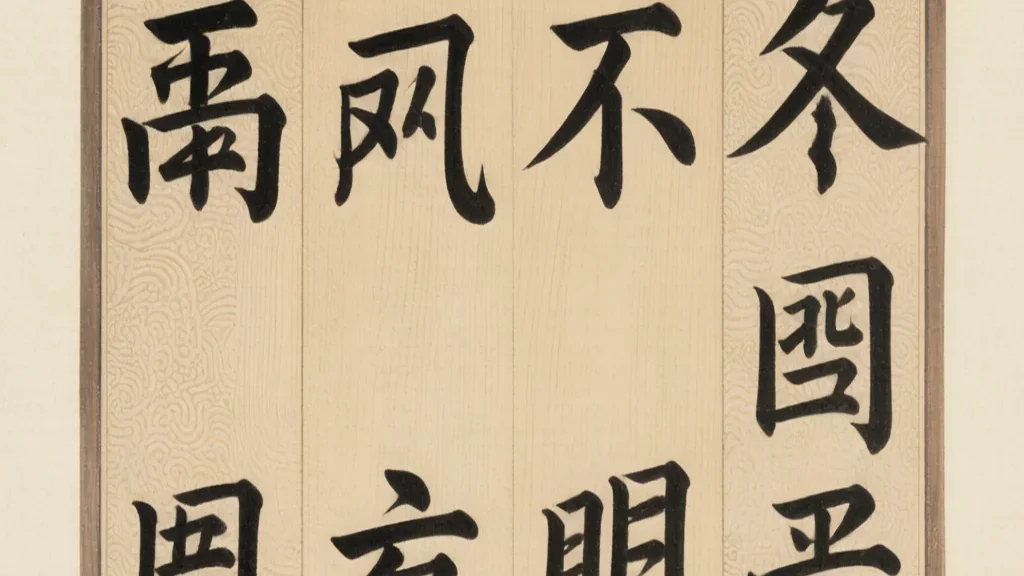
The written Chinese language contains tens of thousands of characters, yet everyday communication rests on a remarkably small core. A reader who masters a few hundred of the most frequent characters can understand the great majority of ordinary prose, newspapers, and digital text. Modern China maintains official frequency lists that define which characters count as common, and these lists guide textbook design, font production, and literacy policy. This article surveys what makes a character common, the standard lists that codify frequency, the individual characters that appear most often, the grammatical function words that dominate prose, the way common characters relate to radicals, how researchers measure frequency, and what this means for students of the language. Understanding the common core is the fastest route into literate Chinese.
What Makes a Character Common
A character earns the label common when it appears with high regularity across a broad sample of real texts. Frequency is not the same as difficulty, and many of the most common characters are visually simple while some rare characters are extremely complex. The common core is shaped by grammar: words that mark relationships, tense, possession, and questions must appear constantly, so the characters that write them recur on nearly every page. Nouns for people, place, and basic natural phenomena also recur because human experience is shared. Characters that name obscure technical items, archaic office titles, or regional plants fall out of the common set even when they are culturally interesting. Frequency therefore reflects how people actually live and speak, not the prestige of a word.
Commonness also changes with genre. A scientific article favors precise technical characters that rarely appear in fiction, while a novel favors characters for emotion, movement, and dialogue. National frequency lists try to balance these genres by sampling newspapers, books, broadcasts, and later web text. The resulting ranking is thus a compromise, but it is a stable one: the top few hundred characters have held their positions for decades because the deep structure of the language changes slowly. For a learner, targeting the common band first produces the steepest gain in readable material per character studied.
The Modern Standard Frequency Lists
The most important modern references are the Lists of Frequently Used Characters in Modern Chinese, published in 1988 by the national language authority. The primary list contains two thousand five hundred common characters, and a supplementary list adds one thousand secondary common characters, for a combined total of three thousand five hundred. A separate broader table, the List of General Standard Chinese Characters, was issued later with seven thousand entries covering essentially all characters needed for ordinary publication. The two thousand five hundred figure is widely treated as the practical literacy threshold: official campaigns have long used it as a benchmark for basic reading ability among adults.
These lists were built from corpora of contemporary print and broadcast material, then refined by committees of linguists who weighed frequency against pedagogical usefulness. Characters with strong cultural or educational value were sometimes retained even when raw counts were modest. The lists also fixed standard printed forms and, where relevant, clarified simplified and traditional equivalents. Because they are official, publishers, dictionary makers, and examination boards align their materials to them, which means the common core a student meets in a textbook matches the common core found in real newspapers and signs.
The Most Frequent Single Characters
At the very top of every frequency ranking sit a handful of characters that appear constantly. The character for one and unity leads because it serves both as a number and as a prefix of unity. The possessive and relational marker written as a small particle recurs in almost every sentence that links nouns. Characters for person, self, you, and he or she appear in anything conversational. The character for middle or China appears in countless place names and phrases. Large, above, country, and come are likewise near the summit because they belong to fundamental vocabulary about space, scale, and belonging.
Below this tiny summit, the next few hundred characters cover concrete life: water, fire, wood, heart, hand, day, year, say, see, know, good, and many more. What is striking is how few characters carry so much weight. Studies of large corpora consistently show that the first few hundred characters account for the majority of printed tokens, and the first one thousand account for the overwhelming bulk of ordinary text. This concentration is why graded readers can be built almost entirely from the official common lists without sounding artificial, and why the common core is the backbone of literate life.
Function Words and Grammar Markers
A large share of the most common characters are not nouns or verbs but grammatical glue. The sentence ending particle that softens tone, the structural particle that marks modification, the conjunction meaning and, the negation written as a horizontal stroke across a frame, and the question marker are all among the most frequent symbols in print. Because they carry syntax rather than concrete meaning, they are easy to undervalue yet impossible to read without. A student who learns only content words will still fail to parse a sentence; the common function characters are what make the content cohere.
These markers often derive from older content words that grammaticalized over centuries. The particle of modification, for instance, began as a word for target or correctness before settling into its modern structural role. Tracing such characters back to their origins shows that the common core is historical as well as statistical: the words we use most are frequently the oldest. Their frequency is therefore a record of continuous use across more than two thousand years of written Chinese, preserved because daily grammar rarely reinvents itself.
Radicals Among Common Characters
Many of the most common characters also serve as radicals, the component pieces used to index dictionaries and to signal meaning. The character for water appears constantly as a standalone word and also as the liquid radical in hundreds of derived characters. The character for person plays the same double role, heading a large family of characters about human relations and roles. The character for heart, for wood, for grass, and for speech similarly anchor meaning clusters while themselves ranking high in frequency. This overlap means that learning the common core simultaneously builds the key to unlocking thousands of rarer characters through their radicals.
The convergence of frequency and radical status is pedagogically fortunate. A beginner who learns a few dozen common characters has already acquired the majority of the most productive radicals. Later, when meeting an unfamiliar character, the student can often guess a rough semantic field from the radical that is itself a familiar common character. The common core is thus not only the most used vocabulary but also the master key to the rest of the writing system, which is why radical instruction is woven into early frequency based learning.
How Frequency Is Measured
Measuring character frequency begins with a corpus, a large and balanced collection of texts. Researchers count how many times each character occurs, then rank characters by raw count or by the proportion of text they cover. Modern work uses enormous digital corpora drawn from books, news, and web pages, which makes the rankings far more stable than the hand counts of the early twentieth century. Weighting matters: an unweighted count lets a few repetitive sources dominate, so balanced corpora sample many genres in proportion to real reading habits.
Beyond simple counts, linguists distinguish character frequency from word frequency. Chinese writes meaning in characters but thinks in multi character words, so a character may be common chiefly because it appears in many different words. The character for electric, for example, is frequent today largely because it forms part of modern compounds for power, television, and telephone. Frequency lists therefore interact with dictionary making and with the design of input methods, fonts, and reading aids, all of which prioritize the characters that users actually meet.
Common Characters in Learning and Literacy
Textbook authors almost always sequence lessons by frequency, introducing the most common characters first so that learners can read real material quickly. Graded readers, children's books, and literacy primers are constrained to stay within the common bands, gradually expanding outward. National adult literacy programs have historically set the two thousand five hundred common characters as the finish line for basic competence, on the reasoning that this set unlocks newspapers, notices, and practical documents. The common core is thus both a description of usage and a deliberate educational target.
For second language learners, the common core offers the best return on effort. Because the top one thousand characters cover most everyday text, a focused student can reach functional reading faster than the raw size of the writing system suggests. Spaced repetition software and frequency ranked decks are built directly on these lists. The practical lesson is simple: do not try to learn characters in random order, learn the common ones first, and let rare characters arrive naturally through reading once the foundation is secure.
Cultural Resonance of Everyday Characters
Common characters are not merely utilitarian; many carry deep cultural weight. The character for person sits at the heart of Confucian thought about relationships and duty. The character for heart expresses not only the organ but emotion, intention, and moral center. The character for harmony appears in daily greetings and state messaging alike. Because these words are frequent, their associated values are reinforced every time a person reads or writes. The common core is a quiet carrier of cultural continuity, exporting key concepts through ordinary use rather than through专门 study.
Calligraphers return again and again to common characters precisely because their familiarity lets viewers appreciate form over novelty. A well written character for water or for longevity is admired as much for balance and brush control as for meaning. Festivals print common auspicious characters on couplets and banners, making the most ordinary symbols into objects of decoration and blessing. The common core, in other words, is where linguistic utility and cultural expression most completely overlap.
Digital Encoding and Common Characters
Computing reinforced the importance of the common core. Early Chinese fonts and input methods had limited capacity, so engineers prioritized the characters that users needed most, drawing heavily on the official frequency lists. Unicode, the universal text standard, organizes characters into blocks and includes the entire general standard set, but fonts and keyboards still emphasize the common band for speed and storage. Predictive input on phones relies on frequency models trained on billions of characters, surfacing the common ones first.
The internet also reshaped frequency slightly by boosting characters for new technology, commerce, and emotion, yet the ancient summit characters remain firmly in place. Digital corpora simply confirmed what print had shown: a small common core carries the language. For anyone building tools, teaching materials, or search systems in Chinese, the lesson is the same as for learners. Start with the common characters, because they are the infrastructure on which everything else is built, and they are the characters a reader will meet in virtually every sentence.
❓ Frequently Asked Questions
How many characters do I need to read ordinary Chinese?
Roughly two thousand five hundred common characters let you read newspapers and everyday documents, while about one thousand covers most daily text. The official common list defines these thresholds for basic literacy.
Why are grammar particles among the most frequent characters?
Particles mark relationships, possession, and questions, so they appear in nearly every sentence. Though they carry syntax rather than concrete meaning, they are essential for parsing any text.
Are the most common characters the simplest to write?
Often yes, but not always. Frequency reflects how often a character is used, not its stroke count. Some common characters are visually simple, while some rare ones are extremely complex.
How do researchers decide which characters are common?
They count character occurrences across balanced corpora of books, news, and web text, then rank by frequency while weighing cultural and pedagogical value through expert committees.
Do common characters differ between simplified and traditional writing?
The core vocabulary is the same; only some printed forms differ. The common character lists clarify simplified and traditional equivalents so learners can map between them.
Why should a beginner learn common characters first?
Because the common core delivers the steepest gain in readable material per character studied, and many common characters double as radicals that unlock thousands of rarer characters.