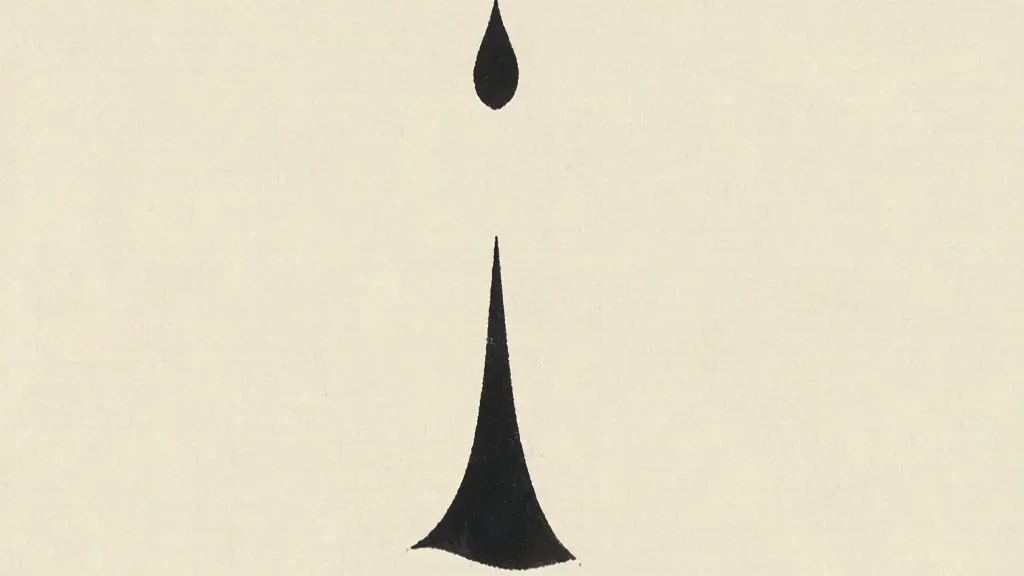
Ideographs (指事字, zhǐshìzì), often called "indicative characters" or "simple ideographs," form one of the six traditional categories (liùshū) of Chinese writing. Where a pictograph draws a thing and a compound ideograph combines two pictures, an ideograph marks an abstract notion by adding a sign — a dot, a stroke, a line — to an existing character. The classic pair is 上 (shàng, "above") and 下 (xià, "below"), written as a mark above or below a baseline. Other staples include 本 (běn, "root"), a dot on the foot of the tree 木, and 刃 (rèn, "blade"), a stroke at the knife's edge of 刀. Though few in number, ideographs are a vital hinge in the system: they show that early scribes could represent not only objects but relations and concepts, laying groundwork for the abstract side of the script.
The Six Categories Framework
The liùshū ("six writings") scheme was formalized in the Han dynasty, most fully in Xu Shen's postface to the Shuowen Jiezi (c. 100 CE). It sorts characters into pictographs, ideographs, compound ideographs, phonetic compounds, loan characters, and mutually-explanatory characters. The ideograph holds the second slot, signaling its role as a step beyond mere drawing.
Modern scholars treat liùshū less as a scientific taxonomy than as an ancient attempt to make sense of a messy, evolving script. Still, the distinction it draws between "drawing a thing" and "marking a concept" remains genuinely useful for understanding how new characters were coined.
Definition of an Ideograph
Xu Shen defined zhǐshì as "an affair that, when observed, may be seen; the upper and lower are examples." In practice an ideograph takes a concrete character and appends an indicator to point at an abstract idea. The added mark is not a picture of the concept but a pointer toward it.
This makes ideographs a bridge between the visual and the abstract. They acknowledge that some meanings — direction, position, emphasis — cannot be pictured directly and must instead be flagged upon a familiar base form.
The Canonical Examples
上 and 下 are the textbook cases: a short stroke above or below a longer base line denotes "above" and "below." 本 "root" places a dot at the base of 木 "tree"; 末 "tip" places it at the top. 刃 "blade" marks the sharp edge of 刀 "knife" with a stroke. 亦 "also," originally "armpit," dots the sides of a person 大.
The numerals 一, 二, 三 are sometimes classified as ideographs too, since they indicate quantity by tally strokes — though some analysts group them separately. Either way, they illustrate the same principle: a minimal graphic signal conveys an abstract count.
Ideographs vs Pictographs
A pictograph (xiàngxíng) resembles its referent — 日 is a sun, 月 a moon. An ideograph does not resemble its meaning; it annotates a picture to reach a concept. The two are easy to confuse because many ideographs start from a pictograph as their base.
The test is intention: if the added element is a semantic pointer rather than a depicted object, the character is an ideograph. 木 is a pictograph; 本 built from 木 plus a dot is an ideograph.
Ideographs vs Compound Ideographs
A compound ideograph (huìyì) fuses two or more whole characters to suggest a new meaning — 休 "rest" shows a person by a tree, 明 "bright" joins sun and moon. An ideograph, by contrast, modifies a single base with a small marker rather than combining independent signs.
The boundary blurs: some reference works reclassify borderline cases, and the same character may be labeled differently across dictionaries. What matters is the general insight that Chinese had at least two strategies for the non-picturable.
How Ideographs Were Coined
Coinage followed a pattern: take a known character whose shape gives a spatial anchor, then add a stroke at the relevant spot. The result is economical — one extra mark does heavy semantic work — and hard to misread once learned. This economy is why the type, though small, is memorable.
Over time, however, phonetic compounds (xínghshēng) came to dominate new character creation, because they could pair meaning and sound at once. Ideographs remained a fixed, closed set: scribes stopped inventing them, leaving later writers to borrow or compound instead.
Limited Yet Foundational
Reliable counts put genuine ideographs in the low dozens at most; they are vastly outnumbered by phonetic compounds. Yet they anchor basic vocabulary — directions, numerals, body parts, tools — that every learner meets in week one. Their small number belies their load-bearing role.
Because they encode fundamental spatial and quantitative concepts, ideographs also reveal the cognitive leap of early literacy: the move from "I draw what I see" to "I mark what I mean." That leap is the seed of all abstract notation.
Ideographs in Teaching
Textbooks love ideographs precisely because they tell a story. Showing a student 刀 with a stroke becoming 刃 makes the logic of the script visible and defuses the myth that Chinese is "only pictures." The type is a perfect teachable case for liùshū.
Calligraphers, too, treat these characters with care: the indicative stroke must sit exactly right, or the meaning shifts. A misplaced dot turns 本 into something else, a small lesson in how meaning rides on precision.
Legacy and Modern Relevance
In the age of input methods and fonts, ideographs survive unchanged in function. They also surface in etymology apps and character-decomposition tools, where users tap a character to see its "root dot" or "edge mark" explained. The category thus enjoys a quiet renaissance among digital learners.
More broadly, ideographs remind us that writing began not as photography but as annotation — humans marking the world to say where, how much, and which part. The humble dot of 本 is, in this light, one of the first abstract thoughts ever fixed in ink.
❓ Frequently Asked Questions
What is an ideograph in Chinese?
It is a character that marks an abstract idea by adding a small indicator — a dot or stroke — to a concrete base character, as in 上 "above" or 刃 "blade."
How is it different from a pictograph?
A pictograph depicts an object (sun, moon), while an ideograph annotates a base with a pointer to express a concept that cannot be drawn.
What are the classic example characters?
上 and 下 (above/below), 本 and 末 (root/tip), 刃 (blade), 亦 (armpit/also), and the tally numerals 一 二 三.
Are ideographs common in modern Chinese?
They are few in number — only dozens — but they encode foundational words like directions and numerals that learners meet immediately.
Why did scribes stop making them?
Phonetic compounds, which show both meaning and sound, proved far more scalable for coining new characters, so ideographs became a closed set.
Where does the idea come from?
From the Han-dynasty liùshū classification, especially Xu Shen's Shuowen Jiezi, which defined them as "indicative characters."