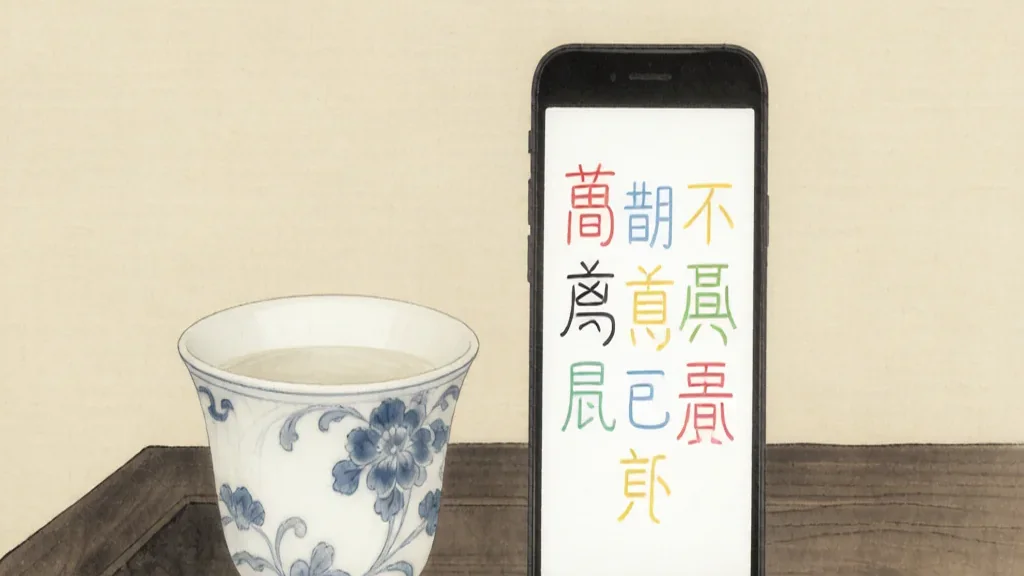
The internet has not replaced Chinese characters; it has reinvigorated them. Far from being clumsy on screens, the logographic script thrives in digital communication, where its compactness, visual punch, and capacity for punning make it ideal for fast, playful messaging. Chinese netizens have invented abbreviations, homophone substitutions, newly coined characters, and emoji like emoticons that bend the old script to new social needs. This article explores how Chinese is written online, how input methods shaped usage, how net slang and substituted characters work, how new characters are born on the web, how platforms police and transform language, and what the digital life of characters tells us about the future of the script.
Typing Chinese on Screens
The central fact of internet Chinese is the input method. Because there are far more characters than keys, users type a word in romanization or in a phonetic spelling, and software offers a list of candidate characters to choose from. This system means people compose in sound and select in script, a workflow impossible with typewriters. Input methods learned from huge text corpora which characters co occur, so they predict the next character with rising accuracy. The result is that typing Chinese is now faster than many expected, and the character system flourished rather than faded online.
Input methods also changed habits. Predictive completion encourages certain character sequences and can subtly standardize usage. Users who might write a rare character instead accept the common candidate the software suggests, gently pulling the language toward the frequent core. At the same time, the same software makes it easy to insert informal variants and slang, because the candidate list can include them. The keyboard is thus both a conservative and a creative force, preserving the script while reshaping how it is written day to day.
Net Slang and Abbreviations
Chinese internet slang borrows a global habit of shortening. Numbers whose pronunciations resemble words stand in for phrases, and Latin letters combine with characters to form hybrid expressions. Young users coin clipped forms of longer phrases, much as English uses initials. Because characters are semantically dense, a single character can carry a whole attitude, so slang often condenses feeling into very few signs. The brevity suits platforms with character limits and the quick pace of chat.
Slang also plays with tone and irony. A polite classical phrase may be repurposed sarcastically, or a cute character appended to soften a demand. The layered irony of internet Chinese rewards in group knowledge: understanding a meme requires knowing both the literal characters and the context that flips their meaning. This dense, context heavy play is possible precisely because the script packs meaning tightly, letting a small string carry a large cultural payload that would need a sentence in an alphabetic language.
Homophone Substitution
A distinctive feature of online Chinese is homophone substitution, where a sensitive or banned word is replaced by a character that sounds the same but means something else. The replacement may be harmless or absurd, which adds comedy while dodging filters. This practice exploits the huge inventory of homophonous characters in Chinese, turning the sound system into a code. Readers decode by pronunciation, recognizing that the written sense is not the intended one, a game that is both linguistic and political.
Substitution also drives creativity unrelated to censorship. Writers swap characters for punning effect, building jokes on near sound matches. Marketers use the same trick to make brand names memorable, and fans rename characters in fiction with playful homophones. The habit shows how fluid the link between sound and sign is in Chinese: because meaning rides on the character while sound is shared across many characters, swapping the surface sign leaves the spoken word intact, a flexibility unique to logographic writing.
New Characters Born Online
The internet has spawned genuinely new characters, or at least new composite graphs, assembled from existing components to capture a modern feeling. A famous example combines characters for man and woman to signify something like watch or peep, circulated as a playful coinage that caught on in chat. Such creations are usually informal and not officially standardized, but their spread shows that the character making instinct alive in oracle bones and loans still operates today, with users minting signs for new social situations.
Most web born characters are ephemeral, fading as a meme passes, but some persist and enter dictionaries or common use. The boundary between unofficial and standard is porous: a character used by millions online eventually pressures reference works to acknowledge it. This bottom up word formation contrasts with the slow, court sanctioned standardizing of the past. The internet has become a workshop where the script evolves in public, and where a graph can be born, peak, and decline within a single season of attention.
Emoji and Character Based Emoticons
Chinese users blend standard emoji with homegrown text emoticons built from characters and punctuation. A string of ordinary characters can be arranged to suggest a face or a gesture, continuing the pictographic spirit of the script in a playful key. Because Chinese characters are themselves visual, they lend themselves to this kind of drawn in text expression more readily than alphabetic letters, which must be twisted into sideways smileys.
Emoticons also carry cultural specificity. Certain characters used as reactions carry tones of teasing, resignation, or affection that translate poorly across languages. Platforms add sticker sets rich with calligraphic and cartoon characters, merging traditional aesthetics with instant messaging. The coexistence of ancient script and modern sticker shows that the visual nature of Chinese writing is not a relic but a living advantage, letting users perform emotion with the same signs that record history.
Policing and Platform Influence
Online language is shaped by platform rules. Automated filters replace or block certain character strings, prompting the homophone workarounds described above, while trending algorithms amplify some slang and bury others. Moderation thus participates in language change, silently editing the written record. Companies also standardize input candidates and emoji sets, giving private firms a quiet role in orthography that once belonged to academies and dictionaries.
This influence raises questions about who governs the script. When a platform decides which characters appear first in a candidate list, it nudges millions of choices. Yet the same platforms preserve minority expressions through groups and dialects that print media ignored. The digital ecology is contradictory: it homogenizes through prediction and amplifies through networks, both at once. Understanding internet Chinese requires watching not only users but the software and rules that mediate their writing.
The Future of Characters Online
The durability of Chinese characters online defied early predictions that alphabetic or romanized writing would dominate screens. Instead, the script proved efficient, expressive, and adaptable, well suited to compact displays and visual culture. Input methods, fonts, and search handle billions of characters daily, and the writing system shows no sign of retreat. If anything, the internet has deepened emotional attachment to characters through calligraphy stickers, character based memes, and national pride in the script.
Looking forward, the script will keep evolving through user coinage, platform design, and artificial intelligence that translates and generates Chinese text. The challenge is balance: preserving the classical heritage while welcoming the living slang that keeps the language vital. Internet Chinese demonstrates that a three thousand year old writing system can be thoroughly modern, that tradition and innovation share the same character, and that the future of Chinese writing will be typed, tapped, and memed as much as brushed.
Regional Speech and Minority Scripts Online
The internet is not only a Mandarin space. Users of regional languages such as Cantonese, Hokkien, and Shanghainese frequently write their speech online using characters chosen for sound, a practice that leans directly on the phonetic and loan habits described earlier in this article. Romanization systems attached to these dialects let young speakers chat in a way that captures local tone and humor inaccessible to standard written Chinese, and short video platforms have amplified dialect performance as a mark of identity rather than error.
Minority writing systems also find room online. Speakers of languages such as Tibetan, Uyghur, Mongolian, and Yi use dedicated input tools and social accounts to publish in their own scripts, sometimes alongside Chinese. The result is a layered digital landscape in which the dominant character system coexists with revived and maintained minority literacies. Far from a single uniform script, the Chinese internet is a contact zone where Mandarin characters, dialect romanization, and minority writing meet, each shaped by the same input methods, memes, and platform rules that govern the networked life of the script.
❓ Frequently Asked Questions
How do people type Chinese characters online?
They type a phonetic spelling or romanization and select the desired character from a predicted candidate list, composing in sound and writing in script.
Why are homophone substitutions common online?
Chinese has many homophonous characters, so swapping a sensitive word for a same sounding character dodges filters and makes puns, exploiting the sound sense split.
Are new Chinese characters really created on the internet?
Yes. Users assemble composite graphs for new feelings or jokes; most are informal and ephemeral, but popular ones can enter common use and even dictionaries.
Do emoji replace characters in Chinese messaging?
They complement rather than replace them. Chinese users also build text emoticons from characters, continuing the script's pictographic visual tradition playfully.
How do platforms influence the language?
Filters block certain strings, prediction lists favor common characters, and algorithms amplify trends, giving private software a quiet role in shaping orthography.
Will Chinese characters survive the digital age?
Strongly yes. The script proved efficient and expressive on screens, and input, fonts, and search handle it at massive scale with no sign of decline.