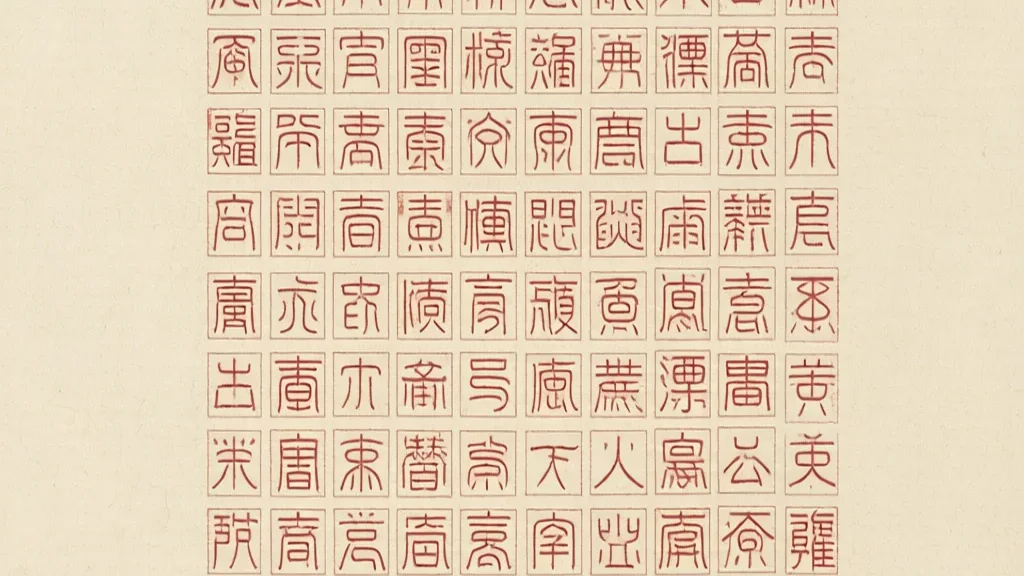
The radical system is the backbone of how Chinese characters are organized, looked up, and understood. A radical is the component of a character that hints at its meaning and serves as its dictionary index. The most influential codification of this system is the Kangxi radicals, a set of two hundred fourteen categories established in the early eighteenth century imperial dictionary that still underlies nearly every traditional character index today. This article explains what a radical is, how the Kangxi system was created, how the two hundred fourteen categories work, how characters are sorted under them, how radicals relate to meaning and pronunciation, and why the system remains essential for learners, lexicographers, and anyone who needs to find a character in a printed dictionary.
What a Radical Is
A radical is a recurring component shared by a group of characters that bear a related meaning. In a character made of several parts, the radical is the part assigned to carry the semantic clue. For example, characters concerning water usually contain the water component, and that component is their radical. Radicals are not always the most visually prominent piece, but they are the piece chosen by convention to index the character. Learning radicals is like learning the drawer labels of a filing cabinet: once you know the labels, finding any character becomes systematic rather than random.
It is important to distinguish a radical from a phonetic component. Many characters are compounds of a meaning part and a sound part. The radical is the meaning part, while the other part may suggest pronunciation. In some simple pictographs there is only one component, which then serves as its own radical. In modern pedagogy, radicals are taught early because they compress the writing system: a few hundred radicals cover the entire dictionary, and recognizing them turns a bewildering mass of characters into manageable families grouped by sense.
Origins of the Kangxi System
The Kangxi radicals take their name from the Kangxi emperor, who reigned in the early Qing dynasty and sponsored a great dictionary to standardize the script. Completed in the eighteenth century, that dictionary arranged characters under two hundred fourteen radicals and became the authoritative reference for later lexicography. The number two hundred fourteen was not invented from nothing; it consolidated earlier radical schemes that had varied in size, fixing a canonical set that printers and scholars could rely on. The choice balanced completeness with practicality, covering the full range of characters then in use.
Before Kangxi, major dictionaries had used somewhat different radical counts, which created confusion when moving between references. By adopting a single standard, the imperial project gave the writing system a stable organizational spine. Later dictionaries, including those used in Japan and Korea for Chinese derived scripts, inherited the same two hundred fourteen categories. The endurance of the system is a tribute to its usefulness: more than three centuries later, a reader trained on Kangxi radicals can still navigate almost any traditional character dictionary without relearning the framework.
The Two Hundred Fourteen Categories
The Kangxi radicals are ordered by stroke count, beginning with the one stroke radicals such as the horizontal line, the vertical stroke, and the dot, and proceeding through increasingly complex components. Each radical is itself a character or a character fragment, and each heads a list of characters that contain it. Some radicals are extremely common, heading thousands of entries, while others are rare and head only a handful. The first radical, a simple stroke, and the later complex radicals together form a complete tree under which every character in the dictionary can be placed.
Because radicals are sorted by stroke count, using them requires counting strokes accurately. A user must first identify the radical of an unknown character, count its strokes, turn to that radical section, then count the remaining strokes of the character to locate it in the sublist. This method demands care, since misidentifying the radical or miscounting strokes sends the searcher to the wrong place. Yet the system is remarkably robust, and with practice it becomes fast. The two hundred fourteen categories are a compact, learnable map of the entire classical lexicon.
How Characters Are Sorted
Within a radical section, characters are listed by the number of additional strokes needed to complete them beyond the radical itself. Thus a character whose radical has three strokes and whose remainder has five strokes is filed under the three stroke radical, then located among the five stroke remainder entries. Dictionaries print these stroke counts explicitly, so the reader scans a short numbered list rather than reading every character. This two level sort, first by radical stroke count then by residual stroke count, is the classical mechanism behind every paper character dictionary.
The system also handles characters whose radical is not obvious. Some components can serve as radicals in one character but appear as mere phonetics in another, so dictionaries include cross referencing rules. A character might be listed under more than one possible radical, or the user must learn conventions such as always checking the left side or the top first. Modern dictionaries add indexes by total stroke count and by pronunciation to reduce frustration, but the Kangxi radical order remains the canonical spine on which these aids are built.
Radicals and Meaning
The power of radicals lies in their semantic grouping. Characters sharing the speech radical tend to concern words, talk, or language. Those sharing the heart radical tend to concern emotion or thought. Those sharing the metal radical tend to concern tools, coins, or hardness. This clustering means that even an unknown character signals its domain through its radical, giving readers a hypothesis about meaning before they consult a definition. The radical is therefore both an index and a miniature dictionary encoded in the character's shape.
Of course the link is a clue, not a guarantee. Over centuries, characters drifted in sense, and some radicals are historical rather than transparent. A character filed under a certain radical may now mean something only loosely connected to that radical's original domain. Still, the statistical tendency is strong enough that radical knowledge dramatically improves guessing and memory. Learners who study radicals report that characters feel less random and more like relatives within recognizable families of meaning.
Radicals and Pronunciation
Although radicals primarily signal meaning, the writing system also uses sound components, and the two often sit side by side in the same character. The radical gives the sense field while the other component suggests how the word sounds. This division of labor is why many characters can be partially read even by beginners: knowing the sound component lets you approximate pronunciation, while the radical tells you the topic. A character for a kind of fish, for instance, may pair the fish radical with a component borrowed for its sound.
The Kangxi system does not index by sound, which is its main limitation in a language with many homophones and tonal distinctions. That is why modern electronic dictionaries add pinyin search. Yet even with sound search available, radicals remain valuable because they group meaning, helping users choose among homophonous characters and understand nuance. The radical and the phonetic component are complementary: one organizes the dictionary by sense, the other helps the mouth say the word.
Using Radicals to Look Up Characters
To look up an unknown character in a traditional dictionary, first decide which component is the radical, counting its strokes to find the right radical section. Then count the strokes of the rest of the character and scan that residual sublist. If the radical is unclear, try the leftmost component, the topmost component, or the component that looks most like a known radical. Many dictionaries provide a table of difficult radicals for characters whose index component is unusual. With a little practice, the method becomes reliable even for complex characters.
Learners benefit from drilling the two hundred fourteen radicals as a set, because recognition is the bottleneck. Flashcard apps now teach radicals separately, then teach characters as radical plus remainder. This mirrors how native speaking children learn: first the meaningful building blocks, then the combinations. Mastering the Kangxi radicals is a one time investment that pays off for every character thereafter, turning the dictionary from a maze into a map.
Legacy of the Kangxi Radicals
The Kangxi radical system survives in digital tools as well as paper. Unicode and major input methods still reference radical based sorting, and many dictionary apps offer a radical plus stroke input mode for characters whose pronunciation you do not know. The two hundred fourteen categories are also taught in calligraphy and historical philology, because knowing the radical of a character often reveals its etymological layer. Even as pinyin search grows dominant, the radical remains the universal fallback and the deepest structural insight into the script.
In the broader East Asian context, the Kangxi system influenced how Japanese and Korean lexicography organized Chinese derived characters, creating a shared infrastructure across several writing traditions. Its stability across centuries is unusual in the history of reference works. For students of Chinese, the lesson is that radicals are not an obsolete scholarly curiosity but a living tool: learn them, and the entire dictionary becomes navigable, the characters become related rather than isolated, and the logic of the writing system finally comes into view.
❓ Frequently Asked Questions
What exactly is a radical in Chinese?
A radical is the component of a character chosen to signal its meaning and to serve as its dictionary index. It groups related characters into families and is the basis of traditional lookup systems.
Why are there two hundred fourteen Kangxi radicals?
The Kangxi dictionary consolidated earlier varying schemes into a canonical set that balanced completeness with practicality, and it became the standard reference adopted across East Asia.
How do I look up a character by radical?
Identify its radical, count the radical strokes to find the section, then count the remaining strokes to locate the character in that section's sublist.
Do radicals always indicate exact meaning?
They give a strong semantic clue but not a guarantee, since character senses drifted over time. Still, the radical usually reveals the general domain of a word.
What is the difference between a radical and a phonetic component?
The radical signals meaning while the phonetic component suggests pronunciation. Many characters combine both, with the radical on one side and the sound hint on the other.
Are Kangxi radicals still useful in the digital age?
Yes. Dictionary apps keep radical plus stroke input for unknown characters, and radicals remain the deepest structural key to understanding how the script is organized.