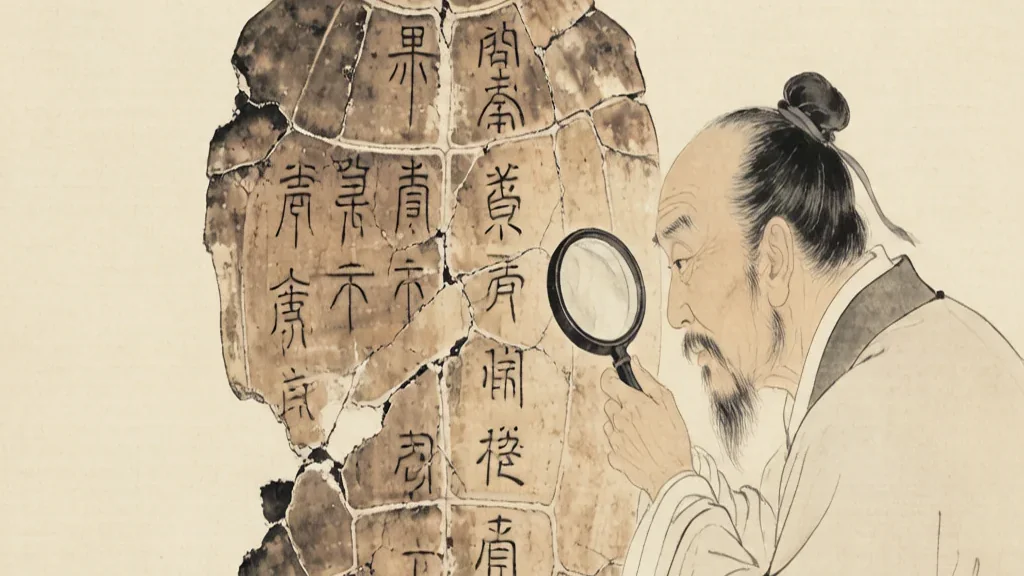
Oracle bone inscriptions are the earliest substantial body of Chinese writing that survives, carved on turtle shells and the shoulder bones of oxen more than three thousand years ago. Produced in the royal courts of the late Shang dynasty, these texts recorded questions put to ancestors and spirits about harvests, weather, warfare, and sickness. Rediscovered by scholars in the late nineteenth century, the bones opened a direct window onto the beginnings of the Chinese script and validated the historical reality of the early dynasties. This article explains what oracle bones are, how they were used in divination, what the inscriptions reveal, how they were discovered and studied, how the script connects to later characters, and why they remain central to understanding Chinese writing.
What Oracle Bones Are
The term oracle bone refers to two kinds of prepared bone: the plastrons of turtles and the flat shoulder blades of oxen. Both were cleaned, smoothed, and sometimes drilled with shallow pits on the back. A heat source applied to these pits caused the bone to crack with a sharp sound, and diviners interpreted the pattern of cracks as an answer from the spirit world. The question and often the outcome were then carved into the bone surface in tiny characters, producing the inscriptions we study today.
These objects are extraordinary because they combine writing, ritual, and archaeology in a single artifact. A single bone may carry the date, the name of the diviner, the topic of the query, and a recorded result. Because the bones were buried and forgotten, vast numbers survived in dry loess soil, protected from decay. Their discovery transformed the study of Chinese history from a matter of legend into a matter of dated, written evidence that could be read and verified.
The Practice of Divination
Shang royalty used bone divination as a routine way to consult ancestors and high spirits. A typical session began with a formulated question, such as whether the coming harvest would be good or whether a military campaign should proceed. The diviner applied heat, read the cracks, and inscribed the query and a prediction. Later, the actual outcome might be added, creating a kind of written archive of predictions and their fulfillment. The practice was both religious and administrative, guiding real decisions about agriculture, ritual, and war.
Divination was highly formalized. Certain kings and officials appear repeatedly as diviners in the records, and the phrasing of questions follows regular patterns. This formality helps modern scholars, because the repeated structure makes the archaic characters more predictable and decipherable. The bones thus reveal not only beliefs but the bureaucracy of a Bronze Age court, where writing served the state and the ancestors together, and where the act of recording was part of governance itself.
Contents of the Inscriptions
The inscriptions cover the practical concerns of a late Shang court. They ask about rain and drought, the timing of rituals, the health of the king, the success of hunts, and the outcome of battles. They name ancestors, places, and officials, and they record sacrifices offered to spirits. The vocabulary is small compared with later literature, but it is startlingly modern in being recognizable Chinese: many characters are ancestors of forms still used today, three millennia later.
Because the texts are transactional rather than literary, they give a frank picture of a society organized around agriculture, kinship, and ceremony. They also provide some of the earliest evidence for Chinese calendrical and astronomical knowledge, noting days and cycles used to schedule rites. For historians, the bones are a treasury: they confirm the existence of the Shang kings named in later chronicles and let us read, in their own words, how an early Chinese state understood its world and its gods.
Rediscovery and Early Scholarship
Oracle bones came to scholarly attention in the late nineteenth century when carved bones were noticed among items sold as traditional medicine in drug markets. A scholar recognized the markings as ancient writing, and the source was traced to a site in modern Henan associated with the late Shang capital. This moment launched a new field, as collectors and researchers raced to acquire and interpret the fragments. The find was revolutionary because it pushed secure written Chinese history back by many centuries.
Early scholars faced the hard task of reading a script no one had seen for thousands of years. They matched bone characters to known forms in later scripts, used the repeated structure of inscriptions, and gradually built a corpus of identified graphs. The work was painstaking and sometimes speculative, but it established the methods still used: compare to bronze inscriptions and classical characters, exploit formulaic context, and verify by accumulation of examples. The bones thereby became the foundation of modern Chinese paleography.
Deciphering the Script
Reading oracle bone script is challenging because the forms are ancient and often abbreviated. Scholars rely on several strategies. They compare bone graphs to the same characters in later bronze and seal scripts, where evolution is clearer. They exploit the formulaic language of divination, which repeats words in predictable slots. And they use modern computational databases that align thousands of inscriptions, letting patterns emerge from volume that no single reader could memorize.
Not every character is solved. A substantial portion of graphs remain uncertain or undeciphered, and readings are sometimes debated. Yet the core vocabulary of the bones is well understood, enough to reconstruct the questions and many answers. Each new identification tightens the chain linking Shang writing to the classical script, showing continuity rather than rupture. The decipherment of oracle bone characters is thus an ongoing, collaborative science rather than a finished achievement.
Connection to Later Characters
The importance of oracle bones lies partly in continuity. Many bone graphs are direct pictorial ancestors of characters still written today, letting us watch the script simplify and standardize over centuries. A bone pictograph of the sun or a person can be traced through bronze, seal, clerical, and regular scripts to the modern form. This lineage proves that Chinese writing is a single tradition stretching more than three thousand years, with observable evolution at every stage.
The bones also show that the principles of the later script were already present. Characters combined meaning and sound, used radicals, and exploited phonetic loans, all in embryonic form. Studying the bones therefore explains not only origins but the deep logic of the mature writing system. For anyone learning Chinese characters, seeing their oracle bone ancestors is revelatory: the abstract strokes of today were once clearer pictures, and the bones recover that lost imagery.
Studying Oracle Bones Today
Modern oracle bone study is a mature discipline combining archaeology, linguistics, and digital methods. Excavations continue to recover new caches, and databases make high resolution images and transcriptions available to researchers worldwide. Machine learning now assists in matching fragmented characters and in clustering similar graphs, accelerating work that once took a lifetime. International conferences and editions keep the field lively and rigorous.
For the public, oracle bones are displayed in major museums, where their tiny carved writing astonishes visitors. They are also a point of national heritage pride, evidence of an unbroken literary civilization. Yet the scholarly value is universal: the bones are among the earliest examples anywhere of a developed writing system used for administration and record keeping. To study them is to stand at the source of Chinese characters and to watch a civilization begin to write its own history.
Oracle Bones in Modern Heritage
Beyond scholarship, oracle bones have become a potent emblem of Chinese civilization's depth. Major museums display select shells and bones as treasures of national heritage, and their tiny carved graphs astonish visitors who realize they are reading the same script used today more than three thousand years ago. The bones feature in exhibitions, publications, and educational programs that present continuity of writing as a source of cultural pride, linking the modern state to its earliest documented ancestors.
The imagery of the bones also feeds contemporary art and design. Calligraphers study oracle bone forms for their archaic energy, and the pictographic ancestors of characters inspire logos, fonts, and crafts that evoke antiquity. In this public role the bones do cultural work beyond paleography: they stand as proof of an unbroken literary tradition and as a reminder that Chinese writing began as a tool of ritual and administration. To encounter an oracle bone in a museum is to confront the literal origin point of the script, and to see how a Bronze Age court's questions to its ancestors became the foundation of a writing system still in daily use.
❓ Frequently Asked Questions
What are oracle bone inscriptions?
They are the earliest substantial Chinese writing, carved on turtle shells and ox bones in the late Shang dynasty to record questions and answers from divination.
How were oracle bones used?
Diviners heated pitted bone until it cracked, interpreted the cracks as spirit replies, then carved the query and often the outcome onto the surface.
What do the inscriptions say?
They ask about rain, harvests, rituals, health, hunts, and war, and they name ancestors, places, and officials of the Shang court.
How were oracle bones rediscovered?
In the late nineteenth century carved bones appeared in medicine markets; a scholar identified them as ancient writing and traced them to a Shang site in Henan.
Are all oracle bone characters deciphered?
No. The core vocabulary is well understood, but a meaningful portion remains uncertain or undeciphered, and readings are sometimes debated.
Why are oracle bones important?
They prove the continuity of Chinese writing over three thousand years and confirm the historicity of early dynasties through direct written evidence.