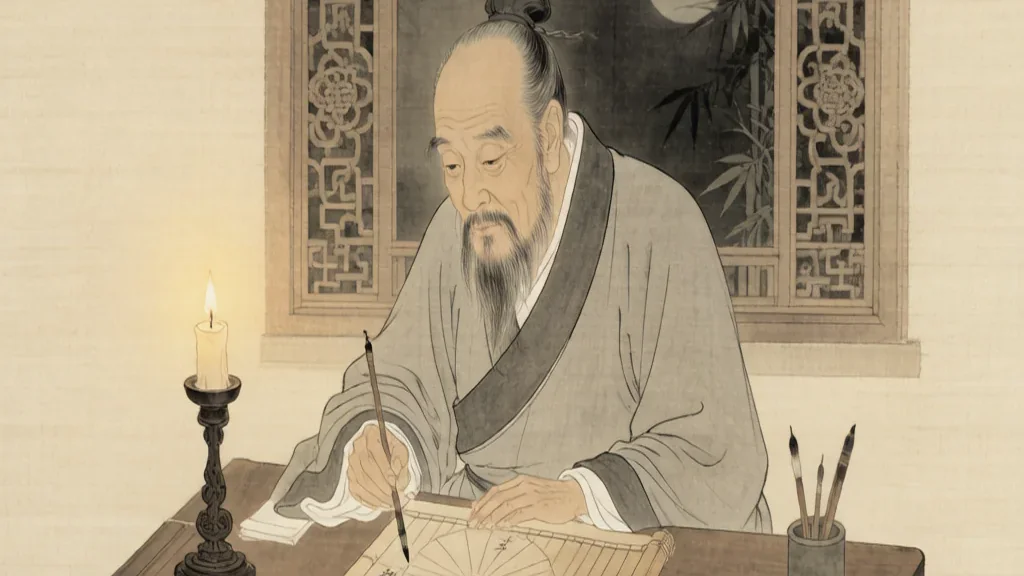
The Shuowen Jiezi (说文解字, "Explaining Graphs and Analyzing Characters") is the oldest surviving Chinese dictionary and the foundational work of Chinese philology. Compiled by the scholar Xu Shen around 100 CE during the Eastern Han dynasty, it catalogues some nine thousand characters, analyzes each into its components, and records the earliest systematic theory of how Chinese writing works. For two thousand years it has been the starting point for anyone seeking to understand character origins, the six-scripts classification, and the worldview encoded in the script. This article surveys its creation, its method, its famous definitions, and its enduring influence.
The Author and His Era
Xu Shen (c. 58–c. 147 CE) was a Confucian scholar and official of the Eastern Han. Living in a period of energetic text criticism and rivalry among interpretive schools, he set out to fix the correct forms and readings of characters so that the classics could be understood without error.
He worked for decades, consulting bronze inscriptions and earlier glosses. The book was presented to the throne in 121 CE, though Xu Shen had by then refined it for years. His goal was explicitly conservative: to preserve the "proper" small-seal forms against the drifting clerical script of his day.
Why the Book Was Written
The immediate motive was scholarly and political. Competing commentaries on the Confucian classics rested on conflicting character interpretations, and Xu Shen believed that errors in reading characters produced errors in statecraft and morality. A definitive analysis of the script was, to him, a matter of good government.
The broader motive was scientific curiosity about the writing system itself. Shuowen is the first work to treat characters not as a flat list but as a structured system built from meaningful primitives according to knowable rules.
Scope and Organization
The dictionary contains 9,353 main entries plus around 1,100 variant forms, organized under 540 radicals. Xu Shen arranged the radicals not by stroke count but by a philosophical logic, beginning with 一 (one) and proceeding through categories he saw as cosmologically ordered.
Under each radical, characters are listed in a set order, and every entry gives the small-seal form, a definition, notes on pronunciation, and an analysis of components. The result is both a reference work and a compressed encyclopedia of Han-period knowledge.
The 540 Radicals
Xu Shen's 540 radicals were the first comprehensive radical system and remained the model until later dictionaries compressed them to 214. He chose primitives that were themselves meaningful, so the radical list doubles as a taxonomy of basic concepts: heaven, earth, humans, plants, animals, utensils.
This taxonomy is revealing. The sheer number of radicals for plants, water, and animals shows how finely classical Chinese分类 the natural world. The dictionary is, among other things, a snapshot of Han-era categorizing instincts.
The Six Scripts (Liushu)
In his postface, Xu Shen laid out the liushu — the six principles of character formation: pictographs, simple ideographs, compound ideographs, phonetic compounds, mutually-explanatory characters, and borrowed characters. This framework became the standard scholarly account of how the script grew.
Although modern linguists refine or question parts of the scheme, Xu Shen's six categories still shape how characters are taught and analyzed. Shuowen is thus the source of the very vocabulary used to talk about Chinese writing.
Famous Definitions
The book is famous for pithy definitions that blend etymology with cosmology. It defines 王 (king) through the three horizontal lines of heaven, earth, and man joined by the vertical ruler. It explains 一 (one) as the beginning from which everything divides. Such entries show Xu Shen reading cosmic order into strokes.
Some definitions are etymologically sound; others reflect Han speculation. Either way they are invaluable, because they preserve pronunciations and forms from before the great dialect splits, a record unmatched for its age.
Small Seal Script as the Standard
Xu Shen used the small-seal (xiaozhuan) script as his reference forms, even though his contemporaries wrote in clerical script. Small seal, standardized under the Qin, was more regular and closer to the underlying component logic than the flattened clerical hand.
By anchoring definitions to seal forms, Xu Shen preserved shapes that might otherwise have been lost. Modern readers use his seal transcriptions to reconstruct how characters looked before clerical and regular scripts reshaped them.
Limitations and Errors
The Shuowen is not infallible. Xu Shen had no access to oracle-bone inscriptions, which were not excavated and deciphered until the twentieth century, so his accounts of the earliest pictographs are sometimes fanciful. He also forced some characters into the six-scripts framework awkwardly.
His cosmological readings of simple graphs are now understood as Han interpretation rather than original intent. Scholars therefore use the book critically, weighing its analyses against archaeology and modern phonology.
Influence Through the Ages
For nearly two thousand years, Shuowen was the required first text for serious students of the classics and of calligraphy. Commentaries, rhyme tables, and later dictionaries all built on it. The Tang scholar Li Yangbing and many others devoted their careers to collating and explicating it.
It shaped the Kangxi Dictionary and every major character dictionary since. Its radical method is the direct ancestor of the lookup systems still taught to students of Chinese today.
The Modern Scholarly Legacy
Today the Shuowen is a primary source for historical phonology, paleography, and lexicography. Its pronunciations, recorded via a fanqie spelling method, let linguists reconstruct stages of Chinese sound. Its seal forms anchor the study of script evolution.
Digitization has made the full text searchable, and facsimiles of annotated editions are widely available. Far from a museum piece, it remains an active research tool for anyone tracing how a character was formed and understood in antiquity.
Commentaries and Later Editions
The Shuowen survived because later scholars annotated and reprinted it. The Tang calligrapher Li Yangbing produced a celebrated seal-script edition that fixed many forms, and the Song scholar Xu Xuan (徐铉) prepared the standard recension still used as the base text today, adding his own notes to distinguish them from Xu Shen's.
Through the Ming and Qing, a stream of commentators corrected miscopied strokes and debated readings, and modern punctuated editions with photographs of old manuscripts make the work far more accessible than the fragile woodblock prints of earlier centuries. This editorial continuity is why a book two millennia old remains usable.
❓ Frequently Asked Questions
What is the Shuowen Jiezi?
It is the oldest surviving Chinese character dictionary, compiled by Xu Shen around 100 CE, analyzing about nine thousand characters by component and meaning.
Why did Xu Shen write it?
He wanted to fix correct character forms and readings so the Confucian classics could be interpreted accurately and the script preserved against drift.
What are the 540 radicals?
They are the organizing heads under which Xu Shen classified characters, chosen as meaningful primitives and forming a taxonomy of basic concepts.
What is the liushu in the book?
The liushu is Xu Shen's six-category theory of character formation: pictographs, ideographs, compounds, phonetic compounds, mutually-explanatory, and borrowed characters.
Is the Shuowen completely accurate?
No. Lacking oracle-bone evidence, some etymologies are speculative, but it remains invaluable for seal forms and early pronunciations.
How is it used today?
It is a primary source for historical phonology, paleography, and lexicography, and its radical method underlies modern dictionary lookup.