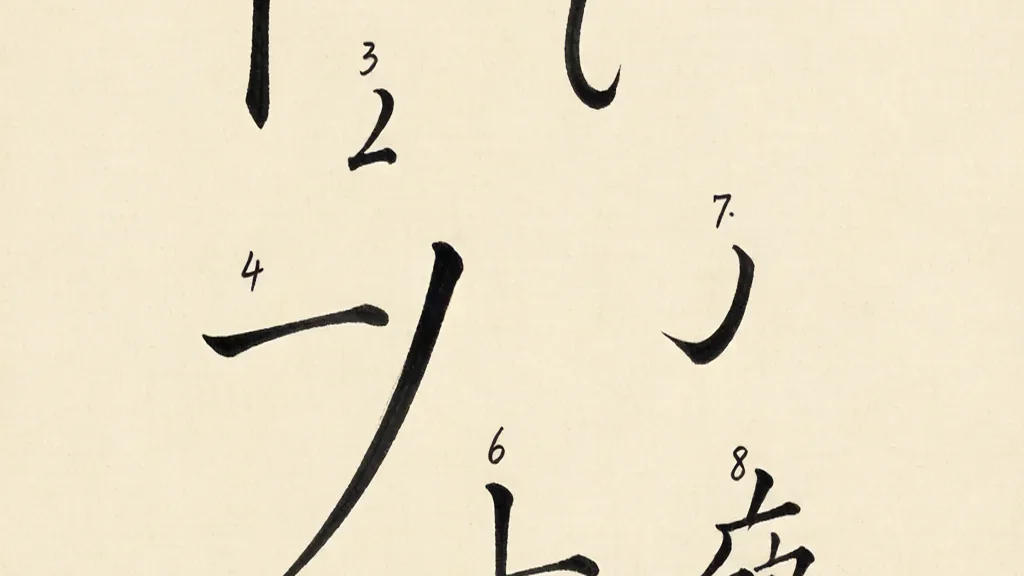
Stroke order is the conventional sequence in which the strokes of a Chinese character are written. Although any order that ends with the right shape might seem acceptable, native writers follow a settled set of rules — left before right, top before bottom, horizontal before vertical, outside before inside — that date back to the regular-script tradition. Proper stroke order is not mere etiquette; it affects writing speed, the balance of the finished character, and the accuracy of handwriting recognition and calligraphy. This article explains the standard rules, why they exist, how they vary across scripts, and how learners can internalize them.
Why Stroke Order Matters
Stroke order grew from practical brush writing. A correct sequence lets the hand move efficiently, keeps the brush or pen from smudging earlier strokes, and produces balanced proportions. Characters written in the "wrong" order often look lopsided even when the final shape is correct.
In the digital age the order still matters. Handwriting-input systems on phones and tablets recognize characters by tracking the stroke sequence, so deviating from convention can cause misrecognition. Calligraphy, of course, depends on order for rhythmic flow.
Consider the character 永, the calligraphy drill: its eight strokes must follow a fixed path — the dot first, then the horizontal, then the vertical hook, and so on — and deviating makes the figure look wrong even to a beginner's eye. The same discipline applies to the simplest characters; 一 is a single left-to-right stroke, but 二 and 三 immediately teach the top-to-bottom stacking rule. Stroke order is therefore taught from the very first lesson, long before a student meets complex characters, because the habit must be formed early to feel natural.
The Core Rules
The foundational rules are few. Write from top to bottom and from left to right. Draw horizontal strokes before vertical ones that cross them. Enclose a frame from the outside in, and close the bottom of a frame last. Symmetry is built from the center outward.
These rules combine into a predictable routine. For 十 (shí, "ten"), one writes the horizontal then the vertical. For 三 (sān, "three"), the top line, then middle, then bottom. The logic is gravitational: build the top and left supports first.
Top to Bottom, Left to Right
The "top before bottom" rule handles stacked characters. In 昌 (chāng), the upper 日 is written fully before the lower one. The "left before right" rule handles side-by-side structures: in 林 (lín, "forest"), the left tree is completed before the right.
When both apply, top-left generally leads. This keeps the writing hand moving downward and rightward across the page, the same sweep used in Latin cursive, which is why the system feels natural once learned.
Horizontals, Verticals, and Crossings
Where a horizontal crosses a vertical, the horizontal usually comes first. The character 丰 (fēng) is drawn with its three horizontal lines before the vertical spine. The exception is when the vertical begins above and is the main axis, as in some central-stroke characters.
For characters with a dominant central vertical, such as 中 (zhōng, "middle"), the vertical is written first as the backbone, then the box around it. The rule bends to respect a character's structural logic rather than apply blindly.
Enclosures and Frames
Enclosing shapes follow an "outside in, bottom last" pattern. In 国 (guó, "country"), one writes the left vertical, top, and right of the outer frame, then the contents, then the bottom closing line. This prevents the inner part from being trapped.
The rule produces tidy boxes and is essential for balanced regular-script writing. Skipping the closing stroke until the end is a hallmark of correct order that learners frequently forget, leaving frames visually unfinished if rushed.
Symmetry and Center-Out
For symmetric characters with a central element, write the center first, then left, then right. In 小 (xiǎo, "small"), the vertical comes first, then the left dot, then the right dot. The central stroke anchors the figure.
This center-out habit also appears in 水 (shuǐ) and similar forms. It reflects an aesthetic ideal: establish the axis, then hang the balanced wings on either side, mirroring the composition of calligraphic works.
Differences Across Scripts
Stroke order is most strictly codified for regular script (kaishu). Cursive and running scripts permit abbreviated, merged sequences that defy the standard rules for the sake of flow. A cursive 书 may be written in a single connected motion impossible to parse stroke by stroke.
Dialect regions and old textbooks sometimes show minor local variants, but the regular-script order taught in mainland, Taiwanese, and Japanese schools is broadly consistent, since all descend from the same calligraphic tradition.
Teaching Stroke Order to Learners
Modern pedagogy introduces order early, with animated diagrams showing each stroke's path and direction. Mnemonics based on the core rules help students predict order even for unseen characters, reducing the need to memorize each one.
Writing practice books (tián zì gé grids) reinforce order by guiding stroke placement. Repetition builds muscle memory, so that after a few hundred characters the correct sequence becomes automatic rather than a conscious choice.
Stroke Order and Technology
Handwriting recognition depends on order. A phone that expects 横 then 竖 will be confused if the user draws 竖 first, especially for characters where either order yields the same pixels. Some systems are tolerant, but correct order improves accuracy.
Interestingly, typing by pinyin or component removes the need for order entirely, which is why many fluent typists have weak handwriting. The order survives mainly through school drill, calligraphy, and recognition software.
Common Mistakes and How to Fix Them
Learners most often err on enclosures, writing the bottom closing stroke too early, or on characters like 乃 and 方 where the order of diagonal strokes is counterintuitive. Another frequent slip is drawing the right component of 火 before the left dots, breaking the center-out logic.
The fix is to pause and name the rule before writing: is this top-bottom, left-right, or an enclosure? Animated models help by exposing the error visibly. Once a learner can predict order from structure rather than memory, these slips largely disappear, and the hand follows the logic automatically.
❓ Frequently Asked Questions
What is stroke order?
It is the conventional sequence for writing a character's strokes, governed by rules like top-before-bottom and left-before-right from the regular-script tradition.
Why does stroke order matter?
It improves writing speed, balance, and calligraphic flow, and it helps handwriting-recognition software identify characters correctly.
What are the main rules?
Top to bottom, left to right, horizontal before vertical, outside-in for frames with bottom last, and center-out for symmetric shapes.
Does cursive follow the same order?
No. Cursive and running scripts merge strokes for flow and often break the regular-script sequence while keeping the final shape.
How do learners memorize order?
Through animated diagrams, the core-rule mnemonics, and repeated practice in grid books that build muscle memory.
Can wrong order still be understood?
A human may read it, but the character can look unbalanced, and recognition software may misidentify it.