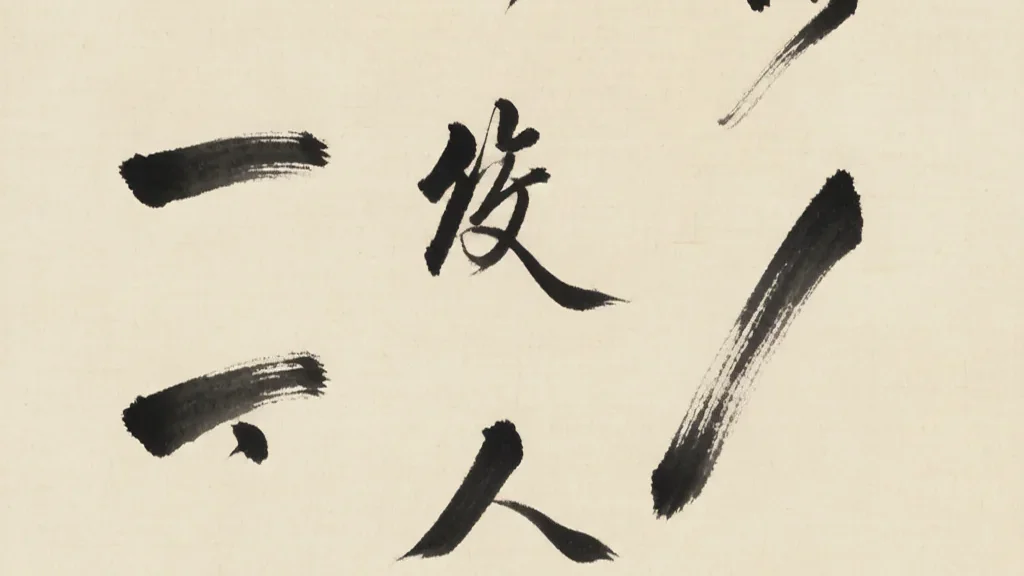
Every Chinese character, however complex, is built from a small inventory of basic strokes — the irreducible pen movements of which the script is made. Traditional pedagogy counts eight "fundamental strokes" (永字八法, the strokes illustrated by the character 永), but modern classification expands this to dozens once variants and compound strokes are included. Knowing stroke types is the first step to writing legibly and to understanding how components fit together. This article surveys the basic strokes, their names, how they combine, and why stroke shape is central to calligraphy and learning alike.
The Eight Principles of Yong
The character 永 (yǒng, "eternal") is famously said to contain eight fundamental strokes, a set known as the "Eight Principles of Yong" (永字八法). Used for centuries as a calligraphy drill, it displays the dot, horizontal, vertical, hook, rising, left-falling, right-falling, and turning strokes.
Mastering 永 was considered a gateway to regular-script writing, because every stroke type in the script appears within it. A student who could render 永 well had, in principle, learned the whole stroke repertoire needed for any character.
Historically the eight principles were codified in regular-script treatises and remain the backbone of calligraphy training, with a student copying 永 until each of its strokes shows the correct beginning, travel, and stop, thereby internalizing the repertoire before tackling characters with more parts. Because the principle is visual rather than phonetic, it crossed dialects: a writer of any region learns the same eight movements, making the stroke set one of the rare points of universal agreement across the whole script, untouched by the simplified-traditional split.
The Dot (Dian)
The dot, 点 (diǎn), is the smallest stroke yet the most expressive. In regular script it is written as a short, controlled diagonal press with a slight taper, often described as a falling stone or a drop of water. Though tiny, its angle and weight set the character's energy.
Dots appear atop characters (主), inside them (玉), and in clusters (学). Their placement must be precise; a misplaced dot unbalances the whole figure, which is why calligraphers give it outsized attention.
The Horizontal (Heng)
The horizontal stroke, 横 (héng), is not a flat line but a gentle rise from lower-left to upper-right, ending with a small check. This slight upward tilt prevents the character from looking like it is sinking and gives regular script its quiet vitality.
In 二 (èr, "two") and 三 (sān, "three"), horizontals are layered with increasing length and subtle angle changes. The stroke seems simple but requires control of start, travel, and stop to avoid a dead, mechanical bar.
The Vertical (Shu)
The vertical stroke, 竖 (shù), comes in two main kinds: a straight "hanging needle" that tapers to a point, and a "dew drop" that ends with a rounded stop. Verticals are the spine of characters like 中 (zhōng) and 十 (shí).
A vertical must be truly upright or deliberately leaning with intent; a wobble reads as weakness. Calligraphers practice verticals endlessly because they reveal a writer's control of pressure and breath better than any other stroke.
The Left-Falling (Pie) and Right-Falling (Na)
The left-falling stroke 撇 (piě) sweeps down and left with a tapering tail, while the right-falling stroke 捺 (nà) presses down and right, ending in a broad foot. Together they form the open arms of characters like 人 (rén, "person").
The contrast between the light, flying pie and the heavy, grounded na is a core aesthetic rhythm. Getting the two to balance — one rising energy, one settling weight — is a milestone in learning to write well.
The Hook (Gou) and Turn (Zhe)
The hook 钩 (gōu) is a short sharp turn at the end of a vertical or other stroke, like the foot of 丁 or the inner tick of 小. The turn 折 (zhé) bends a stroke mid-course, as in the corner of 口 (kǒu, "mouth"). Both add angular complexity.
Hooks and turns are where beginners most often err, either rounding a corner that should be sharp or stabbing a hook that should be restrained. They are the punctuation marks of the stroke system.
Compound and Variant Strokes
Beyond the eight principles, modern lists recognize strokes formed by combining basics: the horizontal-turn (横折), vertical-turn (竖折), and rising stroke (提, tí) that flicks up to connect to the next component. Counting these, standards may list over thirty distinct stroke shapes.
Unicode and input-method design rely on such extended classifications to index and recognize characters. What the eye sees as one movement, the system may catalog as a precise variant, important for handwriting software.
Strokes in Component Formation
Strokes assemble into components, and components into characters. A radical like 木 (mù) is itself four strokes arranged in a fixed way; change one stroke's type and you get a different component. Stroke identity is therefore the foundation of the whole writing system.
This is why stroke-counting matters in dictionaries: characters are first sorted by their number of strokes, then by radical. The stroke is the atom; everything larger is built from it.
Stroke Shape and Calligraphy
In calligraphy, the quality of each stroke — its beginning (起笔), travel (行笔), and ending (收笔) — is the medium of artistic expression. Different scripts stylize strokes differently: seal script makes them uniform and curved; clerical script fattens the horizontal; regular script gives each its full individual character.
A master calligrapher is judged first on strokes. Beautiful composition cannot save weak strokes, while strong strokes can elevate a simple character. The stroke is where technique meets feeling.
Learning the Strokes
Beginners typically drill the eight principles first, then practice them inside real characters. Grid paper (米字格) with diagonal guides helps position each stroke. Tracing and copying models build the fine motor control the script demands.
Because the stroke set is small, it is learnable in weeks, after which attention shifts to combining strokes into balanced components. The investment pays off across every character a learner will ever meet.
Stroke Direction and Pressure
Every stroke has a direction and a life cycle: the start (起笔), the travel (行笔), and the stop (收笔). Regular script typically begins with a hidden "reverse" entry and ends with a checked stop, giving strokes a contained, deliberate feel quite different from the flying freedom of cursive.
Pressure shifts within a stroke — heavier at the start, lighter through the body, firm at the close — create the contrast that makes a character lively rather than mechanical. Mastering this internal dynamics, not just the outer shape, is what separates competent writing from calligraphy, and it is trained one stroke at a time.
❓ Frequently Asked Questions
How many basic strokes are there?
The traditional Eight Principles of Yong list eight, but modern classification extends to over thirty when compound and variant strokes are included.
What is the Eight Principles of Yong?
It is the idea that the character 永 contains eight fundamental stroke types, used for centuries as a calligraphy training drill.
Why is the dot so important?
Though tiny, its angle and weight set a character's energy, and a misplaced dot unbalances the whole figure.
Are horizontals really flat?
No. In regular script they tilt slightly upward to keep the character from looking like it is sinking.
How do strokes relate to components?
Strokes assemble into components like 木, which assemble into characters; the stroke is the atom of the system.
Why do strokes matter in calligraphy?
Stroke quality — start, travel, and end — is the primary measure of a calligrapher's skill and expression.