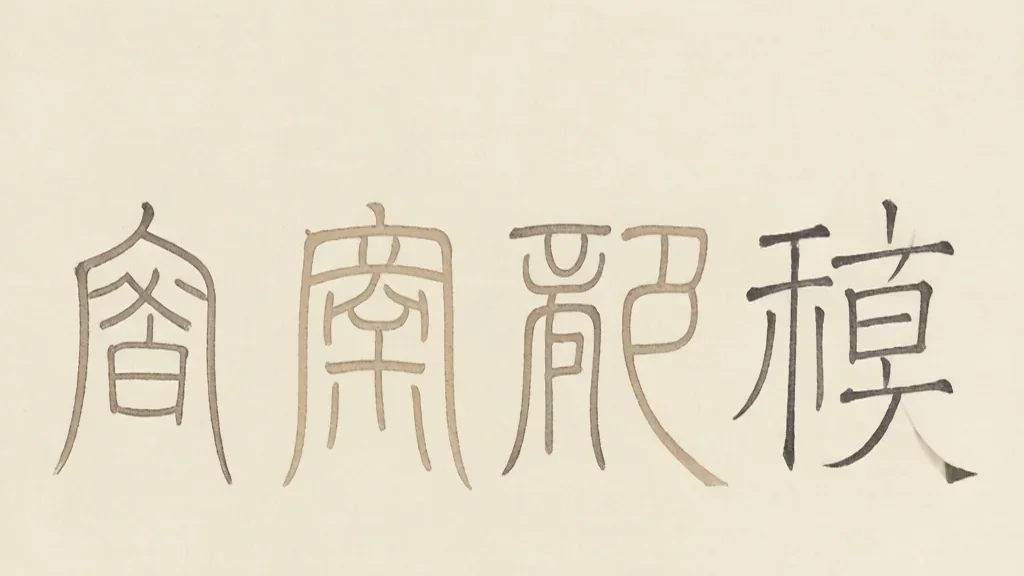
The Chinese writing system did not appear in its modern form but evolved through a sequence of distinct scripts, each shaped by new materials, new administrations, and new artistic ambitions. From the incised cracks of Shang divination to the printed regular script of today, the characters passed through oracle bone, bronze, seal, clerical, and regular forms, with running and cursive emerging as faster hands. Tracing this evolution is to watch a picture gradually become a system: strokes regularize, curves straighten, and meaning is carried less by likeness and more by convention. The story is one of the great continuities of human civilization — three thousand years of the same script, slowly reformed.
Oracle Bone Script (c. 1250 BCE)
The earliest substantial Chinese writing is the oracle-bone script of the late Shang, incised on turtle plastrons and ox scapulae for royal divination. The characters are thin, angular, and pictographic, carved with a bronze knife so curves are rare. Many forms already match later characters closely enough to be read, proving the script's great antiquity. Because the medium was hard bone, the hand is crisp and economical; this is writing at the moment of birth, still half-picture.
Bronze Script (c. 1100–256 BCE)
As the Zhou dynasty elaborated ritual, important texts were cast into bronze vessels. Bronze script (金文) is rounder and more ample than oracle bone, its lines thicker and more decorative, suited to the mold. Characters often swell and turn, and regional variants multiply as the Zhou realm fragments. The cast medium allowed a weight and symmetry impossible on bone, and many characters gained the balanced proportions that later scripts refined.
Seal Script (c. 3rd century BCE)
Under the Qin, the script was standardized into small seal script (小篆), attributed to the minister Li Si. Seal script straightens and unifies the older forms into slender, evenly curved lines with a calm, vertical rhythm. It was the first empire-wide standard, used on edicts, weights, and monumental steles. Though elegant, it was slow to write, and it survives today mainly in seals and decorative inscriptions rather than daily use.
Clerical Script (c. 3rd c. BCE – 3rd c. CE)
The administrative explosion of the Qin and Han demanded speed, and scribes developed clerical script (隶书) on bamboo and wood. Clerical script flattens the round seal forms into square blocks, turns curves into crisp turns, and introduces the signature "silkworm head, goose-tail" sweep of the horizontal. This was the great turning point: the script became practical, legible, and bureaucratic, and most modern stroke shapes descend from it.
Regular Script (c. 2nd–7th c. CE)
Regular script (楷书), maturing through the Wei, Jin, and Tang, fixes the clerical forms into the standard, upright characters taught today. Its strokes are clearly separated, its structure disciplined, and its proportions codified by Tang masters such as Ouyang Xun, Yan Zhenqing, and Liu Gongquan. Regular script is the baseline of literacy and printing; every other script is measured against its order.
Running and Cursive Scripts
Alongside the formal scripts grew faster hands. Running script (行书) links regular strokes with light connections, keeping characters recognizable — the hand of letters and notes. Cursive script (草书) goes further, abbreviating and joining characters into sweeping gestures where legibility yields to expression. These were not degradations but esteemed arts; Wang Xizhi's running-script works are the pinnacle of the tradition, and cursive became a vehicle for pure emotion.
Why the Scripts Changed
The engine of change was the tension between beauty and speed across new media. Bone favored carving; bronze favored casting; bamboo favored brushing; paper and printing favored a fixed, repeatable form. Each new material and each larger bureaucracy pushed the script toward regularity and ease, while calligraphers pulled it back toward individual life. The result is a layered system in which a modern reader can still feel the bones of the oracle through the regular script.
The Evolution Continues
The story did not end with regular script. The twentieth century brought simplification (in mainland China) and the typewriter and computer, which froze forms into fonts yet again. Today a reader of Mandarin meets characters whose deepest shapes were set three millennia ago, even as new scripts — pixel fonts, handwriting recognition — extend the long evolution. The Chinese script is less a fixed code than a living river with identifiable currents.
Reading the Scripts Across Time
One reward of studying evolution is being able to read characters across three millennia. A student who knows regular script can still trace a Tang stele back to its clerical ancestor, and from there to the seal forms on a bronze, and finally to the pictograph on a bone. The thread is continuous: the "water" radical 氵 is the seal 水 flattened, which is the bronze wave smoothed, which is the oracle drop stylized. This legibility across time is rare among the world's scripts; Egyptian hieroglyphs and Mesopotamian cuneiform died and had to be deciphered, but Chinese can be read by its own descendants. The evolution is therefore not just history but a living ladder.
Why the Script Never Became an Alphabet
A natural question is why Chinese did not simplify into an alphabet, as Phoenician and Greek writing did. The answer lies in the language's structure: Chinese is tonal and rich in homophones, so a purely sound-based script would be hopelessly ambiguous. A character like "shi" could mean dozens of things, and an alphabet would lose the sense. The logographic script, by tying form to meaning, keeps clarity across dialects that sound utterly different when spoken. A Cantonese and a Mandarin speaker cannot understand each other's speech, yet they read the same newspaper. The script's resistance to alphabetic reform is therefore not conservatism but a functional adaptation to the very nature of the language.
❓ Frequently Asked Questions
What is the order of the main Chinese scripts?
Roughly: oracle bone, bronze, seal, clerical, regular, with running and cursive as faster hands developed alongside.
Why did clerical script replace seal script?
The Qin and Han bureaucracies needed faster writing on bamboo, so scribes flattened the slow, curvy seal forms into practical square characters.
Who standardized seal script?
The Qin minister Li Si is credited with unifying the script into small seal script as the first imperial standard.
What is the difference between running and cursive?
Running script connects strokes but stays legible; cursive abbreviates and joins characters, often at the cost of easy reading.
How did materials drive the changes?
Bone favored carving, bronze casting, bamboo brushing, and paper printing — each pushed the forms toward a new balance of speed and order.
Is the evolution finished?
No; simplification, the typewriter, and digital fonts are recent chapters in a still-continuing development.