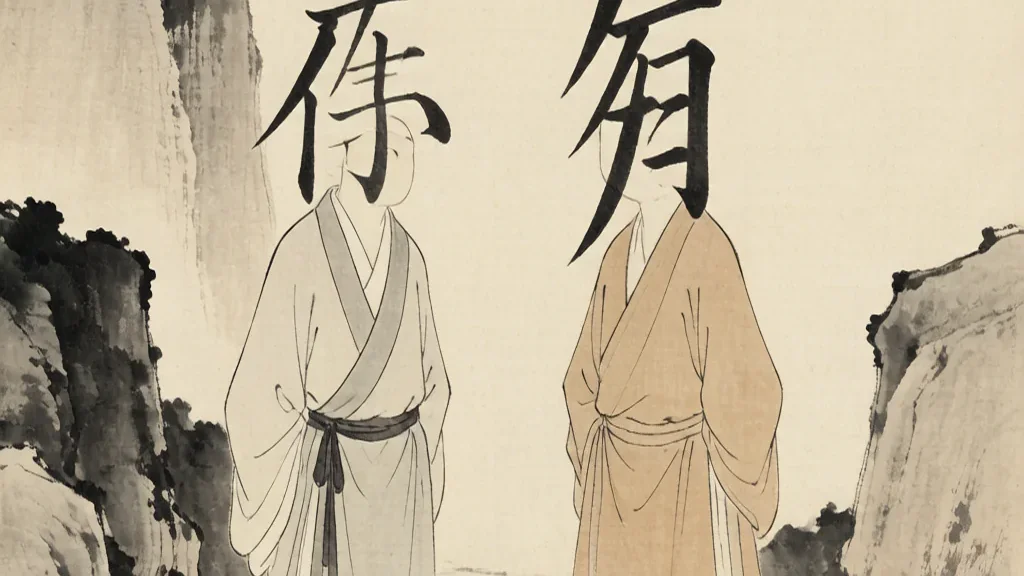
Variant characters (异体字, yìtǐzì) are different written forms of the same word and pronunciation — characters that mean and sound alike but are drawn differently. Far from a modern nuisance, variation is native to Chinese writing: across three thousand years and many regions, scribes, calligraphers, and printers produced alternative shapes for the same word, some based on different etymologies, others on shorthand or aesthetic preference. This article explains what variants are, how they arise, famous examples, their relationship to simplification, and how dictionaries and standards have tried to tame the abundance.
Defining Variant Characters
A variant character is an alternate graphic form of a word that is otherwise identical in meaning and reading. The pair 够 and 夠 both mean "enough"; 峰 and 峯 both mean "peak." A reader meets the same word in two bodies.
This differs from a heterophone (one shape with several readings) or a synonym (different words with near meanings). Variants are true graphical alternatives, interchangeable in the same context, which is what makes them both useful and confusing.
A useful contrast is with 通假 (tōngjiǎ), phonetic loan characters, where one character is borrowed to write an unrelated homophone; that is a different phenomenon from graphical variation. Variants are true doubles of the same word, not sound-based substitutions, so the two categories must be kept distinct when reading classical texts, where both kinds of alternation appear side by side in the same manuscript. Confusing a phonetic loan with a variant can lead a reader to misread a passage as a scribal slip when it is in fact a deliberate sound-based usage, or vice versa.
How Variants Arise
Variation has many sources. Different regions or script stages produced different shapes: a clerical-script abbreviation versus a seal-derived form could both survive. Calligraphers favored fluid variants; stone carvers favored angular ones. Local scribal habits froze into local standards.
Some variants reflect competing etymologies for the same word — one analysis using one radical, another using a different one. Others are simply reversed component orders or swapped phonetics. The script's long life guaranteed that many such forms would coexist.
Examples from Daily Life
Common variants include 群 and 羣 (both "group," with the sheep radical on different sides), 峰 and 峯 ("peak"), 够 and 夠 ("enough"), and 蟹 versus the less common 蠏 ("crab"). In each, the meaning and sound are unchanged.
These examples show the typical patterns: a radical moved from one side to another, a component swapped for a synonymous one, or a cursive shape promoted to print. None alters what the word says.
Variants in Dictionaries
Old dictionaries such as the Kangxi listed variants under the main entry, sometimes with dozens per character. The Shuowen Jiezi already recorded "heavy" (重文) forms. Collecting variants was part of a lexicographer's duty, since a learned reader might meet any of them.
Modern comprehensive dictionaries still note major variants, but everyday dictionaries usually list only the standard form, leaving variants to scholarly appendices. The abundance that was once a mark of literacy is now mostly hidden from casual users.
Variants and Simplification
Simplified characters are, in a sense, a special, officially sanctioned class of variants. The reform picked certain popular abbreviated forms and elevated them to standard, demoting the traditional shapes to "variant" status on the mainland.
This overlap explains why simplification felt natural to many writers: the simplified forms were already familiar shorthand. The difference is that simplification was enforced by policy, whereas classical variants competed freely without a single authority.
Regional Standardization
Standardization reduced but did not erase variation. Mainland China, Taiwan, Hong Kong, and Japan each declared certain forms standard, so a character may have one standard shape in one region and a different "variant" in another, with both used by millions.
For instance, 直 is standard in some regions while 直 with a different interior stroke appears elsewhere; the differences are minor but real. Cross-strait reading is usually easy, but editors must choose a standard per publication.
Calligraphy and Aesthetic Variants
In art, variants are a resource. Calligraphers choose a form for its balance, flow, or historical resonance, and a single text may use several variants of the same character for visual rhythm. Stele inscriptions preserve prestigious ancient variants studied for style.
This artistic freedom contrasts with print uniformity. Where the printer seeks one correct shape, the brush seeks the best shape for the moment, and variant forms give the artist a palette unavailable in alphabetic writing.
Why Variants Persist
Variants survive because the writing system has no single central authority across its history. Characters evolved in many places at once, and old forms linger in inscriptions, family names, and personal seals even after a standard is declared.
Personal names are a stubborn holdout: people often keep a rare or traditional variant of a character in their name for distinction or luck, even when a simplified standard exists. Variation thus lives on in identity.
Managing Variation Today
Modern standards like the mainland's "General Standard Chinese Characters" list and Unicode aim to catalog variants and map them to preferred forms. Unicode encodes many variants so they are not lost, while conversion software normalizes text between standards.
The goal is not to kill variation but to make it manageable: preserve the rich history in databases while giving writers a clear default. Variants become a layer beneath the surface, available when needed and invisible when not.
Variants in Ancient Manuscripts
Excavated manuscripts reveal how freely variants circulated before printing fixed forms. Bamboo slips from the Warring States and Han periods often write the same word in two or three shapes within a single text, and Dunhuang manuscripts show scribes mixing regional and cursive variants without concern.
These finds confirm that variation was the norm, not an error, for most of the script's history. The printed standard is the exception — a recent constraint laid over a tradition of graphic diversity. Manuscript evidence is now essential for editors deciding which ancient variant to restore in a critical text.
❓ Frequently Asked Questions
What is a variant character?
It is an alternate written form of the same word with the same meaning and pronunciation but a different drawing, such as 峰 versus 峯.
How do variants arise?
Through regional habits, calligraphic preference, competing etymologies, cursive abbreviations, and the script's long decentralized history.
Are simplified characters variants?
In effect yes; they are popular abbreviated forms elevated to standard by policy, demoting traditional shapes to variant status on the mainland.
How did old dictionaries handle them?
They listed variants under the main entry, with the Shuowen already recording them as "heavy text" and the Kangxi noting many per character.
Why do variants persist today?
Because no single authority spans the script's history; old forms survive in inscriptions, seals, and especially personal names.
How are variants managed now?
Modern standards and Unicode catalog them, map them to preferred forms, and let conversion software normalize text between regions.