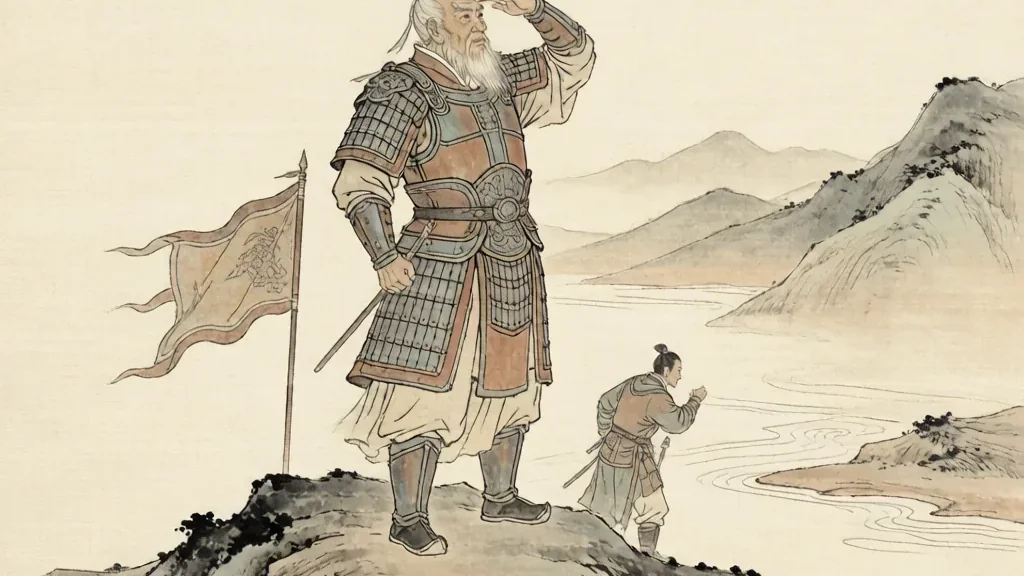
Long before the modern slogan "trust but verify," a Han dynasty general gave Chinese speech its enduring formula for the value of first-hand knowledge: 百闻不如一见 (bǎi wén bù rú yī jiàn) — "hearing a hundred times is not as good as seeing once." The proverb is a quiet revolt against secondhand certainty. It does not say that listening is worthless; it says that no accumulation of reports, however numerous, can substitute for a single direct look. In a culture that also deeply honors books and teachers, the saying carves out essential space for the evidence of one's own eyes — and in an era of endless rumor and filtered images, its ancient counsel feels remarkably modern.
Literal Meaning and the Arithmetic of Trust
The structure is a comparison by quantity. 百 (bǎi) is "a hundred," used loosely to mean "many" or "countless." 闻 (wén) is "to hear" or "to be told." 不如 (bù rú) means "is not as good as" or "cannot match." 一 (yī) is "one," and 见 (jiàn) is "to see." So the line literally weighs one hundred hearings against a single seeing and finds the seeing heavier. The arithmetic is deliberately lopsided — a hundred to one — to make the point unforgettable: quantity of report cannot buy the quality of direct observation.
The saying also implies action. To "see" here is not passive glancing but purposeful inspection, the kind a commander does of a battlefield or a buyer does of goods. The proverb thus praises not just vision but verified, embodied understanding.
Origin in the Book of Han
The proverb is traced to the 汉书 (Hànshū, Book of Han), the official history of the Western Han dynasty compiled by 班固 (Bān Gù) in the first century CE. The anecdote concerns the seasoned general 赵充国 (Zhào Chōngguó), who in his later years was charged with suppressing a revolt among the 羌 (Qiāng) peoples on the northwestern frontier. Court officials proposed sending a large army based on distant reports, but Zhào asked the emperor to let him travel to the border and assess the terrain and the enemy himself. His reasoning, recorded as 百闻不如一见, was that he would rather see the situation once than rely on a hundred accounts.
The emperor granted the request, Zhào surveyed the region, and he devised a strategy of measured, localized campaigns and agricultural garrisons that proved far more effective than the massive expedition others had advised. The proverb therefore comes not from philosophy but from statecraft — a practical lesson that decisions made on hearsay are riskier than those grounded in inspection.
Cultural Context: Empirical Habit Within a Bookish Culture
China is often described as a civilization of texts, yet it has always balanced reverence for the written word with respect for 实 (shí, what is real and concrete). The proverb belongs to a current of Chinese thought that values 实事求是 (shí shì qiú shì, "seek truth from facts"), an attitude that prizes verifying claims against reality. Farmers, merchants, and doctors all relied on direct observation long before it had a name, and the saying gave that everyday empiricism a memorable form.
It also sits comfortably beside the respect for teachers: hearing a master is valuable, but the proverb suggests the student must eventually see for themselves. In crafts and medicine, apprentices learn by watching and doing, not only by listening — exactly the lesson 百闻不如一见 teaches. The saying thus protects experience from being swallowed by authority.
How It Is Used Today
Modern usage is broad. A parent tells a child skeptical of a vegetable to taste it rather than trust a description; a friend insists you visit a city instead of judging it by photos; a consumer is urged to test a gadget rather than believe the commercial. The phrase is the natural ally of "see for yourself" and of documentary or travel content that promises unmediated experience.
In the information age its weight has grown. Facing viral rumors and deepfakes, people invoke 百闻不如一见 to insist on primary sources and physical verification. It is a small but sturdy defense of critical thinking: no matter how many times you have heard a claim, one honest look at the real thing can overturn it. The proverb has become, in effect, an ancient algorithm for separating signal from noise.
Seeing and the Limits of Reports
The proverb also warns about a specific failure of communication: the gap between description and reality. A written report flattens a situation; a rumor distorts it; a single direct view restores proportion. Zhào Chōngguó's frontier insight was precisely that the cost of sending an army on bad information was greater than the cost of one general's journey to look. The saying thus contains an early cost-benefit argument for verification, one any modern investigator would recognize. It prizes the primary source over the secondary account, the witness over the hearsay.
This is why the proverb pairs so naturally with hands-on trades. A cook tastes the dish rather than trusting the recipe's praise; a builder walks the site rather than the survey alone; a doctor examines the patient rather than the chart only. In each case "seeing once" prevents the hundred errors that "hearing a hundred times" might invite. The proverb is, in the end, a compact manual for epistemic humility — knowing the limits of what you have merely been told.
The digital age has only sharpened this lesson. A photograph of a product, a friend's review, or a news clip can all mislead; the proverb nudges us toward primary sources, fact-checking, and physical verification before we act or share. Its ancient counsel — that one honest look outweighs a hundred assertions — is now the everyday discipline of anyone trying to think clearly online.
Legacy and Closing
百闻不如一见 has survived two thousand years because the temptation to trust hearsay is eternal. From a frontier general's prudent request to a modern scroll through conflicting headlines, the lesson is the same: reports are cheap, but a verified fact you have seen yourself is worth more than a hundred untested claims. The proverb does not ask us to stop listening — only to finish the job with our own eyes. To live by it is to keep a healthy skepticism toward secondhand certainty and a steady faith in the evidence of direct experience.