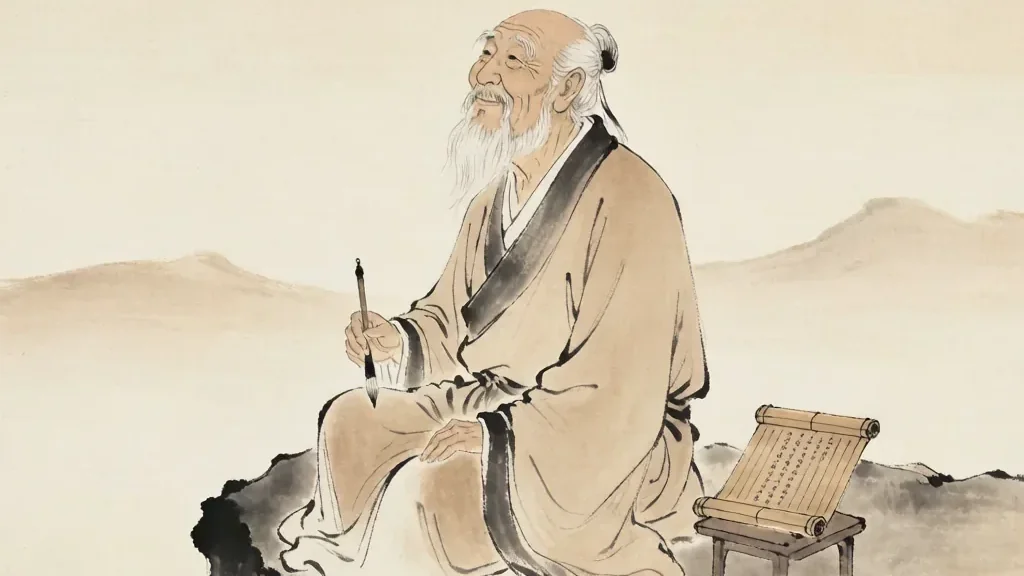
There is a Chinese saying that refuses to let age be an excuse: 活到老,学到老 (huó dào lǎo, xué dào lǎo) — "live until old, learn until old." It is short, rhythmic, and disarmingly simple, yet it carries one of the most demanding ideas in Chinese thought: that education has no finish line. Where many cultures treat schooling as something you complete in youth before "real life" begins, this proverb insists the two are the same thing, and that the moment you stop learning is the moment you start shrinking. For a civilization built on the conviction that character is made through constant self-improvement, the saying is less a piece of advice than a description of a well-lived life.
Literal Meaning and the Parallel Clauses
The proverb is two matched halves. 活 (huó) means "to live," 到 (dào) is "until" or "up to," and 老 (lǎo) is "old" — so 活到老 is "live until old age," a plain statement of a full lifespan. The second clause mirrors it: 学 (xué) is "to learn" or "to study," and 学到老 is "learn until old age." The symmetry is the message: the verb of living and the verb of learning are given the same终点 (zhōngdiǎn, endpoint). They are meant to end together. The rhyme and repetition make it easy for a child to chant and impossible for an adult to forget.
Importantly, the saying does not say "study hard while young." It specifically extends learning into old age, which is a quiet challenge to the idea that the elderly have nothing left to gain. Old age, in this view, is not a withdrawal from growth but its final, freest chapter.
Roots in Confucian Self-Cultivation
The sentiment is ancient even if the exact phrase is folk. Confucius (孔子, Kǒngzǐ) famously summarized his own development: "At fifteen I set my heart on learning; at thirty I stood firm; at forty I was free of doubts; at fifty I understood Heaven's mandate; at sixty my ear was attuned; at seventy I could follow my heart's desires without overstepping the line." That arc — learning as a lifelong ascent — is the seed of 活到老学到老. The Confucian ideal of 修身 (xiū shēn, self-cultivation) assumes a person is never finished; virtue is practiced, not possessed.
The Neo-Confucians later systematized this into 终身学习 (zhōngshēn xuéxí, "lifelong learning"), and the modern slogan simply dresses that ideal in everyday clothes. The proverb therefore belongs to a very long lineage of Chinese thought that treats the mind as a garden to be tended every day, not a field cleared once and left fallow.
Cultural Context: What Counts as Learning
A key to the proverb's warmth is the breadth of the word 学 (xué). It is not limited to books or examinations. It includes mastering a trade, picking up a new skill, learning from one's mistakes, learning from people younger or less experienced, and learning through travel and observation. An old person learning to use a mobile payment app is as much "living the proverb" as a scholar poring over classics. The saying thus licenses curiosity at every stage and removes the shame of not knowing something later in life.
This openness also fits the Chinese respect for 师长 (shī zhǎng, teachers and elders) while paradoxically honoring the reverse: even an elder can have a teacher. The proverb democratizes learning across age, implying that wisdom is not the property of the old alone, nor is youth the only time for study. Everyone, at every age, is both student and teacher.
How It Is Used Today
In contemporary China the proverb has found new urgency. Economic and technological change is so rapid that a skill learned at twenty can be obsolete by forty, so the capacity to keep learning is itself a core competence. The saying underpins a thriving culture of adult education, community "elder universities" (老年大学, lǎonián dàxué) where retirees study calligraphy, dance, and computing, and the widespread pride people take in picking up something new late in life.
It is also a comforting, dignity-affirming message for aging societies. Rather than framing old age as decline, the proverb reframes it as a continuing season of growth — good for mental health and for the social value of the elderly. Parents use it to model curiosity for their children, and teachers use it to argue that graduation is a beginning, not an end.
Learning Across Generations
A lovely feature of the proverb is that it dissolves the usual hierarchy between young and old. In a culture that honors elders, the saying nonetheless insists the elder can still be a student — of a grandchild's phone, of a new recipe, of a changing world. At the same time it reassures the young that learning is not a race won in youth but a long road walked at any pace. Grandparents who take up painting, parents who learn a language alongside their children, and retirees who volunteer to study history all enact 活到老学到老, making the home a place where curiosity has no age limit.
This intergenerational openness matters because it keeps families talking. When an older person admits "I don't know this either, let's learn it together," they model the very humility the proverb praises, and they invite the younger generation to teach — a rare reversal that strengthens bonds. The proverb thereby does more than encourage study; it quietly redesigns how generations relate, replacing silent authority with shared discovery.
The digital era has given the saying new fuel. Online courses, tutorial videos, and language apps mean that an eighty-year-old and an eight-year-old can learn side by side from the same screen, erasing the old excuse that school is only for the young. Far from making lifelong learning obsolete, technology has made 活到老学到老 easier to practice than at any point in history — the only requirement it still demands is the willingness to begin.
Legacy and Closing
活到老学到老 endures because it is both gentle and radical. It asks nothing dramatic — only that you keep your mind open for as long as you draw breath — yet it rejects the comforting lie that we ever "arrive." In a world that rushes people through school and then abandons them to routine, the proverb is a quiet rebellion on behalf of the curious self. To live by it is to agree that the final measure of a life may not be what you achieved, but whether, to your last day, you were still willing to learn.