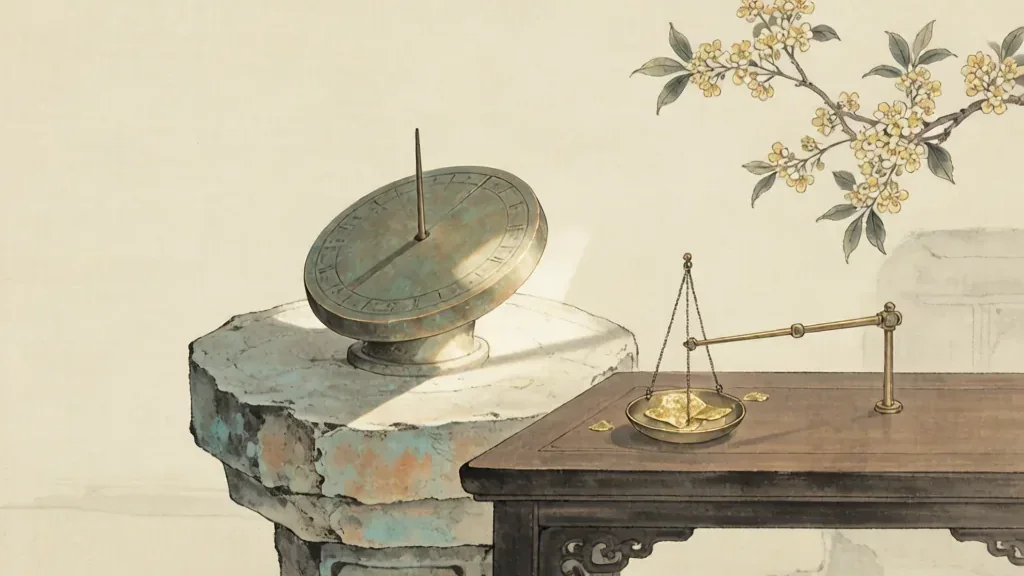
Of all the Chinese sayings that urge people to treasure their hours, none is more quoted than 一寸光阴一寸金 (yī cùn guāng yīn yī cùn jīn) — "an inch of time is an inch of gold." The comparison is striking: it does not say time is like gold, but that a measured unit of time literally equals a measured unit of gold, inch for inch. And the fuller, more biting version adds the punchline that gold cannot buy that inch back. In a culture that has always treated learning as the highest investment, the proverb became the rallying cry of students, the worry of parents, and the quiet reproach of every wasted afternoon. To understand it is to see how Chinese thought learned to weigh time on the same scale as money — and found time heavier.
Literal Meaning and the Metaphor of Light
The saying rests on a small act of measuring. 寸 (cùn) is an "inch," a traditional unit of length still used in Chinese for small distances. 光阴 (guāng yīn) joins 光 (guāng, "light") and 阴 (yīn, "shadow") — the moving sunlight and shade that once told people what hour it was. Together the word means simply "time," but it carries the visual of light sliding across a courtyard. 金 (jīn) is gold. So the line reads: one inch of time equals one inch of gold. The second, often-attached couplet drives the point home — 寸金难买寸光阴 (cùn jīn nán mǎi cùn guāng yīn): "an inch of gold cannot buy an inch of time." Wealth is recoverable; time is not.
What makes the metaphor powerful is that both time and gold are treated as quantifiable strips. Just as you can hold a bar of gold and watch it shrink as you spend it, you can "spend" time and watch it run out. The proverb turns an abstract, invisible flow into something you can almost weigh in your hand.
Origin in a Tang Dynasty Poem
The line comes from 王贞白 (Wáng Zhēnbái), a scholar of the late Tang dynasty, in his poem 白鹿洞二首 (Báilùdòng èr shǒu, "Two Poems at White Deer Grotto"), a famous academy site. The relevant verse goes: 读书不觉已春深,一寸光阴一寸金 — "In my reading I did not notice that deep spring had already arrived; an inch of time is an inch of gold." The speaker is so absorbed in study that the season changed without his noticing, and he pauses to note the cost of those lost hours in gold. From a single literary line the couplet escaped the page and entered the mouths of millions.
The poem's setting — a scholarly retreat — explains why the proverb is so bound up with education. For the imperial examination system (科举, kē jǔ), time spent studying was the single investment that could change a family's fortune, so warning against wasted hours was not sentiment but survival advice. The "inch of gold" was, for a poor student, the literal value of a missed opportunity.
Cultural Context: Time, Study, and Self-Cultivation
Chinese tradition places enormous weight on 勤学 (qín xué, diligent study) and on the idea that a person's character is built in unused hours. The proverb fits a broader family of sayings — 少壮不努力,老大徒伤悲 (shào zhuàng bù nǔ lì, lǎo dà tú shāng bēi, "if you do not strive in youth, in old age you will grieve in vain") — all of which treat time as the raw material of a life. Because Confucian self-cultivation is lifelong, wasting time is not laziness but a failure of character.
The saying also reflects a practical agricultural sensibility: farmers know that planting and harvest windows are brief, so "timing" is wealth. That respect for seasons fed the broader intuition that moments, like weather, cannot be stored or repurchased. The proverb thus bridges the farm and the study hall, honoring both the timely deed and the timely lesson.
How It Is Used Today
In modern China the proverb is everywhere students are. Teachers recite it at the start of a term; parents paste it above a child's desk; study-motivation accounts quote it with illustrations of clocks and coins. Its message has only grown louder in an era of smartphones and infinite scrolling, where the "inch of time" slips away unnoticed — exactly the danger Wáng Zhēnbái described when he lost a whole spring to his books, except now the distraction is cheaper and the loss easier.
Beyond school, the saying appears in productivity advice, time-management seminars, and corporate training, often paired with the Western idea that "time is money" — though the Chinese version is sharper, since it insists time is worth more than money. It is also a gentle, non-preachy way for one friend to nudge another off the couch: just a muttered 一寸光阴一寸金 says everything.
Time as Currency in Daily Speech
The proverb's influence shows up in the many Chinese phrases that treat time as a spendable substance. People speak of 花时间 (huā shíjiān, "spending time"), 省时间 (shěng shíjiān, "saving time"), and 浪费时间 (làngfèi shíjiān, "wasting time") using the same verbs they apply to money, a habit the gold metaphor helped naturalize. The saying also underlies the cultural ideal of 争分夺秒 (zhēng fēn duó miǎo, "fighting for every minute and second"), a phrase used of athletes, rescuers, and students alike. In exam season, banners quoting 一寸光阴一寸金 hang in classrooms and above school gates, turning the couplet into a near-official motto of the education system. The proverb has thus moved from a Tang poem into the infrastructure of how Chinese society talks about, prices, and guilt-trips itself over time.
Legacy and Closing
一寸光阴一寸金 has outlasted the examination halls that bred it because its truth is portable. Whether the "gold" is a scholar's future, an artist's practice, or a parent's fleeting years with a child, the proverb insists that time is the one currency you spend whether you choose to or not. Its genius is the inversion it performs: we usually think gold is the standard and everything else is measured against it, but here time becomes the heavier metal, the one gold cannot buy. To remember the saying is to carry, in six characters, a lifelong reminder that the most precious thing you own is the next inch.