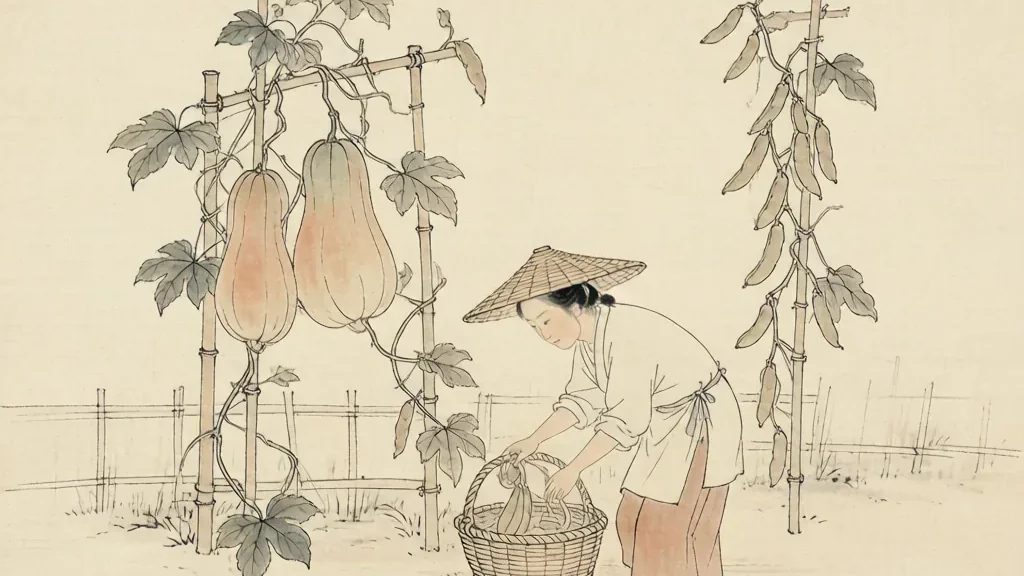
There is a Chinese saying so plain that a child can understand it and so deep that it has carried a Buddhist worldview into everyday speech for over a thousand years: 种瓜得瓜,种豆得豆 (zhòng guā dé guā, zhòng dòu dé dòu) — "plant melons and you get melons; plant beans and you get beans." In the West we say "you reap what you sow," and the Chinese version uses the same agricultural metaphor with even more concrete parallelism. Behind its humble imagery lies one of the most influential ideas in Chinese moral thought: that every action is a seed, and the harvest it brings is determined not by luck but by the seed itself. To explore this proverb is to see how a farming observation became a lesson in personal responsibility.
Literal Meaning and the Parallel Structure
The full saying is built from four short clauses. 种 (zhòng) means "to plant" or "to sow"; 瓜 (guā) is a generic word for melon, including the round 西瓜 (xī guā, watermelon) and the ridged 南瓜 (nán guā, pumpkin); 得 (dé) means "to get" or "to obtain"; and 豆 (dòu) is "beans," standing for any small legume crop. The two halves mirror each other exactly — plant X, get X; plant Y, get Y — which is what makes the line so satisfying to say and so hard to forget. The rhythm of the parallel structure turns a moral point into something almost musical.
On its most basic level the proverb is simply true of agriculture: you cannot sow melon seeds and expect a bean crop. The saying then extends that literal fact into a general law of life. Because the Chinese language loves this kind of balanced couplet, the proverb sits comfortably alongside countless other 农谚 that use planting and harvest as stand-ins for human effort and reward.
Origin in Buddhist Teachings of Cause and Effect
Unlike many folk proverbs that grew from the fields alone, this one entered Chinese through translation. Buddhist missionaries and Chinese monks rendered Sanskrit scriptures into Chinese beginning in the Han and peaking in the Tang dynasty, and they needed vivid images to convey the doctrine of 因果 (yīn guǒ, cause and effect). The metaphor of sowing and reaping appears in the 涅槃经 (Nièpán Jīng, Nirvana Sutra) and in the 法句经 (Fǎjù Jīng, Dhammapada), where it illustrates that wholesome deeds produce wholesome fruits and unwholesome deeds produce suffering. The seed-and-harvest image was already familiar to farmers, so it traveled easily from scripture into the vernacular.
Over the centuries the Buddhist framing faded from everyday awareness. Today a speaker quoting 种瓜得瓜 is rarely thinking of karma or rebirth; the phrase has become a piece of common moral currency. Yet its origin explains why the proverb feels more philosophical than a simple "work hard" maxim — it is really about the moral quality of causes, not just their quantity.
Cultural Context: Responsibility and the Moral Order
In a society that places great weight on 报应 (bào yìng, moral retribution) and on the idea that one's fortune is shaped by one's conduct, the proverb supplies a gentle, non-religious way to remind people of consequences. Confucian education emphasized that character is built through repeated right action, and the "seed" metaphor dovetails neatly with that: small daily choices accumulate into a life, just as small seeds accumulate into a harvest. The proverb thus reinforced both Buddhist and Confucian stress on personal accountability.
It also appears in folk stories and operas, where a villain's schemes boomerang and a kind person's quiet good deeds return as unexpected help. The audience already knows the rule — 种瓜得瓜 — so the plot's justice feels natural rather than imposed. The saying is the invisible grammar of countless Chinese narratives about deserts and rewards.
How It Is Used Today
Modern usage is broad and affectionate. Parents tell children that bullying others plants a bitter seed, while sharing and kindness plant a sweet one — a way to teach empathy without sermonizing. Teachers invoke it to explain study habits: the hours you invest are the seed of your exam results, and no amount of last-minute wishing changes the crop. In the workplace it surfaces as a warning against dishonest shortcuts, since a fraudulent "seed" can only yield a fraudulent "harvest."
The proverb also thrives in self-help and business writing, where it is paired with advice about habits, reputation, and long-term thinking. Because it is so visual, it works in a single sentence where a lecture would fail. To say 种瓜得瓜 is to compress a whole ethical system into four characters and their echo.
The Proverb in Family and Folk Life
Beyond its moral use, the saying shapes everyday folk logic about consequences. Village wisdom applied it to parenting — a child raised with kindness tends to repay kindness, while neglect sows estrangement — and to 邻里 (línlǐ, neighbors), where shared goodwill was treated as a seed that ripens into mutual aid during hard times. It also appears in traditional 家训 (jiāxùn, family instructions), the written rules by which clans taught the young that reputation, like a crop, is something you cultivate rather than inherit. Storytellers used the planting metaphor to explain both fortune and misfortune: a sudden stroke of luck was "a melon planted long ago," and a downturn was "the bitter beans of one's own sowing." Folk diagnoses of family decline — a grandson who forgets his grandparents, a brother who hoards the harvest — were framed as the predictable yield of a bad seed, which made personal accountability feel natural rather than imposed.
This domestic framing gave the Buddhist doctrine a warm, practical home. A grandmother need not mention karma to teach a grandchild that cruelty returns; she need only point to the garden. The proverb thus did quiet cultural work, translating a cosmic law of cause and effect into the small, repeatable lessons of the household, where most Chinese moral education has always happened. It is why the saying feels less like scripture and more like a grandmother's hand on your shoulder.
Legacy and Closing
种瓜得瓜 endures because it speaks to a truth everyone has felt: our lives are the sum of what we have planted. Stripped of its Buddhist scaffolding, it remains a quiet teacher of cause and effect, urging people to look at their actions as seeds rather than isolated events. Whether used by a grandmother correcting a grandchild or a manager coaching a team, the saying carries the calm authority of the field itself — patient, impartial, and impossible to argue with. To live by it is to accept that the harvest, good or bad, was always yours to sow.