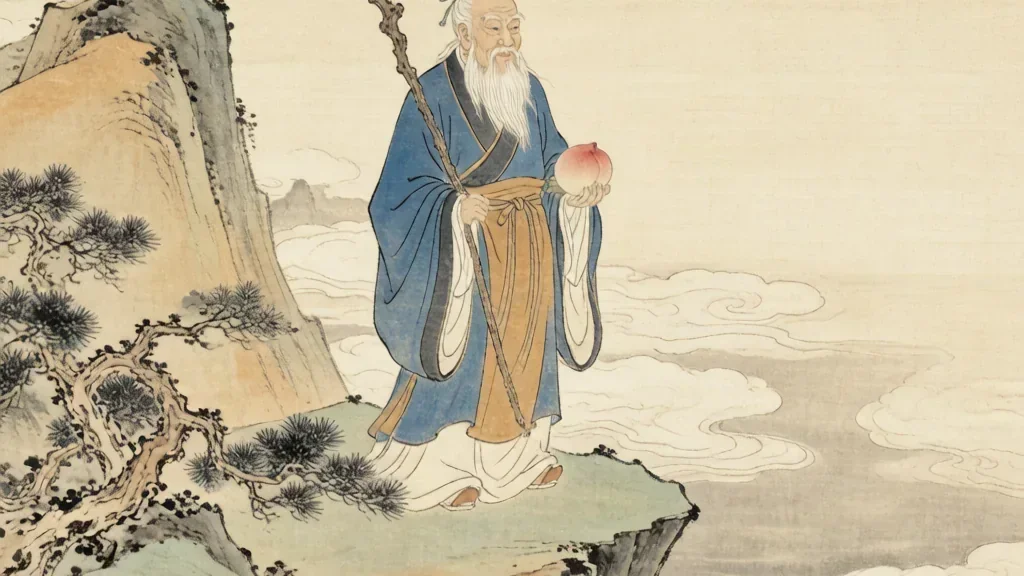
At the farthest west, on the mountain that touches the edge of the world, Chinese myth places one of its most powerful and mysterious goddesses: the Queen Mother of the West (西王母 — ). She is the keeper of the peaches of immortality, the ruler of a paradisal realm, and the mother who separates the Weaver Girl from the Cowherd. Yet her image changed dramatically over the centuries — from a fearsome, tiger-toothed mountain spirit who brought plague and death, to a gracious golden goddess presiding over the banquet of eternal life. To follow her story is to watch a raw natural power soften into a beloved grandmother of heaven.
A Terrifying Spirit of the Mountains
The earliest records describe the Queen Mother of the West in stark, even frightening terms. In the Classic of Mountains and Seas she appears as a being with a leopard's tail, tiger's teeth, and a love of loud wailing, who wears a victory crown and rules the diseases and calamities of the world. She dwells on Mount Kunlun, the pillar-mountain at the cosmic west, a place of jagged cliffs and cold winds where mortals cannot easily go.
This early form is the spirit of the wild west itself — the unknown frontier where the sun sets and where death was thought to come from. She is not evil so much as awesome and amoral, a force of nature who dispenses both ruin and the means to escape it. To meet her was dangerous, for she held the boundary between the mortal and the eternal, and she guarded it fiercely.
Keeper of the Peaches of Immortality
Over time the Queen Mother's most famous role became the tending of the Peaches of Immortality. In her orchard on Kunlun grow peach trees that bloom only once every three thousand years and bear fruit that grants eternal life to whoever eats it. The ripening of the peaches is a cosmic event, and when they are ready she holds a grand banquet to which select immortals are invited. To be seated at her table is the highest reward in the Daoist heaven.
This gift transforms her from a spirit of death into a source of life beyond death. The same goddess who once governed plague now offers the cure for mortality itself. The peaches are the mythic answer to human fear of dying: a fruit, grown at the world's edge, that turns time back. Her orchard is the original fountain of youth, tended by the stern but generous queen.
Her Realm on Mount Kunlun
Mount Kunlun is the axis of the Queen Mother's power, the sacred mountain at the west where heaven and earth meet. Surrounded by walls of jade and guarded by strange beasts, her palace there is a place of perfect stillness and shining stone. Rivers of immortality flow nearby, and the air itself is said to grant long life. Kunlun is both a geographic idea — the great mountain of the west — and a symbol of the inaccessible, the place where the ordinary world gives way to the divine.
The journey to Kunlun is a recurring motif in Chinese lore. Heroes and seekers, from the sage-king Mu to the archer Yi, travel west to find the Queen Mother and beg a portion of her secret. The mountain thus stands for the human longing to reach beyond the mortal span, and the queen who lives there is the gatekeeper of that longing — the one who decides who may pass.
Meetings With Kings and Seekers
One of the most charming tales is the meeting between the Queen Mother and King Mu of Zhou, a legendary ruler who journeyed west in his chariot to find her. They feast, exchange poems, and part with mutual regret, she giving him a warning about the brevity of human glory. The story humanizes both: a goddess who enjoys a clever mortal's company, and a king who learns that even empires are fleeting beside her eternal garden.
Another famous visitor is the archer Yi, who receives from her the elixir of immortality — which his wife Chang'e then drinks, flying up to become the moon goddess. Here the Queen Mother is the source of the very medicine that splits a human couple between earth and moon, tying her directly into one of China's best-loved legends. Her gifts always carry consequences, for immortality is never simple.
The Mother Who Separated the Lovers
In the love story of the Weaver Girl and the Cowherd, the Queen Mother plays the role of the stern mother who will not allow a daughter of heaven to remain with a mortal. With a stroke of her hairpin she draws the Silver River between the two, allowing them only one meeting a year. In this episode her ancient association with separation and boundary returns: she is the keeper of the line between the divine and the human, and she will not let it be crossed for long.
Yet even here she is not cruel without reason. Her task is to preserve the order of heaven, and a goddess married to a farmer threatens that order. The annual meeting she permits shows her mercy — she bends enough to honor love, but not enough to break the rule. In this she is the mature form of the old mountain spirit: still the guardian of boundaries, but now capable of compassion.
From Fearsome to Beloved
The long evolution of the Queen Mother is one of the great transformations in Chinese myth. By the Tang dynasty she was painted as a stately, golden-robed goddess, often surrounded by maidens and attended by the Queen of the East as her counterpart. Folk religion made her a grandmotherly figure who answered prayers for longevity, offspring, and protection. The tiger-toothed wailer of the mountains had become the benevolent "Queen Mother" of popular devotion.
This softening reflects a broader pattern in Chinese religion, where awesome natural powers are gradually drawn into a warm, familial heaven. The Queen Mother's change shows a culture learning to trust the world's edges — to believe that the force which once brought plague might also offer the peach that defeats death. She became safe to love because she became safe to approach.
Why the Queen Mother of the West Endures
The Queen Mother endures because she holds the two things humans fear and want most: death and its defeat. She is the boundary and the bridge, the one who says no and the one who offers the peach. Her double nature — terrible and tender, distant and hospitable — maps exactly the human relation to the unknown.
In the end she is the grandmother of the Chinese heaven, the keeper of the feast to which the worthy are called. To honor her is to hope for a long life and a seat at the table when the peaches ripen. Her long journey from leopard-tailed spirit to golden queen is itself a kind of immortality — a goddess who changed with her people and so was never forgotten.
The Queen Mother in Daoist Religion
As Daoism developed, the Queen Mother of the West was drawn into its pantheon as a high goddess of immortality and a master of esoteric rites. Daoist scriptures describe her presiding over assemblies of immortals and granting secret scriptures to worthy adepts who sought long life. She became especially associated with the cult of immortality, with her peaches and elixirs standing for the devotee's goal of transcending death. In this role she is both fearsome and generous, a tester as well as a giver. Daoist ritual and art often place her at the head of a heavenly court of maidens and purified beings. Her long journey from a leopard-tailed mountain spirit to a central Daoist deity shows how Chinese religion absorbed wild natural powers into a structured heaven while keeping their aura of mystery.
❓ Frequently Asked Questions
📝 Chinese Vocabulary
西王母 — : the Queen Mother of the West, keeper of immortality.
昆仑 — : Mount Kunlun, her sacred western mountain.
蟠桃 — : the flat peach of immortality from her orchard.
长生 — : long life, eternal life, her great gift.
瑶池 — : the Jade Pool, her paradise realm on Kunlun.
玉山 — : Jade Mountain, another name for the Queen Mother's sacred western abode on Kunlun.
九天 — : The nine heavens or highest heaven, where the Queen Mother's court is sometimes placed.
王母 — : Queen Mother, the short form of her title as ruler of the western paradise.
🎉 Fun Facts
- In the earliest texts the Queen Mother had a leopard's tail and tiger's teeth and was associated with plague and death.
- Her peaches of immortality were said to ripen only once every three thousand years, making the banquet a rare cosmic event.
- She gave the elixir of immortality to the archer Yi, which his wife Chang'e drank to become the moon goddess.
- King Mu of Zhou was said to have traveled west in his chariot to feast with the Queen Mother and exchange poems.
- In Daoist texts the Queen Mother is served by a troupe of celestial maidens who tend her orchard and attend her court.
- Her birthday is celebrated in some folk traditions as a feast of longevity, with offerings of peaches and incense.