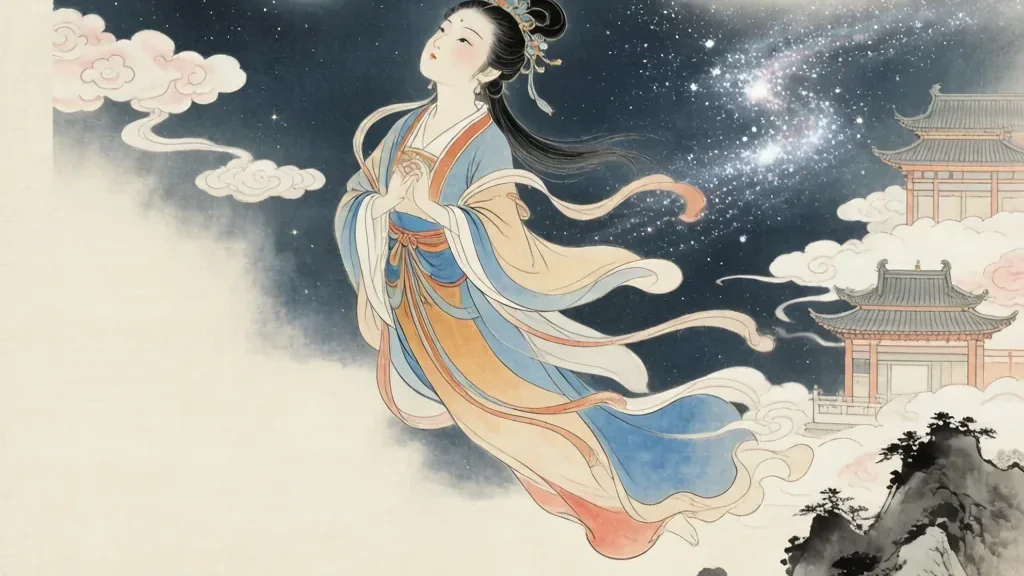
High above the summer sky, where the Milky Way flows like a silver river, Chinese legend places a weaver who longed for the earth. She is Zhiniang, the Weaver Girl (织女 — ), daughter of the Queen Mother of the West and the celestial seamstress who spins the clouds and the very fabric of the heavens. Beautiful, tireless, and lonely, she fell in love with a mortal cowherd, and their separation and single yearly meeting became one of the most beloved love stories in China — the tale behind the Qixi Festival, often called Chinese Valentine's Day. Her story is about duty and desire, the sky and the soil, and the thin bridge of magpies that love builds once a year.
The Daughter of the Queen Mother of the West
In the old astronomy of China, the Weaver Girl is the star Vega, shining in the constellation we call Lyra. She is said to be the seventh daughter of the Queen Mother of the West, the stern and powerful goddess who guards the peaches of immortality on the far western mountain. As a princess of heaven, Zhiniang's task was to weave clouds and robes for the gods, and to clothe the sky in its changing garments of dawn and dusk. Her loom was the loom of the weather itself.
This royal birth explains both her skill and her constraint. As a daughter of heaven she is bound to her work and to the order of the celestial court. She cannot simply wander down to the world of men; her station forbids it. Yet it is precisely this high, fixed station that makes her longing for earth so poignant — she who weaves the sky has never stood on the ground, and the forbidden thing becomes the desired thing.
The Weaver at Her Loom
The image of the Weaver Girl at her loom is one of the most enduring in Chinese poetry. She spins not cloth alone but the very texture of the heavens: the morning reds, the evening golds, the soft grey of rain. In the Book of Songs, the oldest collection of Chinese poetry, she already appears as a figure of tireless, almost sorrowful industry, her shuttles moving while the world below sleeps. The loom is her cage and her identity at once.
What makes her more than a heavenly worker is the hint of feeling beneath the duty. Later legends give her a heart that tires of endless weaving and a glance that falls, one day, to the green earth and the simple mortal tending his ox. The loom that cloths the gods cannot clothe her own loneliness, and that gap between task and tending is where the love story begins.
Meeting the Cowherd
The mortal who caught her eye is Niulang, the Cowherd (牛郎 — ), the star Altair on the opposite side of the Milky Way. In the fuller legend, the Weaver Girl and her sisters descend to bathe in a lake or river on earth, and the cowherd, prompted by his wise old ox, hides her robe so she cannot fly back. They marry, and for a few bright years they live as husband and wife, ploughing and weaving, raising two children. Heaven's princess learns the ordinary joys of a human home.
From the Weaver Girl's side, this episode is a descent from duty into love. She chooses the earth over the loom, the warm chaos of a family over the cold order of the court. The story does not blame her for it; instead it aches with the knowledge that such happiness cannot last, that the sky will call its daughter home. Her love is real enough to defy heaven, but heaven is patient and absolute.
Separation by the Silver River
When the Queen Mother of the West discovers the marriage, she is furious that a heavenly daughter has bound herself to a mortal. She comes down, drags the Weaver Girl back to the sky, and with a single stroke of her hairpin draws a great river — the Milky Way — across the heavens to keep the lovers apart. On opposite banks they weep, two stars that can see each other but never meet, and the story turns from romance to yearning.
The Milky Way as a river of separation is a beautiful piece of mythic astronomy. The two bright stars, Vega and Altair, do sit on either side of the pale band of the galaxy, and the legend gives that silent geometry a heart. Every clear summer night the sky itself seems to rehearse the parting, and the lovers' grief becomes part of the season.
The Bridge of Magpies
The ending is not despair but a fragile mercy. Moved by the lovers' constancy, the Queen Mother allows them to meet for a single day each year, on the seventh day of the seventh lunar month. On that night, so the story goes, all the magpies of the world fly up and form a living bridge across the Silver River, and the two walk toward each other along a span of wings. It is the one night the Weaver Girl leaves her loom for love.
This bridge is the emotional key of the whole myth. Separation is the rule of heaven, but love builds its own passage, however temporary. The magpies — ordinary, chattering birds — become the agents of the impossible, reminding listeners that even small creatures can serve a great devotion. In some versions the weaver's joy is so great that she weeps rain, and that is why Qixi is often a rainy night.
The Weaver Girl in Poetry and Festival
For two thousand years Chinese writers have written of Zhiniang on the seventh night, praying at her shrine for skill in weaving and in needlework, and longing lovers have looked to her as a patron of faithful hearts. The Qixi Festival grew around her story: girls would set out offerings, thread needles by moonlight, and whisper wishes to the weaver for dexterity and for a true match. Though today it is celebrated as a kind of Valentine's Day, its roots are in women's crafts as much as in romance.
In modern times the Weaver Girl appears in film, opera, and song, her tale retold as a defense of love against rigid authority. She has become a symbol of the right to choose one's own heart, and of the quiet heroism of waiting. The star Vega still rises in summer, and with it the old wish: that this year the magpies will come, and the bridge will hold.
Why the Weaver Girl's Story Endures
The Weaver Girl endures because she holds two truths at once: the duty we owe to the world that made us, and the love we owe to the one who shares our days. She is heaven and she is homesick; she is a goddess and a wife; she is skilled beyond measure and still unfinished without the cowherd. Her incomplete happiness is, strangely, why people return to her — she proves that love can be real even when it cannot be complete.
In a culture that values both family duty and the bonds of the heart, Zhiniang is the perfect figure: she does not reject heaven, but she reaches across it. Her single night on the magpie bridge is a small victory that generations have cherished, a reminder that what is forbidden can still be visited, and that the sky itself makes room, once a year, for love.
The Weaver Girl as a Symbol of Women's Skill
For most of Chinese history the Weaver Girl has been a patron of women's crafts, especially weaving and needlework. On Qixi, girls would display their sewing, thread needles by moonlight, and pray to Zhiniang for dexterity and for a good husband, turning the love story into a festival of female skill. This side of the myth honors the everyday artistry of women who spun, wove, and embroidered the cloth of family and court. In poems she is the tireless worker whose shuttles move while the world sleeps, a figure of industry as much as romance. By linking a star to the loom, the tradition gave ordinary women a heavenly model of patience and craft, and made their labor part of the same sky that holds the gods.
❓ Frequently Asked Questions
📝 Chinese Vocabulary
织女 — : the Weaver Girl, the star Vega and celestial weaver.
七夕 — : the Double Seventh Festival honoring the lovers.
银河 — : the Silver River, the Milky Way that separates them.
喜鹊 — : the magpie, the bird that forms the bridge of meeting.
西王母 — : the Queen Mother of the West, the Weaver Girl's mother.
牵牛 — : The Cowherd star, Altair, the mortal lover who sits across the Milky Way from the Weaver Girl.
梭 — : Shuttle, the tool the Weaver Girl moves at her loom to weave the clouds of heaven.
天孙 — : Grandchild of heaven, an old poetic title for the Weaver Girl as a princess of the celestial court.
🎉 Fun Facts
- The Weaver Girl is the star Vega and the Cowherd is Altair, with the Milky Way lying between them just as the myth describes.
- On Qixi, tradition says you should not look directly at the magpies, because their heads are bald from building the lovers' bridge.
- The weaver appears in the Book of Songs, China's oldest poetry collection, over two thousand years ago.
- Qixi is sometimes called Chinese Valentine's Day, though its oldest purpose was girls praying for sewing skill.
- The Weaver Girl is sometimes called the grandchild of heaven in old poetry, reflecting her rank as a princess of the celestial court.
- On Qixi night, folklore says the Weaver Girl weeps for joy at the reunion, and her tears fall to earth as summer rain.