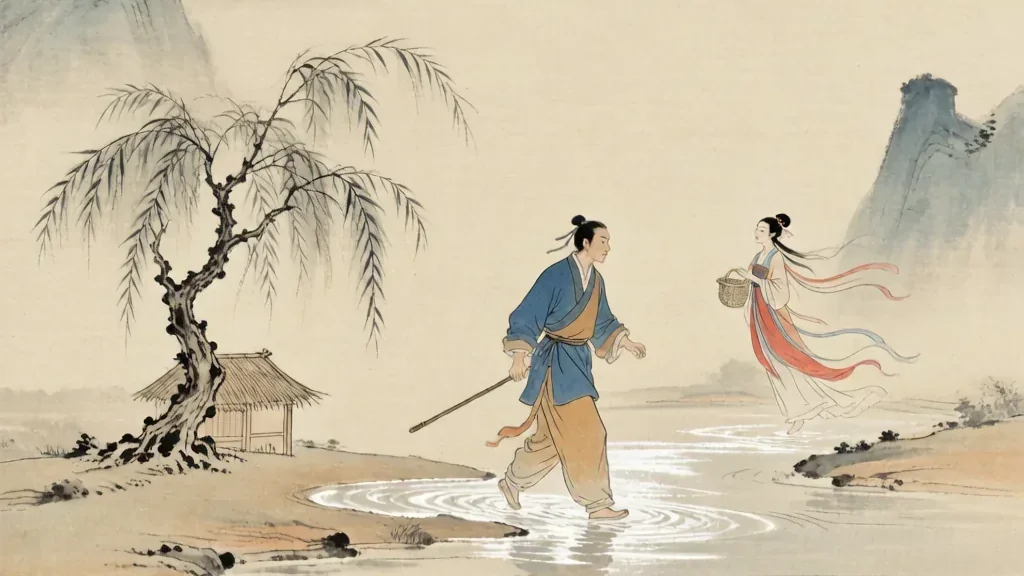
On the earth side of the Silver River stands the other half of China's most famous love story: Niulang, the Cowherd (牛郎 — ), the star Altair. Unlike the Weaver Girl, he is no princess but a poor orphan who tends cattle for a living, a humble man whose only friend is his wise old ox. Yet it is this mortal who wins the heart of a heavenly daughter and whose devotion moves the magpies of the world to build a bridge once a year. The Cowherd's tale is the story of ordinary love against impossible odds — proof in Chinese myth that the smallest, poorest man can reach the stars if his heart is true.
A Poor Orphan and His Ox
The Cowherd begins life as the unwanted younger son of a family, sometimes cast out by a cruel brother and sister-in-law who keep the house and leave him only an old ox. He lives by the fields, sleeping under the sky, tending the beast that is his sole companion. This opening marks him as the classic folk hero: lowly, kind, and unprotected, the sort of person whose reward must come not from rank but from virtue.
His ox, however, is no ordinary animal. In the fullest versions it is a fallen heavenly being or a creature with speech and foresight, sent to watch over the boy. The ox understands the ways of heaven and, when the time comes, it tells Niulang exactly what to do to win the Weaver Girl. The friendship between the poor man and the wise beast is the emotional foundation of the tale, a bond of loyalty that outlasts even death.
The Ox's Strange Advice
The turning point comes when the ox reveals that seven celestial maidens will descend to bathe in a nearby stream or lake. It instructs the Cowherd to hide the robe of the youngest — the Weaver Girl — so that she cannot fly back to heaven. When she rises from the water and finds her garment gone, the Cowherd steps forward, and the ox's plan unfolds. It is a trick, yes, but a gentle one born of matchmaking rather than malice, and in folk telling it is the ox's dying wish fulfilled to see his friend happy.
After the Weaver Girl agrees to stay, the ox's role does not end. As it nears death, it tells the Cowherd to keep its hide, for the hide will one day carry him up to heaven to find his wife. That instruction becomes the hinge of the whole later story: the humble gift of a faithful animal is what lets a mortal cross the sky. The ox, in other words, is the quiet author of the miracle, the one who planned the bridge before the bridge of magpies existed.
Marriage and the Years of Joy
For a few luminous years the Cowherd and the Weaver Girl live as man and wife. He ploughs; she weaves; they raise a son and a daughter, and the household is full of the ordinary happiness that heaven never offered her. The Cowherd, a man who owned nothing but an ox, gains a family and a purpose. The Weaver Girl, a goddess who wove for the gods, learns to cook, to laugh, and to be a mother.
These years matter because they establish what is lost. The story needs the sweetness of the middle before it can break the heart at the end. The Cowherd is not pining from the start; he is a contented husband and father, and that is precisely why the separation cuts so deep. The mortal's brief taste of heaven-on-earth makes the long starlit waiting that follows all the more wrenching.
The Queen Mother's Wrath
The peace shatters when the Queen Mother of the West learns that her daughter has married a mortal and borne his children. Descending in anger, she seizes the Weaver Girl and drags her back toward the sky. The Cowherd, returning from the field, finds the children crying and the house empty. Remembering the ox's hide, he wraps it around himself, takes up his children in two baskets on a pole, and leaps into the air to chase his wife.
Just as he is about to catch her, the Queen Mother snatches a hairpin and scratches a line across the heavens. From that line springs the roaring Silver River, the Milky Way, wide and cold, and the Cowherd falls back to his side of the sky. It is one of the most sudden reversals in Chinese myth — a hair's breadth from reunion, then an ocean of stars between them. The hairpin, a woman's ornament, becomes the instrument of the sternest separation.
The Magpie Bridge and the Annual Meeting
The ending softens through mercy rather than victory. The lovers' grief and the Cowherd's steadfastness move even the celestial court, and the Queen Mother permits them to meet on the seventh day of the seventh lunar month. On that night every magpie in the world flies up and lays its body across the river, forming a feathered bridge along which the two walk to embrace. The Cowherd, the mortal, crosses the sky at last — not by force but by the consent of heaven and the help of small birds.
From the Cowherd's point of view, this single day is the prize for a lifetime of patience. He waits through eleven months of separation for one meeting, and he is said to weep with joy, his tears falling as summer rain. The tale thus grants the poor orphan a kind of immortality: he becomes a star that every child can find, and a husband whose love outlasts distance, rank, and even death.
The Cowherd in Folk Life and Festivals
The Cowherd's story spread from poetry into the daily rhythm of the year. The seventh night of the seventh month became Qixi, the festival built around the lovers, and though it is now known as Chinese Valentine's Day, its older customs centered on girls emulating the Weaver Girl's skill and on couples quietly honoring faithful love. The Cowherd, as the earthly half, made the myth a story ordinary people could claim as their own.
In the countryside the tale was sung by farmers who saw themselves in Niulang — men who rose before dawn, who loved their few possessions, and who measured wealth in family rather than gold. The Cowherd validated a peasant ideal: that devotion and honest labor are themselves a kind of nobility, and that even a man with nothing but an ox can be worthy of a star.
Why the Cowherd's Story Matters
The Cowherd matters because he is the mortal in a world of gods. His victory is not conquest but constancy. He does not defeat the Queen Mother; he simply refuses to stop loving, and in the end that refusal is honored. The myth tells the small and the poor that their feelings are as cosmic as any deity's, written into the same sky that holds the gods.
Together with the Weaver Girl, the Cowherd turns the Milky Way into a love letter. Two stars, a river, and a bridge of birds: this is Chinese myth at its most human, insisting that the widest distance can be crossed, if only for a night, by those who wait for each other. The Cowherd's quiet faith is the reason the story has outlived empires.
The Cowherd in Modern Qixi Celebrations
Today the Cowherd's tale anchors Qixi, often marketed as Chinese Valentine's Day, when couples exchange gifts and meet for dinner. Yet the holiday's older heart was practical and domestic: girls would set out offerings and thread needles by moonlight, praying to the Weaver Girl for skill at weaving and to the Cowherd's household for a good match. In the countryside the story once affirmed a peasant ideal, that a man with only an ox could be worthy of the stars. Modern celebrations blend the two, keeping the romance while remembering the crafts. Each year on the seventh night of the seventh lunar month, the myth returns to everyday life, and the poor orphan who reached the sky becomes, once again, a symbol that faithful love outlasts distance and rank.
❓ Frequently Asked Questions
📝 Chinese Vocabulary
牛郎 — : the Cowherd, the star Altair and mortal lover.
牵牛 — : "leading the ox," another name for the Cowherd star.
老牛 — : the old ox, the Cowherd's wise companion.
鹊桥 — : the magpie bridge across which the lovers meet.
七夕 — : the Double Seventh Festival of the two stars.
织女 — : The Weaver Girl, the celestial princess and star who becomes the Cowherd's wife.
天河 — : The Heavenly River, another name for the Milky Way that separates the lovers.
王母 — : The Queen Mother, the goddess who draws the river between the Cowherd and his wife.
🎉 Fun Facts
- The Cowherd is the star Altair, which really does sit across the Milky Way from the Weaver Girl's star, Vega.
- In many versions the Cowherd carries his two children in baskets on a pole when he flies up to chase his wife.
- The ox's hide is the magical object that lets a mortal rise into the heavens, a gift of loyalty repaid.
- Qixi, built on this story, is often called Chinese Valentine's Day but began as a festival of women's weaving skill.
- In some versions the Cowherd's two children became stars themselves, said to flank Altair as small companions.
- The story is among the earliest Chinese love tales, with references dating back more than two thousand years to the Book of Songs.