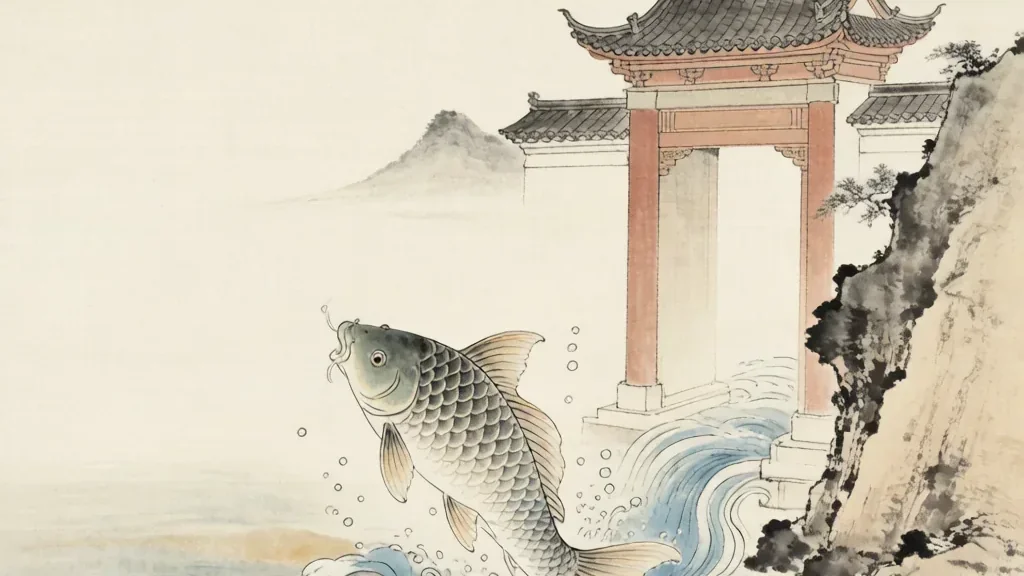
Of all the animals in the Chinese symbolic world, the humble carp carries one of the most hopeful stories. A common fish of rivers and ponds, the liyu (鲤鱼, lǐ yú) is prized not for rarity but for what it does: it swims against the current. Out of that simple fact grew a legend that every child in China learns — that a carp which leaps the waterfall at the Dragon Gate is changed into a dragon. The carp is therefore the emblem of effort rewarded, of the poor boy who through study becomes a mandarin, and of the New Year wish for abundance. It is the fish of upward movement.
The Carp in Nature
The common carp is a sturdy freshwater fish that can grow large and live for decades. It is adaptable, hardy, and famously persistent: it noses along the bottom, stirs the mud for food, and will fight a current rather than drift with it. In the warm rivers of central China the carp was abundant and easy to farm, which made it a staple of the table and, in time, of the imagination. Its golden and red colour forms were especially valued and later bred into the ornamental koi.
What caught the eye of observers was the leap. Carp do indeed jump, clearing the water to pass falls and obstacles, and a school of them battling upstream to spawn reads like a contest of will. Nature supplied the action; legend supplied the gate.
The Legend of the Dragon Gate
The tale is set at Longmen, the "Dragon Gate," a steep gorge on the Yellow River. According to the story, each spring countless carp gather below the cataract and try to leap it. Almost none make it; those that do are instantly transformed into dragons and ride the clouds away. The image is vivid and exact: a lowly fish becomes the mightiest creature in the cosmos by a single act of courage and effort.
This made the carp the perfect metaphor for the imperial examination system. A village youth who passed the gruelling exams "leapt the Dragon Gate" and became a dragon among men — a civil official with power, honour, and the means to raise his whole family. The phrase liyu tiao longmen (鲤鱼跳龙门) is still used for anyone who makes a great leap in status through their own work.
The story also taught a moral about effort. The carp does not become a dragon by birth or by favour; it becomes one by swimming against the current when every other fish drifts with it. That detail mattered in a society that prized self-discipline, and parents told the tale to sons who faced years of study with no guarantee of reward. The waterfall at Longmen was, in effect, the examination hall written into nature: a single act of will, repeated against the odds, that could transform a life. The carp's struggle upstream is still the image Chinese speakers reach for when they want to say that merit, not luck, is what lifts a person.
Exams, Ambition, and the Family
For a thousand years the exam was the main road upward in China, and the carp was its mascot. Mothers embroidered carp on the robes of sons going to sit the tests; painters depicted a carp mid-leap as a good-luck gift to a scholar; and a successful graduate was congratulated with the words that he had jumped the gate. Because one man's success lifted his parents, wife, and children, the carp also carried the family's collective hope.
The symbol appears in the ci lyrics and the folk prints pasted on doors at New Year, where a chubby child astride a carp (or holding one) wishes the household a son who will rise. The carp thus links private effort to public glory, and the dinner table to the throne.
The Carp at New Year and on the Table
The carp is central to the reunion dinner. The word li (鲤) sounds like li (利), "profit" or "advantage," and serving a whole fish promises nian nian you yu (年年有余) — "may you have surplus year after year." The fish is often left partly uneaten so the surplus carries into the next year. A carp, with its dragon-gate meaning, doubles the blessing: gain and advancement together.
Carp is also eaten braised, steamed, or sweet-and-sour across the regions, and the "carp jump" shape — a fish bent as if leaping — is a classic presentation. The animal that symbolises striving is, happily, also delicious, which is part of why it stays so present in daily life rather than only in legend.
The Carp in Folk Prints and the Child
The carp leaps off the page and onto the wall in Chinese folk art. The New Year print lián nián yǒu yú (连年有余, "surplus year after year") shows a plump child holding a lotus and a carp — the lotus, lián, punning on "continuous," and the fish promising abundance. The picture is pasted on doors to bless the household with both gain and a son, since the chubby boy stands for the hoped-for child. The carp here is both prosperity and fertility, the double wish of every family.
Carp also swim through proverbs. Beyond the Dragon Gate leap, people speak of "a carp in a vat" as a clever person penned in, and of "the carp's dart" for a sudden rise. Village ponds were stocked with carp not only for the table but as living luck, and a bride's trousseau might include a carp-shaped ornament wishing her future sons the same upward jump. The humble fish thus carried the whole arc of ambition from the dinner bowl to the examination hall.
From Carp to Koi and Back
The ornamental koi of garden ponds are domesticated descendants of the common carp, selected over centuries for colour. The Chinese revered the carp; later breeders, especially in Japan, turned it into living art. Today a pond of red-and-white koi swimming against the current is the direct heir of the Dragon Gate story — a small, calm reminder that persistence can change a fish into a dragon, and a commoner into a gentleman.