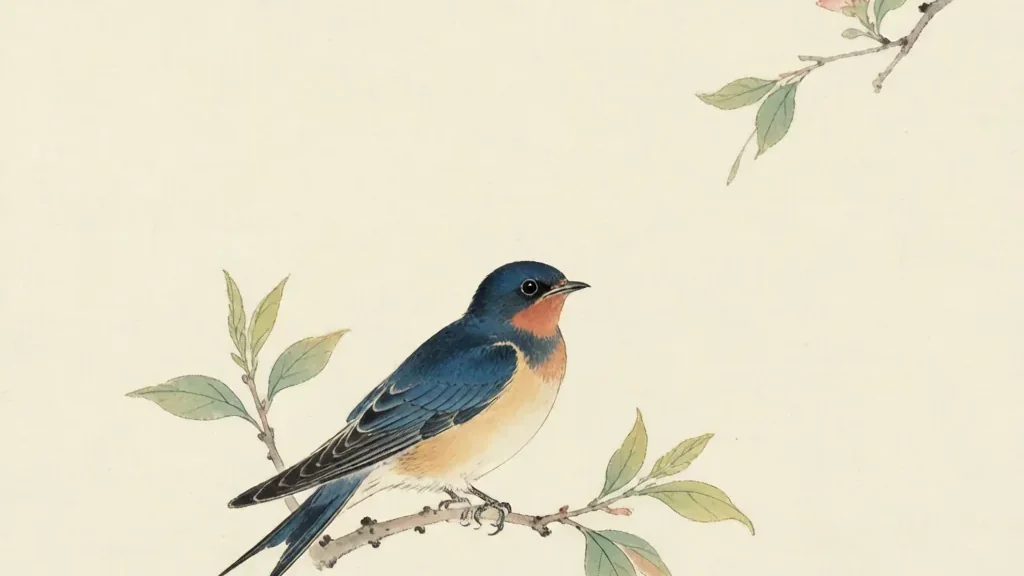
No bird announces the Chinese spring like the swallow. With its swept wings and forked tail, the yàn (燕) slips back from the south each year just as the cold breaks, and for two thousand years its arrival has meant the season has turned. But the swallow is more than a calendar. It builds its mud nest under the family eaves, feeds its young within arm's reach of the hearth, and never harms the people whose roof it shares. In China the swallow is therefore the bird of home itself — of return, of family, and of the quiet warmth of the familiar beam.
The Swallow in Nature
The barn swallow is a slim, agile flier that eats insects on the wing, performing the acrobatics that made it a favourite of observers. It migrates thousands of kilometres between Southeast Asia and northern China, timing its return to the warming north with near-perfect regularity. Unlike the crow or the magpie, the swallow asks nothing of people but a ledge; it gathers mud in its beak and plasters a neat cup under the eave, then rears its brood in plain sight.
This closeness to the house, harmless and helpful, is the root of its meaning. A creature that shares the roof without trouble was naturally read as a guest who brought luck, not a pest to be driven off.
The swallow's seasonal faithfulness also made it a quiet teacher of constancy. It leaves, but it comes back — to the very same eave, year after year, as bands on recovered birds have proved. For a people who valued return — the son to the father, the official to the court, the wanderer to the village — the swallow was a small, yearly proof that departure need not be final. Its return was a comfort and a reproach at once: if the bird remembers the beam, how can the son forget the home? The swallow thus carried a mild moral, folded into something as ordinary as a mud nest under the tiles.
Herald of Spring
Because the swallow's return coincides with the end of winter, it became the standard signal of spring in poetry and painting. The phrase yànzi lái shí (燕子来时), "when the swallows come," opens scenes of new green and soft rain. Farmers watched for it as a natural almanac, and lovers took it as the moment to hope for reunion, since the bird that left had come home again.
The swallow's timing also made it a unit of memory. A wanderer who saw the swallows return in a strange city felt the year turn and his separation deepen — the bird's faithfulness to the season throwing his own distance from home into relief.
The Bird of Home and Family
The swallow's nest under the eave turned it into the emblem of domestic peace. A nest at the beam was taken as a sign that the household was harmonious and fortunate; to knock a swallow's nest down was to invite bad luck and the anger of the ancestors. The bird's paired devotion — swallows mate and return to the same nest year after year — made it, like the mandarin duck, a quiet image of conjugal steadiness, but tied to the house rather than the water.
Children grew up beneath the swallows, and the sight of the mud nest became inseparable from the idea of home. To leave home was, in the poetic shorthand, to leave the swallows; to return was to find them still there, or to mourn that they were not.
The Swallow in Poetry and Memory
Chinese poets use the swallow for both joy and elegy. The Tang poet Liu Yuxi wrote that the swallows which once flew into the great halls of the noble Wang and Xie families now flit into the homes of ordinary folk — a single image that marks the fall of dynasties and the humility of time. A pair of swallows suggests a happy couple; a lone swallow in spring speaks of a separated wife. The bird carries the whole arc from prosperity to remembrance.
In the ci lyrics the swallow often appears with the willow and the screen, small details of a courtyard that stand for a whole lost life. Because the image was shared by writer and reader, a line about swallows could summon an entire home in a few words.
The Swallow, the Willow, and the Cold-Food Feast
The swallow pairs naturally with the willow, the other herald of spring, and painters set the two together as a picture of the season's soft return. At the Cold Food and Qingming festivals the bird takes a literal place at the table: northern families steam buns shaped like swallows, the zǐ tuī yàn (子推燕), in memory of the loyal minister Jie Zitui, and hang them on branches as both food and offering. To eat a swallow at Qingming is to eat the spring itself, and to honour the dead within the same bite.
Children also fly swallow-shaped kites, the paper bird wheeling where the real one nests, so that the symbol of home returns in play as well as in poetry. Regional sayings hold that the first swallow seen in the year should be greeted, not frightened, for it brings the family's fortune back with the warm weather. Between the kite, the bun, and the eave, the swallow is woven into the calendar of the year more tightly than any bird but the crane — a small, constant reminder that home and season rise and return together.
A Name That Built a Kingdom
The swallow's influence reached beyond the poem. The ancient state of Yān (燕), whose name is written with the same character as the bird, gave the north its identity; Beijing is still called the "land of Yan and Zhao" (燕赵, Yān Zhào) after that state. Whether the state was named for the bird or the bird honoured the state, the small creature helped name a region and a capital. In the Qixi tale, too, the swallow is kin to the magpie as a bird of reunion, flying the same skies of love.
So the swallow does what the best symbols do: it connects the sky to the roof, the season to the heart, and the humble nest to the memory of home. To see a swallow is to be told, gently, that spring returns, that families endure, and that whatever left will, if it is faithful, come back.