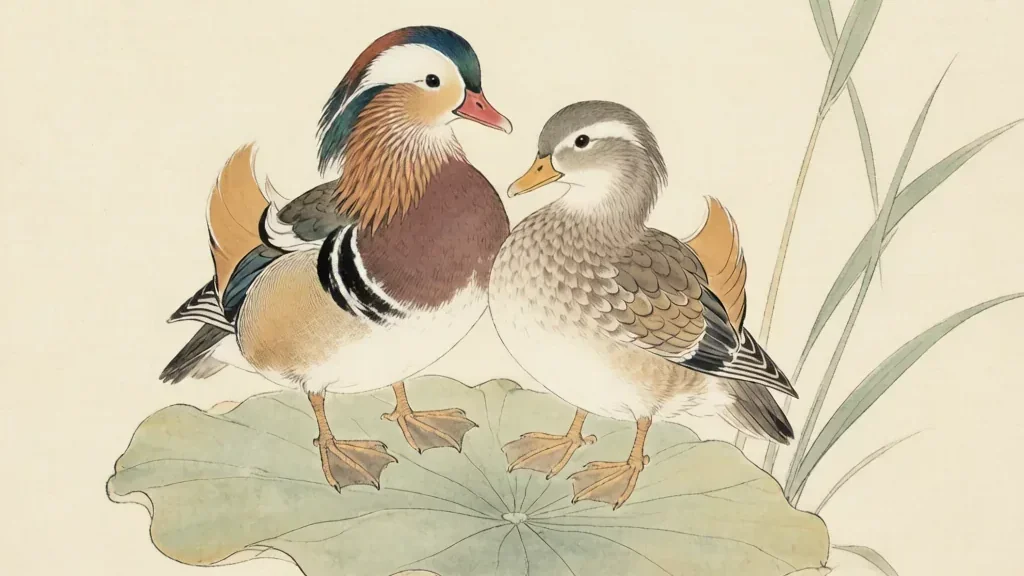
If the crane stands for a long life and the magpie for good news, the mandarin duck stands for something more tender: the love between husband and wife. The yuanyang (鸳鸯, yuān yāng) is a small East Asian perching duck whose male wears a plumage of orange, green, and white like a court robe, while the female is dressed in modest brown. What fixed the bird in the Chinese heart, though, is behaviour rather than feathers — mandarin ducks pair for life and are almost never seen alone. For more than a thousand years a pair of these ducks has been the shorthand for a happy marriage, and a single one the sigh of a lover left behind.
The Duck in Nature
The mandarin duck nests in tree holes near wooded lakes and streams across eastern Asia, an unusual habit for a duck. The drake's breeding plumage is spectacular: a swept-back orange "sail" on the back, a cream-coloured chest, and metallic green flashes on the face. After the season the male moults into a quieter eclipse plumage close to the female's, but the pair bond survives the change. They feed on seeds, insects, and water plants, and they are strong, agile fliers despite their small size.
Most striking to human watchers is the constancy. Mandarin ducks stay together through the year, and the loss of a mate is followed by a long solitary period. This fidelity, visible on any village pond, supplied exactly the quality people wished for in marriage, and so the bird was recruited as a teacher of conjugal devotion.
The Symbol of Married Love
Because the ducks are always in twos, the paired yuanyang became the wish for harmony between spouses. The phrase yuanyang xi (鸳鸯戏, "mandarin ducks at play") is embroidered on bridal pillows and quilts so the couple's rest is blessed with the birds' easy companionship. A single duck, by contrast, signals absence — the wife whose husband is away, the widow, the lover parted by the river. The presence or absence of the second bird carries the whole emotion.
This symbolism is old. The Book of Songs already uses paired waterbirds to open with a picture of proper desire, and later poets made the mandarin duck the standard image of the devoted pair. To call two people yuanyang is still to say they belong together, and the word has outgrown ducks entirely to mean any loving couple.
The duck's lesson was especially pointed in a society where marriages were often arranged. The wish that a couple "be like mandarin ducks" was, in part, a hope that affection would grow where duty had been planted — that two strangers given to each other might, like the birds, stay side by side for life. The image softened the hard edges of arranged union with a promise of companionship, and it gave the bride a gentle ideal to carry into an unfamiliar household. In this way the small duck did quiet cultural work, blessing not just the wedding day but the long, ordinary years the day began.
Weddings, Gifts, and Daily Life
At a Chinese wedding the mandarin duck is everywhere. It appears on the red scrolls, the porcelain, the embroidered coverlets, and the lacquerware given to the new household. Newlyweds receive yuanyang pillows so they may sleep as the ducks sleep, heads touching. The bird is also baked into the language of gifts: a set of mandarin-duck cups or a yuanyang hotpot divided into two broths (one spicy, one mild) is a playful nod to two natures sharing one home.
Beyond the wedding day the image keeps working. An elderly couple who have stayed together for decades may be praised as "old mandarin ducks," and the term colours everything from tea shops to love letters. The duck's lesson is plain and domestic: stay beside the one you chose, through the bright plumage and the plain.
Poetry and the Language of Longing
Chinese poets lean on the mandarin duck whenever they want to speak of love kept or love lost. "The mandarin ducks sleep with heads touching," writes one, "but we are parted by the long river." The fixed pairing means that to mention a lone duck is at once to confess separation, which gives the image enormous compression — a single line does the work of a whole lament.
The bird also appears in the ci lyrics of the Song dynasty, where singers compare the lover's sleeve to a duck's wing or wish to be transformed into a pair that nothing can part. Because the symbol was shared by writer and audience alike, the mere name yuanyang could summon the whole world of faithful, anxious, delighted love without a word of explanation.
Earthly Love Above the Immortals
The mandarin duck's appeal is captured in one famous line: zhǐ xiàn yuānyāng bù xiàn xiān (只羡鸳鸯不羡仙) — "I envy only the mandarin ducks, not the immortals." The speaker says that a lifetime beside the one you love is worth more than cold eternity on a cloud. This sentiment, repeated in plays and songs, turned the duck from a wedding charm into a statement about what makes life worth living: not power or long life, but the daily company of a trusted partner.
The stage took up the image gladly. In the great Kunqu and Peking operas, separated lovers are "a lone duck on the wrong shore," and their reunion is "the pair together again." The duck even threaded into palace poetry, where a neglected concubine compares herself to the single bird while the emperor's favour is "the other duck flown away." Because the symbol was so widely shared, a single painted pair could carry an entire argument about fidelity and loss that needed no explanation.
A Quiet, Enduring Emblem
Unlike the dragon or the phoenix, the mandarin duck asks for nothing grand. It teaches no philosophy and promises no immortality; it simply shows two creatures choosing each other and staying. That modesty is its strength. In a culture that placed family harmony at the centre of a good life, the paired duck was the gentlest possible blessing, and it remains so on wedding days and anniversaries across the Chinese world. To give the image is to wish two people the rarest thing the bird represents: a companion who never swims away.