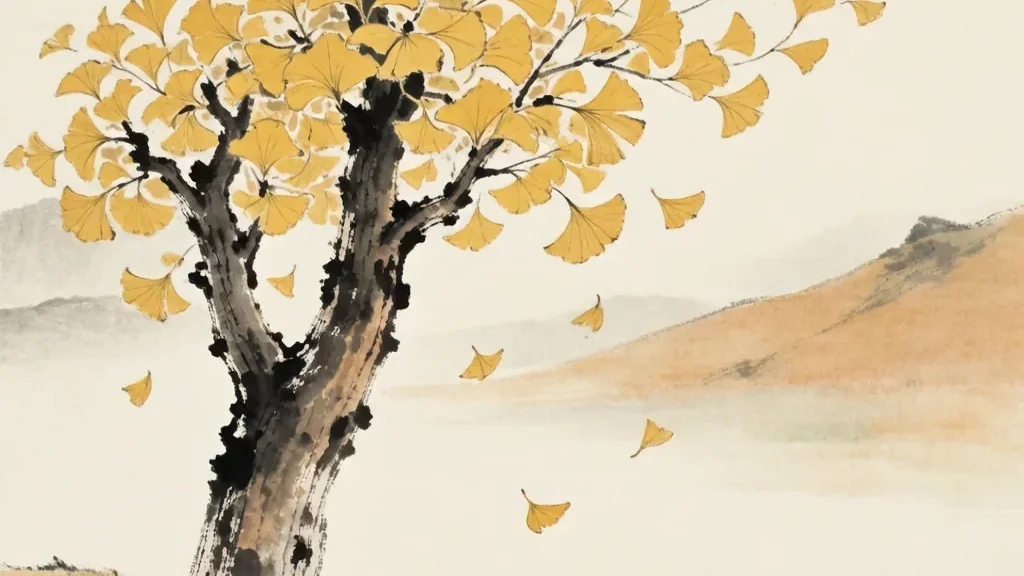
Yínxìng (银杏) is the Chinese name for the ginkgo, the maidenhair tree—a species so ancient that it is often called a living fossil, the lone survivor of a plant lineage that once spanned the globe. Revered in China for its great age, golden autumn foliage, and edible seeds, the ginkgo has stood for centuries in temple courtyards and village squares, a silent witness to changing dynasties. Its fan-shaped leaves and remarkable hardiness have made it both a sacred tree and a modern city favorite, a plant that seems to bridge the deep past and the busy present.
A Survivor From Deep Time
The ginkgo is the only living species of a very old group of plants, distinct from conifers and flowering trees alike. Its relatives flourished long ago and then mostly disappeared, leaving this single survivor cultivated by humans. Scientists value it as a window into the plant life of ancient eras.
Its leaves are unlike any other tree's: flat, fan-shaped, often notched at the tip, with veins that fork in a pattern found nowhere else. In autumn they glow yellow and then drop in a sudden golden shower, a spectacle that has made the tree famous far beyond its native land.
China as Its Homeland
Though ginkgos are now planted around the world, their spiritual and historical home is China. Old trees still stand at temples and in mountain villages, some reputed to be many hundreds of years old, and a few remote stands in the southwest are thought to be close to truly wild populations.
Chinese people have long cultivated the ginkgo for shade, beauty, and food, treating ancient specimens with respect. Temples in particular acted as guardians of the species, keeping trees alive through centuries when wild forests shrank.
How the Tree Lives
A mature ginkgo is a tall, straight tree that can live for many centuries and, in favored spots, possibly over a thousand years. It is dioecious, meaning each tree is either male or female; only females bear the fleshy seeds, while males release pollen.
Ginkgos resist pests, disease, and the stresses of city life, which is why they are planted along streets and in parks. Their calm, upright form and tolerance of pollution make them unusually good urban companions, able to thrive where many trees fail.
The Edible Seed
The ginkgo seed, called báiguǒ (白果, "white fruit"), is a traditional food especially in the south. The seed inside the fleshy coat is cooked—boiled, roasted, or added to soups and festive dishes—and valued for its texture and mild flavor.
Tradition teaches eating it in moderation, since raw seeds contain compounds that can be harmful in large amounts; cooking and restraint are the rule. As an ingredient it appears in banquet dishes and sweet soups, a subtle nod to the tree's bounty.
Trees of the Temples
Ginkgos have long been planted at Buddhist and Daoist sites, where their endurance mirrors the lasting nature of the teachings and their golden canopy lends solemn beauty to sacred grounds. A venerable ginkgo beside a hall is a familiar, revered image.
Communities often protected these trees when clearing land, and local stories attribute guardian powers to them. The link between ginkgo and temple is thus both practical and symbolic, tying the living tree to continuity of place and memory.
The Golden Fall
The ginkgo's autumn display is one of its great charms. The whole canopy turns yellow within a short span, and then, often after a cold night or a gust of wind, the leaves fall almost together, laying a luminous carpet beneath the trunk.
People gather wherever fine old ginkgos grow, photographing and walking through the fallen leaves. The clean fan-shaped leaf is also kept as a bookmark or craft material, so the tree enters homes as a small golden memento of the season.
What It Symbolizes
In Chinese symbolism the ginkgo stands for longevity, steadfastness, and continuity across generations—fitting its great age and survival through ages. Planted in pairs at gates and shrines, it can also suggest harmony and unity.
Because it outlives the people who plant it, the ginkgo embodies the bond between ancestors and descendants, a living monument rather than a carved one. To rest in its shade is, quietly, to sit with deep time.
From Folk Use to Modern Science
Beyond food, ginkgo leaf extracts are widely used in herbal and supplementary products studied for effects on circulation and memory, though such claims deserve careful judgment. Traditional practice valued the plant too, especially the seed.
Modern botany treasures the ginkgo as a research subject precisely because it survived from another era, and its genetics are studied for what they reveal about plant evolution. The tree thus belongs both to folk custom and to the laboratory.
A Civic Tree of Today
Today ginkgos line avenues and fill parks in many Chinese cities, loved for their tidy shape, golden fall color, and toughness against smog and compacted soil. Their regular habit makes them easy to set in rows, giving streets a peaceful, formal rhythm.
Some cities are known for ginkgo avenues that draw autumn crowds. The tree's journey from temple yard to urban boulevard shows how an ancient plant can become a modern companion without losing its quiet authority.
Between Past and Present
The ginkgo is neither fully conifer nor flowering tree, neither wholly wild nor wholly tamed, and it stands between the deep past and the present moment. Few plants invite reflection on endurance in a changing world as plainly as this one.
Whether silent by a mountain monastery or glowing above a city crossing, the ginkgo carries the same message: some things last, and their quiet survival is its own wonder. It is, quite literally, a tree out of the past still growing among us.
Folk Beliefs and Place Names
In many villages the old ginkgo was more than a tree; it was a local landmark and sometimes a silent witness to oaths, gatherings, and farewells. Place names in several regions recall stands of yínxìng, tying the plant into the map itself and into everyday speech.
Folk belief credited great trees with a steadying influence over a place, and communities protected them when clearing fields. These gentle customs, passed by habit rather than by law, helped carry ancient ginkgos into the present alongside the temples that sheltered them, so that the living fossil also became a keeper of local memory.
❓ Frequently Asked Questions
Q: What is special about the ginkgo tree?
A: The ginkgo tree (银杏, yínxìng), also called the maidenhair tree, is a 'living fossil' that has existed for over 200 million years. It is the only surviving species of its division and has remained virtually unchanged since the Jurassic period.
Q: What does the ginkgo symbolize in Chinese culture?
A: The ginkgo symbolizes longevity, resilience, and hope. Its fan-shaped leaves are associated with the yin-yang concept. Ginkgo trees are often planted at temples, and some trees in China are over 1,000 years old. The tree survived the atomic bombing of Hiroshima, becoming a symbol of endurance.
Q: What are the health benefits of ginkgo?
A: Ginkgo biloba extract is one of the most popular herbal supplements worldwide. It is believed to improve memory and cognitive function, increase blood circulation, and provide antioxidant benefits. Traditional Chinese Medicine uses ginkgo seeds (白果) for respiratory health.
Q: Where is the best place to see ginkgo trees in China?
A: Guangdong's Nanxiong Ginkgo Valley has over 100,000 ginkgo trees. The Ginkgo Avenue in Beijing's Diaoyutai area turns spectacularly golden in November. Xi'an's Guanyin Ancient Ginkgo tree is over 1,400 years old and is one of the most photographed trees in China.
Q: Why is ginkgo called a living fossil?
A: It is the last survivor of an ancient plant group with no close living relatives, and its form has changed little over immense spans of time.
Q: Is the ginkgo native to China?
A: Yes; China is its deepest home, with old cultivated trees at temples and some remote stands thought close to wild populations.
Q: Can you eat ginkgo seeds?
A: The cooked seed (baiguo) is a traditional food eaten in moderation, since raw seeds contain compounds that can be unsafe in quantity.
Q: What does the ginkgo symbolize?
A: Longevity, endurance, and continuity, fitting its great age; it also suggests unity when planted in pairs.
Q: Why are ginkgos planted in cities?
A: They resist pests, disease, and pollution, have a tidy upright form, and turn brilliant gold in autumn, suiting avenues and parks.
Q: Are all ginkgo trees the same?
A: No. Trees are male or female; only females bear the fleshy seeds, whose fallen fruit can have a strong odor.