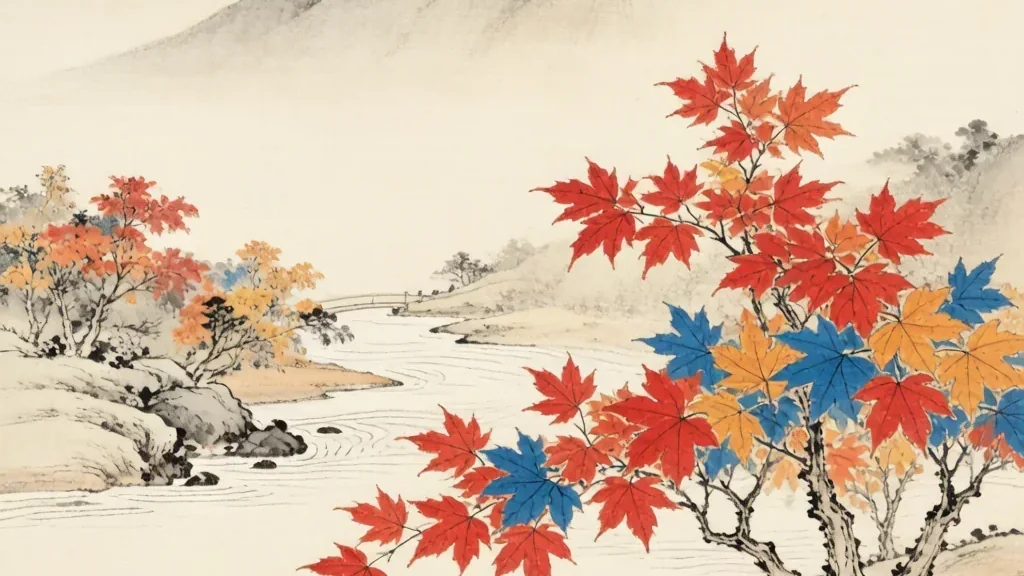
When autumn paints the mountains of northern China, no color burns brighter than the maple — 枫 (). Its leaves turn from green to gold to a deep, almost bloody crimson, and whole hillsides seem to catch fire. For the Chinese, the maple is the undisputed flame of autumn: a symbol of late-year splendor, loyal love, and the bittersweet beauty of things that do not last. To walk a maple grove in October is to understand why Chinese poets called the season the most poetic of all.
The Maple as the Flame of Autumn
Several maple species grow in China, from the Himalayan Acer campbellii to the widespread Acer palmatum and the trident maple. What unites them is the autumn show. As days shorten and nights cool, chlorophyll fades and the leaves blaze red and orange, a transformation Chinese writers described as "mountains dyed with fire" (霜叶, , "frost leaves").
The maple's timing is its meaning. It peaks just as the year turns cold, offering one last explosion of warmth before winter. This made it the natural emblem of autumn's glory and its sorrow — beauty that is also a farewell. Northern parks like Beijing's Fragrant Hills (香山) become famous for maple viewing, drawing crowds who come, like the poets, to stand before the burning slopes.
Maple Leaves and Poetry
The Tang poet Du Mu wrote the most quoted maple line: "Stop the carriage, seated for love of the frosted maple grove at evening; the frost leaves are redder than the flowers of February" (霜叶红于二月花). The poem flips expectation — autumn's leaves outshine spring's flowers — and turns the maple into a champion of late beauty over early youth.
Maple seeds, with their twin wings, were called 飞罗 and the leaves' pointed lobes invited comparison to a traveler's palm or a loved one's letter. Poets used the maple to mark roads, rivers, and parting places, much as the willow marked farewells in spring. Where the willow wept for departure, the maple burned for the melancholy of the ending year — two plants bookending the emotional calendar.
The Maple and Loyal Love
A tender legend tells of two lovers, 枫 and a maiden, separated by fate, who were transformed into maple trees on opposing hills so they could face each other forever. The paired maples became a symbol of steadfast, undying love — a love that, like the tree, only grows more vivid with the cold. In some regions, women planted maples to wish for faithful husbands.
This romantic reading joined the maple to the broader Chinese language of flowers, where each bloom or leaf carried a feeling. The maple's red, the color of happiness and also of the heart's blood, made it especially apt for love that endures hardship. A maple leaf pressed in a letter was a token as eloquent as any written word — a small, flammable emblem of devotion.
Maple, Frost, and the Seasons
The Chinese admired the maple precisely because it needed frost to reach its peak. The phrase 经霜 (, "to undergo frost") praises things that improve through hardship, and the maple is its living proof: only cold brings out the red. This mirrors a cultural esteem for resilience — the person or plant that grows finer under pressure.
In the lunar calendar, maple viewing belongs to late autumn, just before the cold-deep months. Families made outings to the hills, carrying wine and verse, to feast their eyes before winter stripped the trees. The custom parallels the spring excursion to see willows and the summer gaze at lotus — a yearly circuit of botanical pilgrimage that kept people in step with the turning year.
Maple in Art and Gardens
Chinese painters loved the maple for its color against ink, often setting red leaves beside a white waterfall or a black crane for maximum contrast. In Suzhou gardens, a single maple was planted where its autumn reflection would double in a pond, a trick of "borrowed scenery" (借景). The tree's small size and vivid leaf made it ideal for the intimate scale of a courtyard.
Even the wood found use: maple's fine grain was carved for instruments and seals. Nothing of the tree was wasted. Its role in art and craft shows how thoroughly the maple entered Chinese aesthetics — not just as a wild hillside spectacle but as a designed element of how people shaped beauty around them, from scroll to garden to seal.
The Maple Today
Modern China still celebrates the maple. Fragrant Hills and countless provincial parks host autumn "red leaf festivals," and the tree is planted in cities for its shade and its October fireworks. Abroad, the Japanese maple (Acer palmatum) — itself long cultivated in China — fills temperate gardens with the same crimson the Tang poets praised.
To stand before a Chinese maple in fall is to inherit a thousand years of looking. The leaves haven't changed their script: they still turn, still burn, still fall. The maple's lesson is honest and a little stern. Splendor is real, but it is brief, and its brevity is exactly what makes it worth the climb up the cold hill to see. Few plants teach the value of the moment so vividly.
Regional Ways of Loving the Maple
Different parts of China meet the maple differently. In the north, the tree is a mountain spectacle, and whole holidays gather around the red slopes of Beijing and the Taihang range. In the water towns of the south, the maple is a single courtyard tree whose reflection is the point, prized more for intimacy than scale. Sichuan's Jiuzhaigou turns the maple into a mirror game, its leaves repeated in lakes of impossible blue. Even the timing shifts: the far south colors later and paler, while the high north flames early and brief. These regional habits are not competing truths but layers of one feeling, the sense that autumn is the year's truest season and the maple its honest voice. To travel China in October is to read the same poem in many dialects.
The Maple as a Measure of the Year
Long before calendars on walls, the Chinese read the seasons in leaves, and the maple was autumn's clearest dial. Its green-to-red turn announced the ninth month and the approach of winter, telling farmers to bring in the last harvest and telling families to hold their outdoor feasts while they could. The poet who noted maple leaves was also noting the date. In the rhythm of the lunar year the maple sat between the spring willow and the winter plum, one marker in a circle that began and ended with rest. Modern life has blurred these cues, yet the red-leaf outing persists as a kind of bodily memory, a day when offices empty and hills fill. The maple still does its old job: it tells people, gently and in color, that the year is turning and worth noticing.
❓ Frequently Asked Questions
📝 Chinese Vocabulary
枫 — : maple.
霜叶 — : frost leaves; red autumn maple leaves.
香山 — : Fragrant Hills, famous for maple viewing.
经霜 — : to undergo frost; to improve through hardship.
借景 — : "borrowed scenery," a garden design technique.
红叶 — : Red leaf, a general term for autumn leaves, especially the maple.
枫林 — : A maple grove, the classic setting for autumn outings and poetry.
丹枫 — : Red maple, a poetic name for the crimson tree at its autumn peak.
🎉 Fun Facts
- The maple only turns its deepest red after the first frosts, which is why cold is welcomed as the source of its beauty.
- Du Mu's line "frost leaves redder than February flowers" is still recited by Chinese schoolchildren.
- Beijing's Fragrant Hills draws huge crowds each autumn for its red-leaf festivals.
- In Suzhou gardens a single maple is sometimes placed so its color doubles in a pond's reflection.
- The maple's winged seeds, which spin as they fall, were given folk names comparing them to coins or to a letter sent from afar.
- In modern Chinese cities the maple is planted along streets and in university campuses precisely so students can enjoy a free autumn spectacle without leaving town.