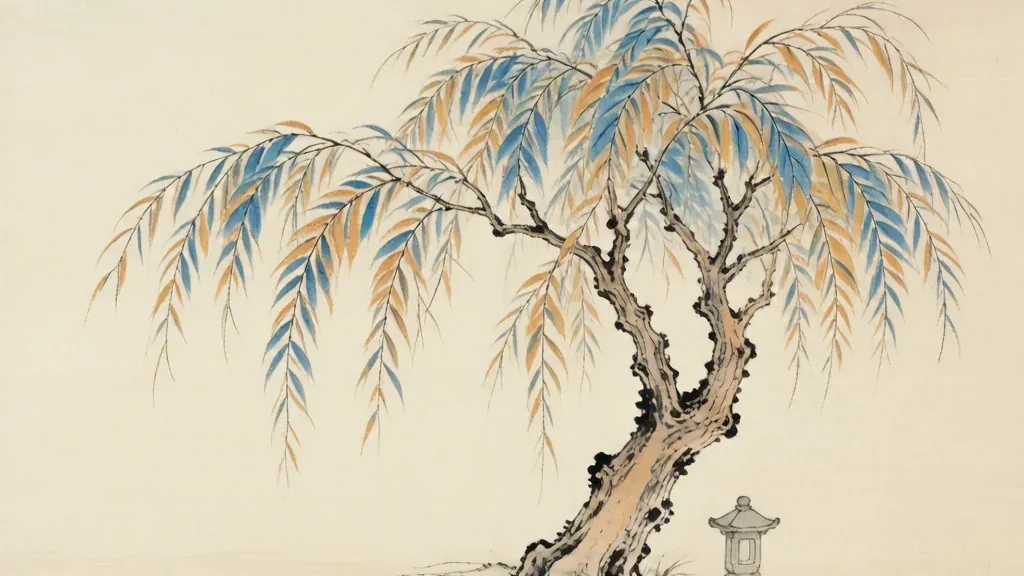
No tree in China carries more gentle sorrow than the willow — 柳 (). With its slender branches trailing like threads of green silk over rivers and canal banks, the willow became the classical emblem of parting. For over two millennia, the st, when friends or family separated, they broke a willow branch and gave it to the traveler, for the word 柳 sounds like 留 (), "to keep" or "to detain." To hand someone a willow was to say, silently, "stay." This single plant holds the whole Chinese grammar of farewell, woven into poetry, painting, and the ritual of the road.
The Willow as a Tree of Farewell
The custom of "breaking the willow" (折柳, ) reaches back to the Han dynasty, when imperial envoys and exiles departed from Chang'an's Ba River bridge, lined with willows. Friends gathered there to snap a soft branch and press it into a traveler's hand before the long journey west. The act was at once blessing and plea: may you return, may you be remembered, may spring find you again.
Because willows root easily from a cut branch, the gift also carried a practical hope — that the traveler, like the cutting, would take root wherever he landed and flourish far from home. The willow's drooping form, too, seemed to weep, giving poets a natural mirror for their own grief. Over centuries the Ba Bridge became synonymous with separation itself, and the willow its unspoken language.
Sound Symbolism: Liǔ and Liú
Chinese classical poetry is built on sound as much as sense, and the willow's power rests partly on a pun. 柳 (willow) and 留 (to stay, to detain) are both pronounced in the third tone (with slight historical variation). To mention a willow in a parting poem was automatically to wish the friend would linger. This is why almost every famous farewell poem in the Book of Songs and Tang anthologies reaches, sooner or later, for the willow.
The pun survived into everyday speech. To "keep a willow" meant to hold a guest; willow branches hung at a door signaled welcome and the wish that a visitor remain. Even today, the willow's sound-symbolism is taught to children as one of the clearest examples of how Chinese words carry feeling through their very pronunciation, turning botany into a kind of spoken charm.
Willows in the Landscape and the Garden
Willows are among the most planted trees in the Chinese countryside, especially along waterways, where their roots bind soil against erosion and their shade cools the banks. The "willow bank" (柳岸, ) is a stock image of southern scenery, immortalized in poems about West Lake in Hangzhou and the Qinhuai River in Nanjing. A misty spring morning with willows reflected in still water is considered one of the classic "ten views" of Jiangnan.
In garden design, the willow is valued for movement. Unlike stiff pines, it responds to every breeze, drawing the eye and softening architecture. Suzhou's classical gardens place a single weeping willow at a pond's edge to "lend the water a temperament." Painters loved the challenge of its restless lines, and the "boneless" ink style of flower-and-bird painting often used willow catkins to suggest wind without drawing it.
The Willow in Poetry and Music
The Book of Songs, China's oldest poetry collection, opens its farewell sensibility with lines about willows by the road. Centuries later, the Tang poet Wang Zhihuan wrote of "a lonely city, a ten-thousand-foot mountain, a willow sung beyond the pass," capturing frontier isolation. The most quoted perhaps is the line "In the past, I went away; the willows were soft and green" from the Book of Songs poem "Cai Wei," where the willow marks the spring of departure and the absent traveler remembers it through war and snow.
Willow catkins (柳絮, ) drifting like snow became a separate motif for restless thoughts and the passage of time. In the hands of a master, a few floating catkins could carry an entire lament. The willow thus moved from a roadside custom into the deepest register of Chinese lyric feeling, a plant that literally embodies the ache of goodbye.
Willows, Women, and the Seasons
Because the willow's new shoots are slender and pale, classical writers compared them to a young woman's eyebrows and to the graceful waist of a beauty — the "willow waist" (柳腰) is a traditional compliment. The tree's early spring green made it a symbol of youth and renewal, even as its use in farewells tied it to loss. This double life let the willow stand for both the joy of meeting and the pain of parting.
Festival custom also used the willow. During the Cold Food and Qingming festivals, people inserted willow sprigs above doors to ward off evil and invite spring's return. Children wore woven willow crowns. The same branch that blessed a traveler also protected a household, showing how flexibly the plant moved between public ritual and private feeling across the Chinese year.
The Willow's Living Legacy
Today the willow remains woven into Chinese life. The phrase "breaking willow to see off a friend" survives as an idiom, and spring outings to view new willow shoots are still beloved. Ecologically, the tree's usefulness has only grown: modern riverbank restoration across China plants willows to stabilize banks and filter runoff, continuing a role the tree has played since antiquity.
To meet a Chinese willow is therefore to meet a compressed history of goodbye. Its trailing branches are a written language older than most books — one that needs no dictionary, only a moment by the water and the willingness to feel a little sadness at someone's leaving. Few plants have been asked to carry so much human feeling, and few have done it with such quiet grace.
The Willow and the Spirit World
In Chinese folk religion the willow sits on the border between the living and the dead. Because it greens first in spring, a willow sprig was believed to carry fresh, protective energy, and during Qingming people set branches above doors and on graves to keep misfortune away. Storytellers went further: willow wood could pin down restless ghosts, and wandering priests in tales by Pu Songling and others carry willow wands to subdue revenants. At the same time the tree's weeping form suited ghosts and lovelorn spirits in legend, so the willow could be both guard and mourner. This ambiguity, a charm that also weeps, matches the plant's everyday meaning, since the same branch that blesses a traveler's departure also marks a household's care for the departed. Few plants hold such a quiet office at the meeting point of memory, loss, and protection.
The Willow Across East Asia
China's willow did not stay within its borders. The parting custom and the liu-liu pun spread with classical poetry into Korea, Vietnam, and Japan, where the tree keeps a kindred meaning. In Japan the weeping willow (yanagi) is a familiar image of spring and gentle sorrow, appearing in haiku and woodblock prints much as it does in Chinese verse, and willow-lined canals remain a feature of old towns. Korean and Vietnamese poets likewise borrowed the Chinese farewell willow wholesale, reciting the same Ba Bridge scenes in their own languages. Even the willow's medicinal use traveled, carried by the same texts that taught acupuncture and herbal lore. The result is a shared East Asian grammar of goodbye in which a single drooping branch means, from Seoul to Hanoi to Kyoto, the same tender wish: stay, and return.
❓ Frequently Asked Questions
📝 Chinese Vocabulary
柳 — : willow.
留 — : to keep, to detain, to stay.
折柳 — : to break the willow; to see someone off.
柳絮 — : willow catkins.
柳腰 — : willow waist; a slender, graceful figure.
灞桥 — : Ba Bridge, the Chang'an departure point famed for its parting willows.
杨柳 — : Poplar and willow, a poetic compound often meaning the weeping willow.
寒食 — : Cold Food Festival, observed just before Qingming and linked to willow customs.
🎉 Fun Facts
- A cut willow branch roots so easily that giving one to a traveler doubled as a wish that they would thrive wherever they settled.
- Chang'an's Ba Bridge, lined with willows, became so tied to farewells that "Ba Bridge willows" is itself a poetic phrase for parting.
- The willow's new shoots were compared to a young woman's eyebrows, giving rise to the compliment "willow waist."
- Willow sprigs were hung above doors during Qingming to invite spring and ward off misfortune.
- Willow catkins drifting like snow were a favorite late-spring image painted onto Tang ceramics and woven into Song textiles.
- Since the willow greens before almost any other tree, farmers once read its first buds as the natural signal to begin spring plowing.