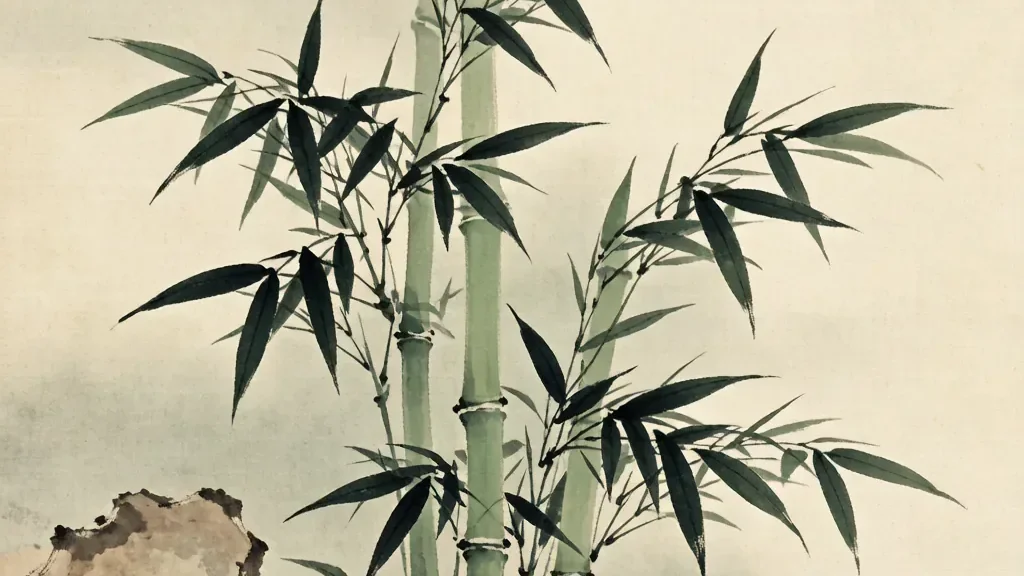
If you were asked to name the single plant that best represents China, you might say the plum blossom or the peony. But you would be wrong. The true botanical soul of China is bamboo. It feeds the nation's most beloved animal, builds its scaffolding and furniture, provides the raw material for its writing brushes and paper, and inspires its poets and painters. Bamboo is not just a plant in China — it is a civilization's companion, a teacher of virtue, and a way of life.
A Plant Like No Other
Bamboo is technically a grass, but calling it a grass does not do it justice. It is the fastest-growing plant on Earth — some species can grow nearly a meter in a single day. It is stronger than steel by weight, yet flexible enough to bend to the ground in a typhoon without breaking. It is hollow, segmented, and evergreen, remaining green even in the depths of winter. Every one of these physical characteristics has been woven into the fabric of Chinese philosophy and culture.
China is home to over 500 species of bamboo, more than any other country in the world. Bamboo forests cover millions of hectares, from the subtropical south to the temperate north. The plant has been part of Chinese life since the earliest days of civilization. Archaeological evidence shows that bamboo was used for tools, weapons, and building materials as far back as the Neolithic period, over 7,000 years ago. Bamboo slips — thin strips of bamboo tied together with string — were the primary writing material in China before the invention of paper. The earliest surviving texts of Chinese philosophy, including the works of Confucius and Laozi, were originally written on bamboo.
The Philosophy of Bamboo
For Chinese thinkers, bamboo was not just useful — it was instructive. The plant's physical qualities became metaphors for human virtues. Bamboo is hollow inside, which represents humility and an open mind — the willingness to receive new ideas and learn from others. Its segmented stem, with regular nodes marking each stage of growth, represents integrity and moral constancy — the ability to remain true to one's principles through every phase of life. Its deep roots represent steadfastness and strong foundations. Its ability to bend without breaking represents resilience and adaptability.
The Song Dynasty poet Su Shi (also known as Su Dongpo) famously wrote: "I would rather eat without meat than live without bamboo. Without meat, one becomes thin; without bamboo, one becomes vulgar." For Su Shi and countless other Chinese literati, bamboo was not a luxury but a necessity — a daily reminder of the virtues they aspired to embody. A home without bamboo was a home without moral guidance.
Bamboo in Art and Painting
Bamboo is one of the most painted subjects in Chinese art history. The reason is partly technical: bamboo leaves and stems are painted with the same brushstrokes used in calligraphy, making bamboo painting the perfect intersection of the two arts. A skilled calligrapher can paint bamboo naturally, because the brush movements are identical — the confident vertical stroke for the stem, the sharp flick of the wrist for the leaf.
But bamboo painting is also a spiritual practice. The artist must internalize the bamboo before putting brush to paper. The Qing Dynasty painter Zheng Xie (also known as Zheng Banqiao) explained: "In my breast, I have the bamboo. But the bamboo that emerges from my brush is not the bamboo in my breast. And the bamboo in my breast is not the bamboo in the garden." The artist does not copy nature; they absorb its essence and recreate it through the filter of their own spirit.
Zheng Xie was one of the "Eight Eccentrics of Yangzhou," a group of Qing Dynasty painters known for their individualistic styles. He devoted much of his career to painting bamboo, orchids, and rocks — the classic literati subjects — and his bamboo paintings are among the most beloved in Chinese art. His inscriptions on his paintings, often poems or philosophical reflections, add another layer of meaning, making each work a fusion of visual art, poetry, and moral instruction.
The Many Lives of Bamboo
Beyond philosophy and art, bamboo is woven into the practical fabric of daily life in China. Bamboo shoots are a prized ingredient in Chinese cuisine, appearing in stir-fries, soups, and dumplings. Bamboo charcoal is used for water purification and air filtration. Bamboo fibers are woven into fabric for clothing and towels. Bamboo is made into furniture, flooring, baskets, hats, and countless household items.
Perhaps the most spectacular use of bamboo is in construction. In southern China, bamboo scaffolding has been used for centuries to build everything from simple houses to towering skyscrapers. Even today, in Hong Kong, bamboo scaffolding is preferred over steel for many construction projects because it is lighter, cheaper, more flexible, and equally strong. Watching workers lash together bamboo poles high above the streets of Hong Kong is to witness a living tradition that stretches back thousands of years.
And then there are the giant pandas. China's national treasure, the giant panda, eats almost nothing but bamboo — up to 40 kilograms a day. The panda's dependence on bamboo is so complete that its entire biology has evolved around the plant, from its enlarged wrist bone (the "panda's thumb") for gripping stalks to its powerful jaw muscles for crushing tough fibers. The fate of the panda and the fate of China's bamboo forests are inseparable, making bamboo conservation not just a cultural priority but an ecological one.
Bamboo for the Future
As the world searches for sustainable materials to replace plastic, concrete, and steel, bamboo is attracting global attention. It grows faster than any tree, sequesters carbon at an extraordinary rate, and requires no pesticides or fertilizers. Bamboo products — from toothbrushes to bicycles to building panels — are appearing in markets around the world. China, with its vast bamboo resources and centuries of expertise, is at the forefront of this bamboo renaissance.
But for the Chinese people, bamboo will always be more than a sustainable resource. It is the plant that taught them humility and resilience. It is the subject of their most cherished paintings and poems. It is the food of their most beloved animal. It is, in the deepest sense, a part of who they are. As the old saying goes: "Bamboo has integrity, and integrity has bamboo."
Bamboo in Music and Sound
Long before the modern orchestra, bamboo gave China its voice. The dizi, a transverse flute, and the xiao, a vertical end-blown flute, are both cut from a single bamboo node, their clear tone prized for solos and ensemble alike. Bamboo also forms the pipes of the sheng, one of the world's oldest free-reed instruments, and the body of the qudi and many folk wind instruments. Because every stalk is slightly different, a maker listens as much as measures, selecting nodes for pitch and evenness. The plant's straight, hollow, resonant character made it the natural material for sound, and its music carried the same associations as its painting: restraint, clarity, and composure. In village and court, bamboo flutes marked festivals, accompanied opera, and opened the day in temples. To hear a bamboo flute is still to hear the plant's old lesson, that emptiness, properly shaped, can sing.
The Bamboo Grove and the Recluse
Bamboo groves have always been places to retreat from the world. In the third century, a circle of Wei-Jin dynasty scholars known as the Seven Sages of the Bamboo Grove met among the stalks to drink, play the qin, and debate philosophy beyond the reach of corrupt courts. Their example set a lasting ideal: the gentleman who plants bamboo beside his study signals that he values integrity over office. Later poets and painters copied the gesture, and classical gardens reserved a shaded grove as a spot for reading and quiet talk. The plant suited the mood perfectly, green in winter, silent in wind, never showy, so that to 'enter the bamboo grove' became a way of saying one had chosen reflection over ambition. Across dynasties, the rustle of bamboo marked the boundary between public duty and private freedom.
Bamboo at the Table and in Medicine
Bamboo feeds and heals as readily as it builds. In spring, tender bamboo shoots (zhusun) are dug and cooked across China, blanched to remove bitterness, then stir-fried, braised, or floated in soups, prized for their crisp bite and clean taste. Regional cuisines each claim a favorite variety, from the fat shoots of the south to the slender winter bamboo of Jiangnan. Traditional medicine values other parts of the plant: the leaves are brewed as a cooling tea said to clear heat and reduce swelling, the sap is used for coughs, and the charred ash of the stalk is applied to stop bleeding. Even the fluid inside a fresh node is collected as a cooling drink. Almost no part is wasted, so bamboo earns its place in the kitchen and the pharmacy as firmly as in the garden and the studio.
❓ Frequently Asked Questions
📝 Chinese Vocabulary
- 竹 (zhú) — Bamboo; one of the most important plants in Chinese culture, symbolizing integrity and resilience
- 虚心 (xū xīn) — "Empty heart"; the humility represented by bamboo's hollow stem, also meaning open-mindedness
- 节 (jié) — The nodes or joints of bamboo; also means integrity, moral principle, and festival
- 胸有成竹 (xiōng yǒu chéng zhú) — "To have a finished bamboo in one's breast"; an idiom meaning to have a well-thought-out plan
🎉 Fun Facts
- Some bamboo species can grow up to 91 centimeters (36 inches) in a single 24-hour period, making it the fastest-growing plant on Earth.
- Bamboo has a higher tensile strength than many steel alloys, which is why it is used for scaffolding on skyscrapers in Hong Kong.
- The earliest Chinese books were written on bamboo slips tied together with string — the Chinese character for "volume" (册, cè) is a pictograph of bamboo strips bound together.
- Some bamboo species flower only once every several decades in a synchronized mass bloom, then die back, a puzzle that still intrigues botanists.
- Spring bamboo shoots are such a delicacy that special varieties are grown for the table and digging them is a cherished seasonal outing.
- Because it stays green through winter, bamboo pairs with pine and plum as the 'Three Friends of Winter,' an emblem of endurance.