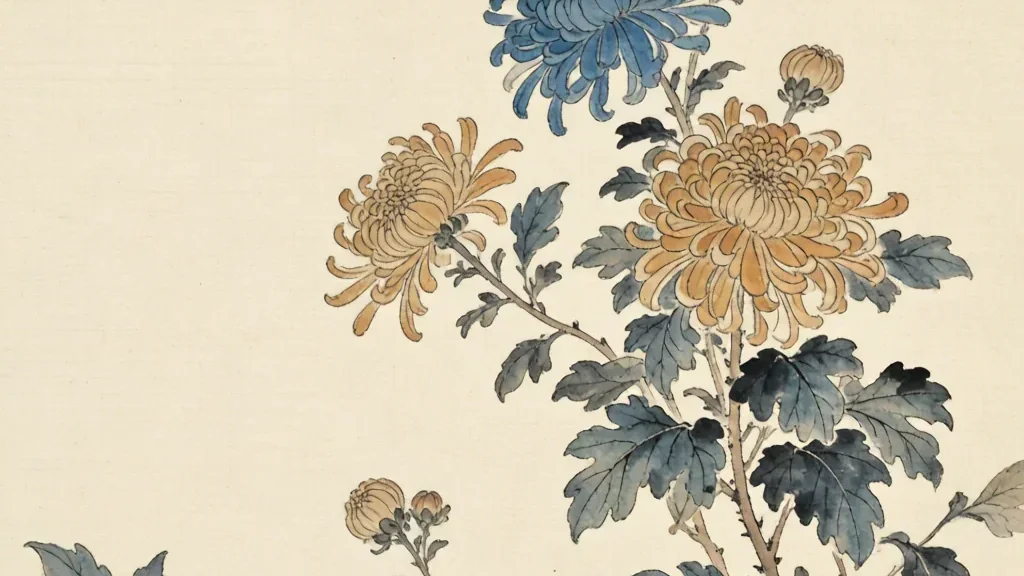
The chrysanthemum (Chrysanthemum morifolium), known in Chinese as 菊花 (júhuā), holds a place of profound reverence in Chinese culture that stretches back over three millennia. First cultivated during the Zhou Dynasty (1046–256 BCE) as a flowering herb, the chrysanthemum was initially valued for its medicinal properties — its petals were brewed into teas believed to promote longevity and sharpen eyesight. By the time of the Warring States period (475–221 BCE), the flower had already begun its transformation from a humble garden plant into a powerful cultural symbol. The great poet Qu Yuan (c. 340–278 BCE) mentions chrysanthemums in his seminal work 'Li Sao' ('Encountering Sorrow'), linking the flower to the virtues of the noble recluse who withdraws from worldly corruption to preserve inner purity. Over the centuries that followed, the chrysanthemum would accumulate associations with longevity, nobility, autumn, and scholarly integrity that make it one of the most layered and resonant symbols in the Chinese cultural tradition.
Chrysanthemum and Tao Yuanming: The Poet and the Flower
The chrysanthemum holds a special place in Chinese poetry, and no figure is more closely associated with the flower than Tao Yuanming (365–427 CE), the greatest poet of the Six Dynasties period. Tao is so intimately connected with the chrysanthemum that he is often called the "Chrysanthemum Poet," and his famous lines about gathering chrysanthemums at the eastern hedge have shaped Chinese literary imagination for over 1,600 years. Tao Yuanming lived during a period of political turmoil and served briefly in minor official positions before resigning in disgust at the corruption of court life. His decision to retire to a rural farming existence was both a practical necessity and a profound philosophical statement. In his most famous poem, "Drinking Wine" (饮酒, No. 5), he writes: "I build my hut among the world of men, / Yet there is no noise of horse and carriage. / You ask me how this can be — / When the heart is distant, the place is naturally remote. / I gather chrysanthemums at the eastern hedge, / And gaze at the southern mountains." The chrysanthemum here is not merely a decorative element but a symbol of Tao's integrity and his choice of spiritual autonomy over public recognition. He "plucks chrysanthemums" — the act of a free man enjoying the simple pleasures of life — while officials scramble for power and wealth. The flower blooms late, after all other flowers have withered, just as Tao's virtue shines most brightly in a corrupt age. This image of the chrysanthemum-gathering hermit became an archetype that later poets and painters would invoke for centuries whenever they wished to express their own commitment to authentic living over social conformity.
The Double Ninth Festival and Chrysanthemum-Viewing Traditions
The chrysanthemum's deepest cultural association is with the Double Ninth Festival (重阳节, Chóngyáng Jié), celebrated on the ninth day of the ninth lunar month. This ancient festival, with roots dating to the Han Dynasty (206 BCE–220 CE), is dedicated to honoring elders, warding off misfortune, and celebrating the autumn season. The number nine (九, jiǔ) is a homophone for 'long-lasting' (久, jiǔ), making the Double Ninth a natural celebration of longevity — and the chrysanthemum, with its late-blooming nature and resilience against frost, became the perfect botanical emblem of endurance through adversity. Chrysanthemum-viewing parties became a cherished tradition during this time, particularly among scholars and the literati. Families would gather to admire elaborate chrysanthemum displays, drink chrysanthemum wine (菊花酒), and eat chrysanthemum cakes (菊花糕). The wine was prepared by steeping chrysanthemum petals in rice wine, sometimes with the addition of other medicinal herbs, and it was believed to purify the body and extend life. The chrysanthemum-viewing tradition reached its height during the Tang dynasty, when the imperial court held lavish banquets in the palace gardens, with poets composing verses in praise of the finest blooms. Today, the tradition continues in cities across China, with major chrysanthemum festivals held in Kaifeng, Hangzhou, and Nanjing. The Kaifeng Chrysanthemum Cultural Festival, held every autumn since 1983, draws millions of visitors to admire over 1.6 million potted chrysanthemums arranged in elaborate landscapes and sculptures across the ancient city — a spectacle that transforms the streets into a sea of gold, purple, white, and crimson petals.
The Four Gentlemen: Chrysanthemum Among Its Peers
In the classical Chinese artistic tradition, the chrysanthemum is counted among the 'Four Gentlemen' (四君子, Sì Jūnzǐ), alongside the plum blossom (梅, méi), orchid (兰, lán), and bamboo (竹, zhú). This quartet of plants has served as the foundational subject matter for Chinese ink-wash painting (水墨画, shuǐmòhuà) and calligraphy since the Song Dynasty (960–1279). Each 'gentleman' represents a season and a Confucian virtue: the plum blossoms in late winter and embodies perseverance through hardship; the orchid blooms in spring and signifies refinement and humility; bamboo stands tall in summer and represents integrity with its hollow, upright stem; and the chrysanthemum, blooming defiantly in the face of autumn frost, stands for the noble scholar who maintains moral rectitude even when isolated and unappreciated. Together, the Four Gentlemen form a complete cycle of virtues that the cultivated person should develop: perseverance, refinement, integrity, and steadfastness in adversity. In painting, each of the Four Gentlemen requires mastery of a different brush technique: the plum blossom demands bold, angular strokes for its gnarled branches; the orchid requires flowing, graceful lines for its leaves; bamboo demands precise, segmental brushwork; and the chrysanthemum challenges the artist with its complex, layered petals that must be rendered with controlled yet expressive strokes. Learning to paint the Four Gentlemen was traditionally the essential foundation of a scholarly education, and even accomplished painters would return to these subjects throughout their careers as a practice of humility and a test of their skill.
Chrysanthemum Varieties and Tea Culture
Chrysanthemum cultivation in China has produced an extraordinary diversity of varieties. The earliest Chinese horticultural manual devoted to a single flower species, "The Treatise on Chrysanthemums" (菊谱, Jú Pǔ) by the Song dynasty author Liu Meng, documented over 30 named cultivars. By the Ming dynasty, this number had grown to several hundred, and today there are over 3,000 registered chrysanthemum cultivars in China, ranging from the classic golden-yellow "Autumn Sunshine" to the deep crimson "Purple Dragon's Beard" to the delicate white "Jade Butterfly." The flowers are classified by petal type (flat, spoon, tubular, anemone), flower head form (single, semi-double, fully double, pompon, spider), and growth habit (standard, spray, cascade). Among the most celebrated varieties are the "Hangbaiju" (杭白菊) from Hangzhou, a small white flower with a sweet, mild flavor that is the most popular variety for tea; the "Gongju" (贡菊) from Anhui, also known as "Tribute Chrysanthemum" for its historical status as an imperial offering; and the "Chuju" (滁菊) from Chuzhou, valued for its large flower heads and cooling medicinal properties. Chrysanthemum tea (菊花茶, júhuā chá), made by steeping dried flower heads in hot water, is one of China's most beloved herbal infusions. The dried flowers unfurl in hot water, releasing a pale golden infusion with a delicate, slightly sweet flavor and a faint herbal aroma. In summer, the tea is often served chilled with rock sugar and wolfberries as a refreshing drink. Beyond tea, chrysanthemum enters Chinese cuisine in other forms: the leaves (茼蒿, tónghāo), also known as crown daisy, are a staple green vegetable in hot pot and stir-fry dishes, and chrysanthemum petals are sometimes added to salads or used as a garnish for their color and mild flavor. The flower even appears on Chinese currency — a chrysanthemum is featured on the reverse of the 1-jiao coin — symbolizing the flower's enduring presence in the fabric of Chinese national identity.