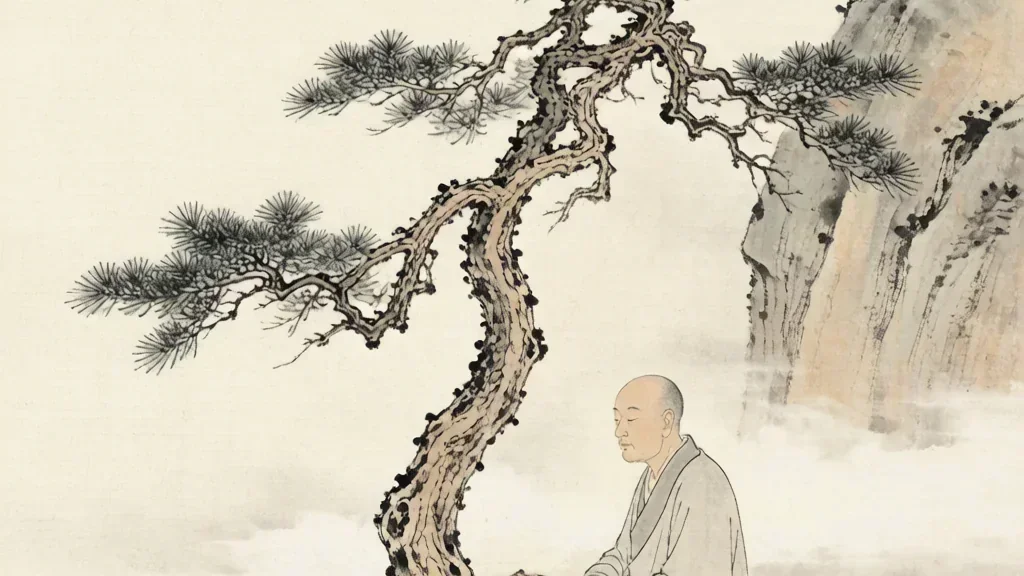
Of all the schools Buddhism spun off on Chinese soil, none became more famous in the modern world than Chan (禅宗) — the tradition the Japanese would later call Zen, and the West would come to associate with raked gravel, sudden laughter, and ink brushstrokes. Yet Chan began as something far grimmer and more disciplined: a refusal to trust words, a conviction that awakening could not be read but only realized. Its history is a long argument about how a human being actually becomes free.
What Is Chan?
The name itself is a clue. Chan (禅) is the Chinese transliteration of the Sanskrit dhyāna, meaning meditation or absorbed concentration. Where other schools leaned on sutras, ritual, or the invocation of a buddha's name, Chan placed seated meditation (禅定, chán dìng) at the very core of practice. Its founding slogan, attributed to Bodhidharma, names a teaching "outside the scriptures, not founded on words or letters, transmitted directly to the mind, pointing straight at the human heart, and awakening one to one's own nature to become a buddha" (教外别传,不立文字,直指人心,见性成佛).
This does not mean Chan discarded the scriptures — monks still chanted and studied — but it insisted that words were fingers pointing at the moon, never the moon itself. The danger, Chan teachers warned, was to mistake the finger for the truth. That suspicion of dogma gave the school its characteristic sharpness: a willingness to slap, shout, or burn a sutra if doing so might jolt a student past the limits of conceptual thought.
At its heart, Chan is the claim that every person already possesses buddha-nature (佛性, fóxìng) and needs only to recognize it. The work is not to acquire something new but to stop obscuring what is already present — like wiping dust from a mirror that was never truly stained.
Bodhidharma and the West
Chan traces its lineage to Bodhidharma (菩提达摩, Pútídámó), a dark-skinned monk from South India or Central Asia who, tradition says, crossed into China around 520 CE during the Liang dynasty. Emperor Wu of Liang, a fervent patron who had built many monasteries, asked him what merit he had gained; Bodhidharma bluntly replied that there was no merit in outward acts — a story that became a founding parable of Chan's iconoclasm and its indifference to worldly approval.
Bodhidharma is most famously linked to the Shaolin Monastery (少林寺) on Mount Song in Henan, where legend holds he sat facing a wall for nine years — the practice of "wall-gazing" (面壁, miànbì) — until his legs atrophied. Later folklore made him the founder of Shaolin martial arts, claiming he taught the monks physical exercises to counter the stiffness of long meditation. Whether or not that is history, the marriage of Chan meditation and Shaolin boxing became one of China's most enduring cultural images.
From Bodhidharma the lineage passes through a series of patriarchs (祖, zǔ) to the Fifth, Hongren (弘忍), and then splits. His disciple Shenxiu (神秀) represented the established, gradualist line, while the illiterate woodcutter Huineng (慧能) — who could not even read — astonished the assembly with a verse and became the Sixth Patriarch. Huineng's biography, the Platform Sutra (六祖坛经), is the only Chinese-authored text ever granted the title "sutra," signaling that a Chinese master had spoken with the authority of the Buddha himself.
Sudden vs Gradual Enlightenment
The single most important doctrinal debate in Chan history is sudden versus gradual. Shenxiu taught gradual cultivation (渐修, jiànxiū): the mind is like a bright mirror that must be polished constantly to remove the dust of delusion. His verse ran, "The body is the bodhi-tree, / the mind a mirror bright; / wipe it clean with care, / let no dust alight."
Huineng answered with the sudden teaching (顿悟, dùnwù): the mirror was never genuinely stained, so the point was not polishing but seeing through the illusion of dust altogether. His counter-verse declared, "Originally there is no bodhi-tree, / nor any mirror bright; / fundamentally there is not a single thing — / so where can the dust alight?" In this view, awakening is not a step-by-step climb but a single instant of recognition, like a light switched on in a dark room.
The Chan of the Tang and Song came down firmly on Huineng's side. His sudden-teaching lineage produced the so-called "five houses" of Chan (五家, wǔ jiā) — branches such as Linji (临济) and Caodong (曹洞) — each with its own flavor of instruction. The Linji school favored the abrupt shout (喝, hè) and the blow; the Caodong school favored quiet "silent illumination" (默照, mòzhào). Both agreed that the goal was the same.
Koans and Meditation
To provoke the sudden break in understanding, later Chan masters developed the koan (公案, gōng'àn), literally a "public case" or precedent from a master's life. A student might be given the famous "mu" koan: when a monk asked whether a dog has buddha-nature, Zhaozhou (赵州) answered "Wu" (无, "no") — and the student must sit with the contradiction until ordinary logic collapses. A koan is not a riddle with an answer to be reasoned out; it is a tool to exhaust the discursive mind.
Meditation in Chan (坐禅, zuòchán) follows a strict physical discipline: the crossed-leg lotus or half-lotus posture, the straight spine, the lowered gaze, the counted breath. In the great monasteries, monks sat in shifts through the night, the silence broken only by the tap of a wooden clapper (木鱼, mùyú) marking time. Walk-and-sit alternation (行香, xíngxiāng) kept the body from stiffening. The aim was not relaxation but a concentrated stillness in which insight could arise.
By the Song dynasty, Chan had so thoroughly merged with Pure Land devotionalism that the phrase "Chan and Pure Land are one" (禅净合一) became common. A monk might meditate by day and chant Amitabha's name by night, holding that the pure land was none other than the awakened mind.
Influence on Art and Tea
Chan's suspicion of ornament and its love of spontaneity reshaped Chinese aesthetics. The monochrome ink landscapes of the Southern School of painting (南宗, nánzōng), with their empty mists and few strokes, were explicitly described by the critic Dong Qichang (董其昌, 1555–1636) as "Chan-like." The gestural freedom of cursive calligraphy (草书) found a spiritual cousin in the Chan brush, which valued a single decisive stroke over careful finish.
The monastery's need to keep meditators awake made tea (茶, chá) a Chan staple, and the mindful preparation of tea became itself a practice. When Chan traveled to Japan as Zen, this seed grew into the tea ceremony (chanoyu), the rock garden, and the aesthetic of wabi-sabi — finding beauty in imperfection and restraint. Even the humble rice-and-vegetable meal of the monk, eaten in silence according to prescribed hand motions, became the template for the disciplined elegance of the Zen kitchen.
In the end, Chan's great gift was a paradox: a school that distrusted words became one of the most literary, artistic, and quietly influential movements in Chinese history. It taught that the path was not elsewhere — not in a distant paradise or a buried scripture — but in the turn of one's own attention, available in this breath, this cup, this wall.