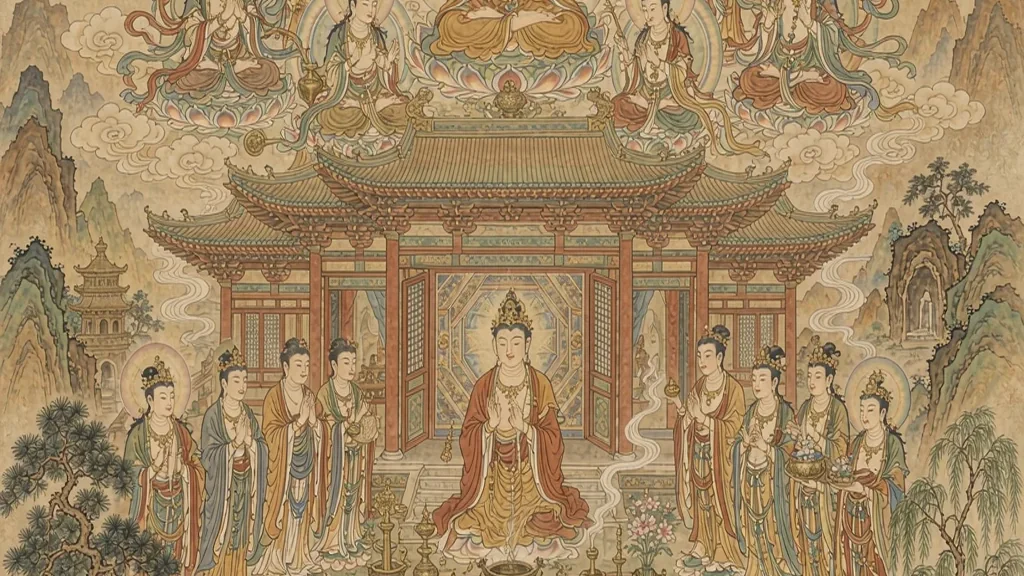
Chinese esoteric Buddhism, known as Tangmi or Zhenyan, was the tantric or Vajrayana form of Buddhism that flourished in China during the Tang dynasty before largely disappearing as an independent school after the mid ninth century persecutions. Distinct from the later Tibetan-derived traditions, Tangmi centered on the ritual use of mantras, mudras, and mandalas to realize the cosmic Buddha Vairocana and to attain both spiritual awakening and this-worldly benefits such as protection, healing, and prosperity. Its transmission is traditionally traced to three foreign masters, Subhakarasimha, Vajrabodhi, and Amoghavajra, who brought the Vairocana and Vajrasekhara lineages from India and Southeast Asia to the Tang capitals. Although the Chinese lineage did not long survive, its scriptures, rituals, and iconography were carried to Japan by Kukai and became the foundation of Shingon, making Tangmi one of the most influential yet elusive currents in the history of Asian Buddhism.
Definition and Distinctive Features
Esoteric Buddhism, in the Chinese context, refers to those teachings and practices restricted to initiates who have received formal consecration, as opposed to the "exoteric" sutras open to all. Its distinctive features include the worship of a cosmic Buddha, the construction of intricate mandalas populated by hundreds of deity forms, the recitation of Sanskrit mantras understood as the sound-body of reality, and the performance of symbolic hand gestures called mudras. Practitioners engage in deity yoga, visualizing themselves as identical with the enlightened figure.
What set Tangmi apart from the broader Mahayana was its claim that enlightenment could be realized rapidly through ritual identification with the Buddha rather than through the slow accumulation of merit over countless lifetimes. This promise of swift, embodied realization, combined with practical rites for state and personal benefit, gave esotericism a special appeal to rulers and lay patrons who wanted results tangible in this life as well as the next.
Indian and Central Asian Antecedents
The roots of Chinese esotericism lie in the late Indian Buddhist developments of the early first millennium, when Mahayana devotion gradually incorporated tantric elements drawn from yoga, mythology, and the cult of empowered speech. By the seventh century, tantric scriptures such as the Mahavairocana and Vajrasekhara sutras circulated in India and the Buddhist kingdoms of the maritime route, especially in the Sri Lankan and Javanese spheres. These texts synthesized older Buddhahood with new ritual technologies of transformation.
Central Asian and Indian monks carried this material along both the overland and maritime Silk Roads. Early tantric materials had appeared in China even before the Tang, in the form of dharani scriptures and protective rites translated by monks such as Zhi Qian and later by the Yogacara masters. But it was only in the eighth century, with the arrival of the three great patriarchs, that a full and systematic esoteric institution took shape in the Chinese heartland.
Subhakarasimha and the Vairocana Lineage
The first of the three patriarchs was Subhakarasimha, a South Indian monk of royal background who arrived in Chang'an around 716 and is credited with introducing the Vairocana or Womb realm lineage. He translated the Mahavairocana Sutra, the foundational scripture of the Womb realm mandala, together with his Chinese collaborator Yixing, who also wrote the indispensable commentary that explained its difficult ritual symbolism to a Chinese audience. This partnership of foreign master and native genius was crucial to the school's early intelligibility.
Subhakarasimha emphasized the Garbhadhatu, the realm of the womb, in which the cosmic Buddha Vairocana contains all phenomena as a matrix contains seeds. His teaching presented the practitioner's own mind as originally identical with the enlightened matrix, to be realized through the sequential visualization of the mandala. The Womb realm thus offered a cosmology of inclusive, nurturing enlightenment that complemented the more rigorous adamantine imagery of the rival lineage.
Vajrabodhi and the Adamantine Lineage
The second patriarch, Vajrabodhi, came to China from South India via Southeast Asia around 720 and brought the Vajrasekhara or Adamantine realm lineage, centered on the Vajrasekhara Sutra and the initiatory rites of the diamond matrix. A formidable ritual specialist, he conducted abhiseka consecrations at court and trained a circle of disciples, the most important being the young Amoghavajra. His lineage emphasized the immutable, diamond-like wisdom that cuts through illusion.
Where Subhakarasimha stressed the Womb realm of compassionate inclusion, Vajrabodhi stressed the Adamantine realm of unshakeable insight, and the two were later understood as complementary halves of a single esoteric whole. This pairing of the womb and diamond realms became the defining structure of Tangmi cosmology and was inherited directly by Japanese Shingon, which arranges its practice around the dual mandalas of the two realms.
Amoghavajra and Institutional Height
The third and most politically successful patriarch was Amoghavajra, who unified the two lineages and raised esoteric Buddhism to the height of court favor under three Tang emperors. He expanded the translation corpus, performed state rituals for protection and rain, and ordained monks in esoteric rites, effectively making tantra a department of imperial governance. His career is treated in detail in his own article, but his role as the consolidator of Tangmi cannot be separated from the school's institutional story.
Under Amoghavajra the esoteric establishment possessed its own temples, translation bureaus, and a liturgical calendar distinct from the exoteric monasteries. For a few decades in the eighth century, Tangmi enjoyed resources and status rivaling any other Buddhist institution. This golden age, however, was precisely what made the school vulnerable when the political winds shifted and the dynasty turned against the monastic order as a whole.
Core Practices: Mantra, Mudra, Mandala
The daily substance of Tangmi practice was the threefold yoga of body, speech, and mind. Through mudras, the practitioner's hands enacted the gestures of the deity; through mantras, the voice intoned the seed syllables that are the sonic essence of reality; and through mandala visualization, the mind mapped the universe of enlightened forms. The integration of these three was believed to dissolve the ordinary sense of a separate self and to manifest theBuddha-body within the practitioner's own person.
Initiation, or abhiseka, was the gateway to these practices. The master sprinkled water or touched the disciple before the mandala and revealed the secret syllables that could not be spoken outside the consecrated circle. Rituals also included fire offerings, the construction of stupas and images, and the recitation of dharani for specific ends such as longevity, the repose of the dead, and the suppression of calamity. This pragmatic, results-oriented dimension distinguished esotericism from more contemplative paths.
The Vairocana Cosmos
At the center of Tangmi cosmology stands Vairocana, not as one Buddha among many but as the embodied principle of reality itself, the radiant ground from which all Buddhas and beings emanate. In the Womb realm mandala he sits at the center surrounded by an ordered assembly of wisdom kings, bodhisattvas, and protective deities; in the Adamantine realm he appears as the lord of the diamond matrix. The practitioner's goal is to realize that his own mind is none other than Vairocana's.
This non-dual identification distinguishes the esoteric vision from the exoteric focus on a historical Siddhartha Gautama. While ordinary Mahayana speaks of becoming a Buddha in the future, Tangmi teaches that one already is the cosmic Buddha, veiled only by ignorance, and that ritual can strip the veil in this very body. The dramatic confidence of this claim was both the school's appeal and the source of suspicion from more conservative quarters.
State Patronage and Political Role
Tangmi's fortunes were bound to the throne. Emperors welcomed esoteric rites as instruments of legitimacy and security, especially during the An Lushan rebellion and its aftermath, when military victory and rainfall were matters of survival. The monks repaid this favor with public rituals presented as technologies of state protection, and they accepted titles, gifts, and official rank. This symbiosis elevated the school but also entangled it with the dynasty's fate.
The political role of the esoteric masters paralleled that of court astrologers and technicians of the sacred. Yixing, the collaborator of Subhakarasimha, was also a renowned astronomer and calendar maker, illustrating how esoteric expertise blended religious, scientific, and administrative functions. The monk who could predict eclipses and summon rain was a valuable servant of the realm, and Tangmi profited from this versatile prestige until the empire turned against Buddhism entirely.
Persecution and Disappearance in China
The independence of Tangmi ended abruptly with the great persecution of Buddhism under Emperor Wuzong in the years around 845. Motivated by fiscal, economic, and anti-foreign sentiment, the court closed monasteries, confiscated land, forced monks to return to lay life, and destroyed scriptures and images on a vast scale. Because the esoteric establishment was concentrated, court-dependent, and reliant on foreign personnel, it was dismantled more completely than the diffuse devotional schools rooted in village piety.
After the persecution, fragments of esoteric practice survived within other traditions, particularly in popular rites of protection, the use of dharani, and later Tibetan-derived tantrism under the Yuan and Qing dynasties. But the unbroken Zhenyan lineage as a Chinese school was gone. Its memory was preserved chiefly through the Japanese transmission, which had already carried the complete teachings abroad before the catastrophe.
Transmission to Japan and Shingon
The survival of Chinese esotericism outside China is one of the great ironies of Buddhist history. The Japanese monk Kukai traveled to Tang China in the early ninth century, received the full dual-realm initiation from the heirs of Amoghavajra's line, and returned to found Shingon on Mount Koya. Shingon preserves the Vairocana and Vajrasekhara scriptures, the womb and diamond mandalas, and the ritual system of Tangmi with remarkable fidelity, making Japan the principal heir of the Chinese esoteric tradition.
Later Japanese pilgrims such as Ennin and Enchin also gathered esoteric materials in Tang China and transmitted them to the Tendai school, producing the "Taimitsu" esoteric wing of Japanese Tendai. Through these channels, much of what scholars know about Tangmi practice, iconography, and liturgy is reconstructed from Japanese sources. Tangmi thus lives on most fully not where it was born but where it was transplanted and protected.
Legacy in Chinese Religious Culture
Although the organized school vanished, esoteric elements permanently infiltrated Chinese popular religion. Dharani pillars, the veneration of protective deities such as the heavenly kings, the use of ritual hand gestures in vernacular practice, and the cult of Cundī and other esoteric goddesses all bear Tangmi's imprint. Tantric iconography also enriched Chinese Buddhist art, visible in the mandala-like arrangements of cave temples and in the fierce guardian imagery of later periods.
In the modern era, renewed contact with Tibetan Buddhism and with Japanese Shingon has revived scholarly and devotional interest in China's own esoteric heritage. Researchers recovering Tangmi texts from the Dunhuang manuscripts have shown how rich and widespread the tradition once was. The story of Tangmi therefore is not simply a tale of disappearance but of transformation, its seed syllables still humming beneath the surface of Chinese Buddhist life long after its institutions fell.
❓ Frequently Asked Questions
What was Chinese esoteric Buddhism?
Tangmi or Zhenyan was the tantric form of Buddhism that flourished in the Tang dynasty, centering on mantras, mudras, and mandalas to realize the cosmic Buddha Vairocana and gain worldly and spiritual benefits.
Who brought it to China?
Three foreign masters, Subhakarasimha, Vajrabodhi, and Amoghavajra, transmitted the Vairocana and Vajrasekhara lineages from India and Southeast Asia to the Tang capitals.
What are the womb and diamond realms?
They are the two complementary mandalas of Garbhadhatu and Vajradhatu, representing inclusive compassion and unshakeable wisdom, which structure Tangmi practice.
Why did it disappear in China?
The persecution under Emperor Wuzong around 845 dismantled the court-dependent esoteric establishment, and the independent Zhenyan lineage did not survive.
How did it survive elsewhere?
Kukai carried the complete teachings to Japan and founded Shingon, while Tendai monks gathered esoteric materials, preserving Tangmi in Japan.
What legacy remains in China?
Esoteric dharani, protective rites, deity cults, and tantric iconography persisted in Chinese popular religion and art after the school's formal end.