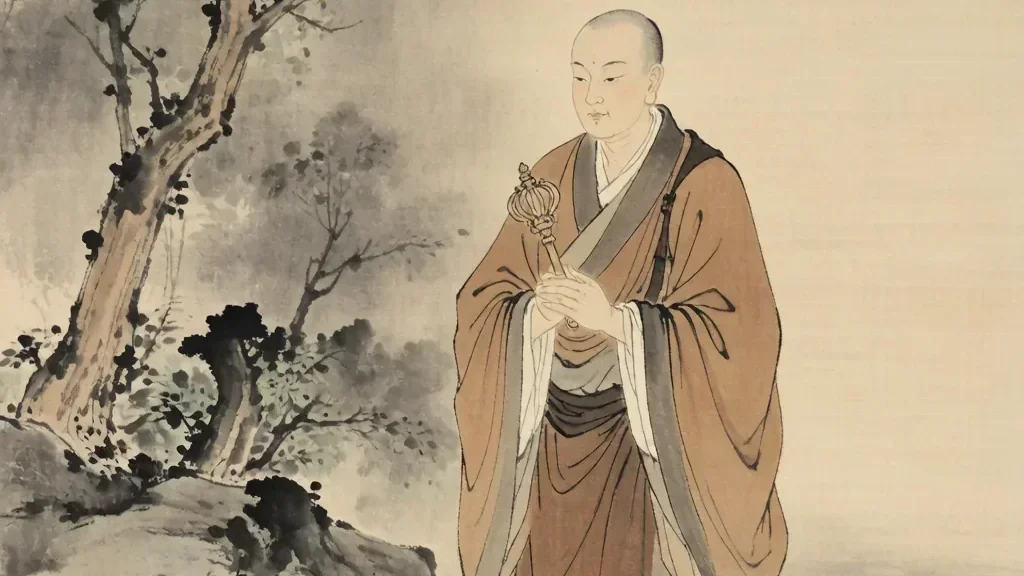
Amoghavajra, known in Chinese as Bukong Jin'gang, was the most politically powerful and institutionally successful of the great esoteric Buddhist masters who flourished in Tang dynasty China. Born in 705 to an Indian father and possibly a Central Asian mother, he became the principal heir of the Vajrayana lineages transmitted by his teacher Vajrabodhi and rose to extraordinary influence at the courts of the emperors Xuanzong, Suzong, and Daizong. He is honored as one of the eight patriarchs of Japanese Shingon and as the third of the three great Tang translators alongside Kumarajiva and Xuanzang. Through state-sponsored rituals for the protection of the realm, massive translation projects, and the ordination of monks in esoteric rites, Amoghavajra welded tantric Buddhism to imperial authority and left a legacy that shaped East Asian esotericism long after the tradition declined in China proper.
Origins and Early Formation
Amoghavajra was born in 705, according to traditional accounts, to a Brahman father from India and a mother of Central Asian origin, and he was brought to China as a child. His mixed heritage placed him within the cosmopolitan world of Silk Road merchants and clergy that supplied the Tang capitals with foreign religious specialists. He was drawn to Buddhism at a young age and ordained as a novice, showing the linguistic aptitude that would later make him a master translator of Sanskrit ritual texts.
His decisive encounter came with the monk Vajrabodhi, a South Indian adept of the Vajrayana who had arrived in Chang'an and was conducting esoteric initiations and translations. Amoghavajra became Vajrabodhi's disciple and accompanied him, absorbing the mandala rituals, dharaṇi recitations, and deity yoga practices that defined the new esoteric current then entering China from India and the maritime routes of Southeast Asia.
Study in South Asia and Sri Lanka
After Vajrabodhi's death, Amoghavajra sought to deepen his training at the sources of tantric Buddhism. He traveled southward through the maritime network to visit the kingdoms of Southeast Asia and the great monastic universities of India, and he spent significant time in Sri Lanka, then a vibrant center of Buddhist learning and of the newly emerging tantric traditions. There he received further transmissions and collected scriptures that were scarce in China.
This pilgrimage enriched his textual holdings enormously. He returned to Tang China carrying a substantial cache of esoteric scriptures, ritual manuals, and images, which he would spend the rest of his life translating and systematizing. The journey established his credentials as a legitimate link in the Indian tantric lineage, a claim essential for the authority he would later exercise over emperors and monks alike.
Service to the Tang Emperors
Amoghavajra's career is remarkable for the degree of imperial favor he enjoyed across three reigns. Under Emperor Xuanzong he conducted esoteric rites at court; under Emperor Suzong, who came to the throne amid the An Lushan rebellion, he performed rituals believed to protect the state and legitimize the ruler; and under Emperor Daizong he reached the height of influence, receiving noble titles and overseeing large-scale state rituals. He was, in effect, the court's chief ecclesiastical technologist of protection.
The emperors granted him the ranks and honorifics normally reserved for high officials, and he used this standing to secure resources for translation bureaus, temple construction, and the ordination of esoteric practitioners. His ability to frame tantric ritual as a technology of kingship, capable of repelling rebellion and ensuring rainfall and prosperity, made him indispensable to a dynasty beset by internal revolt and external threat.
Esoteric Rituals and State Protection
The core of Amoghavajra's public activity was the performance of abhiseka, or consecration rites, and the construction of mandalas for state protection. He taught that the empowered practitioner could harness the energy of embodimental Buddhas such as Vairocana to safeguard the realm. Rituals for rain, for military victory, and for the longevity of the emperor were regular features of his service and were recorded in court annals as effective interventions.
These rites drew on the growing corpus of tantric scripture that he translated, including manuals for deity yoga, fire offerings, and the visualization of the five wisdom Buddhas. By presenting esotericism as a practical instrument of governance rather than merely a path to personal liberation, Amoghavajra secured a durable place for tantra within the Tang religious establishment, at least for as long as the dynasty patronized it.
Translation corpus and catalogued works
Amoghavajra is credited with translating more than a hundred works, a body of scripture second in scale among esoteric translators only to the broader canonical stream. His output includes versions of the Vajrasekhara and Vairocana sutras, the Susiddhikara and other tantric ritual manuals, collections of dharaṇi, and treatises on mandala construction and initiation. These texts supplied the liturgical backbone of Chinese esoteric Buddhism and were later transmitted to Japan.
Because he worked with a team of Chinese scribes and bilingual assistants, his translations are comparatively polished and ritual-ready. Later catalogers such as the compilers of the Kaiyuan and Zhenyuan scripture inventories listed his works prominently, and many remain in the extant Chinese Buddhist canon. His editorial discipline helped standardize the terminology of mantras, mudras, and mandalas for East Asian use.
Role in the Founding of Zhenyan
Amoghavajra is regarded as the principal systematizer of Zhenyan, the "True Word" school that was the Chinese form of mantrayana or esoteric Buddhism. Together with his predecessors Subhakarasimha and Vajrabodhi, he completed the transmission of the two major tantric lineages, the Vajrasekhara and the Vairocana, and organized them into a coherent curriculum of initiation, practice, and exegesis centered on the figure of the cosmic Buddha Vairocana.
Zhenyan flourished under his leadership as a court-backed institution with its own ordination procedures and ritual calendar. Although the school as a distinct Chinese lineage did not long survive the persecution of Buddhism in the mid ninth century, its liturgy and iconography persisted within other schools and, crucially, were carried to Japan by the monk Kukai, who received the full transmission from Amoghavajra's heirs and founded Shingon.
Relationship with Vajrabodhi and Subhakarasimha
Amoghavajra stands at the confluence of two transmission streams. Subhakarasimha had introduced the Vairocana lineage and the Mahavairocana sutra to China; Vajrabodhi brought the Vajrasekhara lineage and the Adamantine Peak teachings. Amoghavajra studied primarily under Vajrabodhi but inherited and harmonized both lineages, presenting himself as the unified heir of the esoteric Dharma. This synthesis was essential to the later Shingon claim of an unbroken lineage from the Indian patriarchs.
The relationship was not merely personal but institutional. Each master established translation sites, trained disciples, and left texts that Amoghavajra then expanded. By the time of his death, the three together were enshrined in memory as the trio of great tantric teachers who brought the esoteric vehicle to China, a status reflected in their joint veneration in later East Asian esoteric devotional literature.
Influence on Japanese Shingon
Amoghavajra's most enduring institutional legacy lies in Japan. The Japanese monk Kukai traveled to Tang China in the early ninth century and received esoteric initiation from the heirs of Amoghavajra's lineage, returning to found the Shingon school on Mount Koya. Shingon venerates Amoghavajra as one of its eight patriarchs, tracing the lineage through Nagarjuna, Nagabodhi, Vajrabodhi, and Amoghavajra to Kukai.
Because Shingon preserved the rituals, mandalas, and scriptures that declined in China after the Tang persecutions, much of what we know about Chinese esoteric practice is mediated through the Japanese transmission. Amoghavajra thus functions as a hinge figure: the organizer of tantra in China and the ancestor of its survival in Japan, where his texts and images remain central to worship today.
Decline of Esoteric Buddhism in China
Despite Amoghavajra's success, the specifically Chinese form of esoteric Buddhism proved fragile. The great persecution of Buddhism under Emperor Wuzong in the years around 845 devastated monasteries, destroyed texts, and dispersed the ordained clergy, hitting the court-dependent esoteric establishment especially hard because it had invested so heavily in imperial patronage. Without that patronage, the specialized initiatory lineages could not easily reproduce themselves.
After the Tang, elements of esoteric ritual survived within other schools, particularly in Tibetan-derived traditions of later periods and in popular practices such as the use of dharaṇi and protective rites. But the independent Zhenyan school as Amoghavajra knew it did not persist as a living Chinese lineage. Its memory was kept alive chiefly through the Japanese Shingon connection and through the scriptures preserved in the canon.
Historical Reputation and Posthumous Honors
Amoghavajra died in 774 after a career of extraordinary reach. The Tang court granted him posthumous titles and honors befitting a pillar of state, and later Buddhist historiography remembered him as a model of the worldly-engaged esoteric adept who served both the Dharma and the throne. His biography became a template for the ideal relationship between tantric mastery and political power.
Modern scholarship sees him as a key agent in the globalization of Buddhism during the Tang, a moment when Indian, Central Asian, and Chinese traditions fused under imperial sponsorship. His career illustrates how religious authority could be converted into political capital and how, conversely, political catastrophe could extinguish a school that had become too closely tied to the fortunes of a single dynasty.
❓ Frequently Asked Questions
Who was Amoghavajra?
Amoghavajra was a Tang dynasty esoteric Buddhist master born in 705 who became the chief heir of the Vajrayana lineages in China and served three emperors with protective rituals and translations.
What school did he lead?
He systematized Zhenyan, the Chinese "True Word" esoteric school, harmonizing the Vairocana and Vajrasekhara lineages transmitted by his predecessors.
How did he influence Japan?
His lineage was carried to Japan by Kukai, who founded the Shingon school and venerates Amoghavajra as one of its eight patriarchs.
Why was he important to the Tang state?
He performed abhiseka and mandala rites for rain, military victory, and imperial longevity, presenting tantra as a technology of kingship that protected the realm.
What did he translate?
He translated over a hundred works including the Vajrasekhara and Vairocana sutras, ritual manuals, and dharani collections that became the liturgical core of East Asian esotericism.
Why did Chinese esoteric Buddhism decline?
The mid ninth century persecution under Emperor Wuzong destroyed the court-dependent esoteric establishment, and the independent Zhenyan lineage did not survive in China.