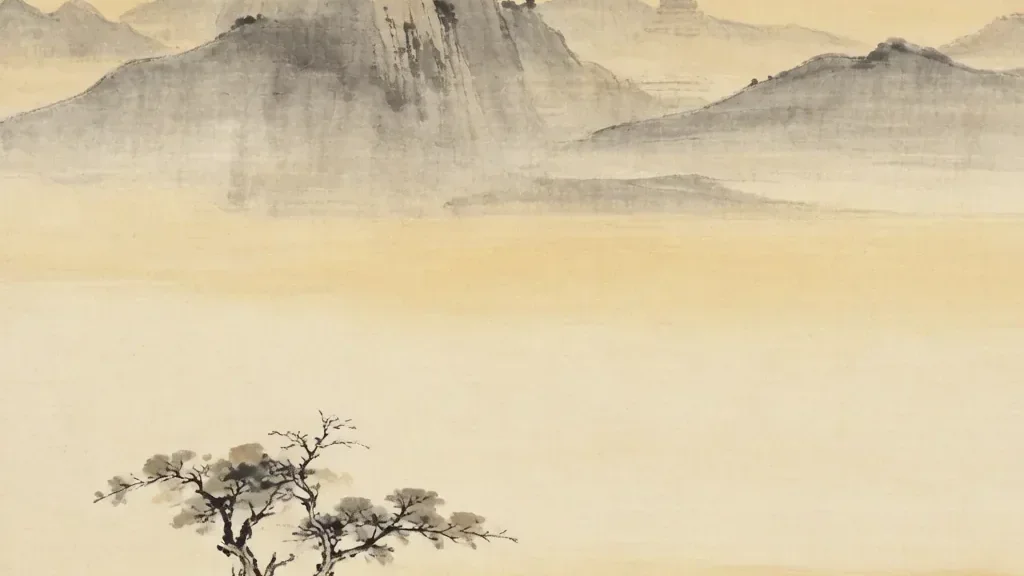
Chinese Buddhist philosophy is the rich tradition of thought that grew as Indian Buddhism took root in China and was transformed by Chinese categories of mind, cosmos, and society. Across two millennia it produced original schools—from the empty-school subtleties of Madhyamaka-influenced Sanlun, through the vast storehouse cosmology of Huayan, to the pure-land faith in Amitabha and the mind-only idealism of Yogacara-influenced Faxiang. Long dismissed in the West as a derivative footnote to Indian Buddhism, Chinese Buddhist philosophy is now recognized as a creative reworking that made Buddhism intelligible to a Confucian-Daoist world and left a permanent mark on Chinese ethics, art, and everyday spirituality.
Arrival and Early Translation
Buddhism entered China along the Silk Roads and sea routes in the first centuries CE, at first as a fringe cult of foreigners. Early translators, working in a Chinese already shaped by Daoist terms, rendered Buddhist concepts with Daoist vocabulary, which both aided and subtly altered understanding.
The great pilgrim-translators Kumārajīva (in the early fifth century) and later Xuanzang (in the seventh) set new standards of accuracy. Xuanzang's journey to India and back became legendary, and his translations of Yogacara texts shaped Chinese scholasticism.
This long translation labor was itself philosophical: every choice of a Chinese term negotiated between Indian doctrine and Chinese intuition.
The Problem of Emptiness and the Sanlun School
Building on the Indian Madhyamaka teaching of śūnyatā (emptiness), the Sanlun ("Three Treatises") school taught that all things are empty of inherent, independent essence. What exists does so only through dependent origination—co-arising with conditions.
The school's dialectic dismantles every fixed view, including the view of emptiness itself, to free the mind from conceptual clinging. Its negative method eerily parallels the Daoist undoing of names, helping Buddhism feel at home in China.
Emptiness here is not nihilism but the open condition that makes change and compassion possible—things are free because they are not frozen essences.
Mind-Only: The Faxiang School
Xuanzang's Faxiang (Dharma-character) school imported the Yogacara analysis of consciousness. It holds that the seemingly external world is a projection of the "storehouse consciousness" (alaya), and that perceived objects are mere "appearances of nothing but mind."
The school meticulously classified mental factors and seeds (bīja) deposited by actions, explaining how karma is stored and ripened. Its eight-consciousness model was a feat of psychological mapping.
Though rigorous, Faxiang's complexity limited its popular spread, but its "mind-only" insight fed directly into the Chinese emphasis on the mind as the seat of liberation.
Huayan: The Jewel-Net of Indra
The Huayan (Avatamsaka) school offered a breathtaking vision of total interpenetration. Its central image is Indra's net of jewels, each reflecting all others, so that every part contains the whole and the whole pervades every part.
Huayan taught that all phenomena are simultaneously identical and distinct, mutually containing one another without obstruction. The smallest atom and the widest cosmos are one suchness seen from different angles.
This philosophy of "dependent arising as perfect interfusion" became a high point of East Asian speculative thought and deeply influenced Chan, which absorbed its non-dual immediacy.
Tiantai: The Threefold Truth
The native Chinese Tiantai school, founded on Chinese soil, taught the "threefold truth": emptiness, conventional existence, and the middle (their non-dual unity). It held that even a single thought contains the whole realm of phenomena—"one thought, three thousand worlds."
Tiantai's meditation aimed at perceiving the suchness of reality directly, integrating doctrine, practice, and the Lotus Sutra's supreme teaching. Its synthesis was both systematic and devotional.
By rooting ultimacy in ordinary experience, Tiantai reinforced the Chinese turn from abstract cosmology to the transformative present moment.
Pure Land: Faith and the Other Power
Pure Land (Jingtu) devotion centered on Amitabha Buddha and his western paradise, where rebirth promises a sure path to enlightenment. Salvation is by "other power"—faith and the invocation of the name (nianfo)—rather than solely by one's own effort.
This offered solace to ordinary people who could not master scholastic subtlety or austere meditation. The simple practice of mindful recitation became the most widespread Buddhist observance in China.
Pure Land shows Buddhism's adaptation to human limitation: grace complements the arduous path of the sage, democratizing liberation.
Buddhism and Chinese Ethics
Buddhism introduced ideas new to China: reincarnation, karma as moral causality, and a strong ethic of non-harm and compassion toward all sentient beings. These enriched the Confucian stress on human relations with a universalist concern.
Yet tension arose: monastic celibacy and departure from family conflicted with Confucian filial piety. Apologists argued that serving all beings and repaying parents' kindness spiritually surpassed mere bodily care.
Over time a synthesis emerged in which Buddhist compassion and Confucian duty coexisted, each tempering the other in Chinese daily morality.
Chan as Chinese Buddhist Philosophy
Chan distilled Buddhist meditation through a Chinese lens of spontaneity and directness, insisting that the Buddha-nature is present in everyone and needs only sudden recognition. Its "no reliance on words" echoed Daoist naturalness.
By internalizing enlightenment as a matter of the everyday mind, Chan completed Buddhism's sinification: the Indian path of monastic discipline became a Chinese way of awakening in the midst of life.
Chan's influence radiated into poetry, painting, and tea, making Buddhist philosophy a texture of Chinese aesthetic experience.
Legacy in Chinese Culture
Chinese Buddhist philosophy endowed the culture with a language of impermanence, compassion, and emptiness that sits alongside Confucian activism and Daoist ease. Temple art, cave sculpture, and scripture-copying are its monuments.
Its concepts migrated into literature and folk religion; notions of karma and rebirth became common currency. Even Confucian and Neo-Confucian thinkers argued against or absorbed its claims.
Monasteries also served as libraries, schools, and workshops of printing and art, preserving texts and skills through turbulent eras and carrying learning across regions. The cave-temples and stone sutras they left are among the great archival treasures of East Asia.
As a creative fusion, Chinese Buddhist philosophy remains a living tradition, practiced and studied from Mount Wutai to the modern city, a testament to thought crossing borders and becoming native.
❓ Frequently Asked Questions
What is Chinese Buddhist philosophy?
It is the creative Chinese reworking of Indian Buddhism through native categories, producing schools like Huayan, Tiantai, Faxiang, Pure Land, and Chan.
What does "emptiness" mean?
Emptiness means things lack independent essence and arise dependently; it is the open condition enabling change and compassion, not nothingness.
What is the Huayan vision?
Huayan teaches total interpenetration: every phenomenon contains and reflects all others, like jewels in Indra's net.
How did Buddhism meet Confucianism?
Tensions over celibacy and filial piety were eased by arguments that universal compassion fulfilled family duty at a deeper level.
Why is Chan important?
Chan sinified Buddhism by locating awakening in the ordinary mind, blending meditation with Chinese spontaneity and shaping art.
Is it still practiced in China?
Yes; Buddhist philosophy and practice remain living traditions across China, from monasteries to lay devotion.