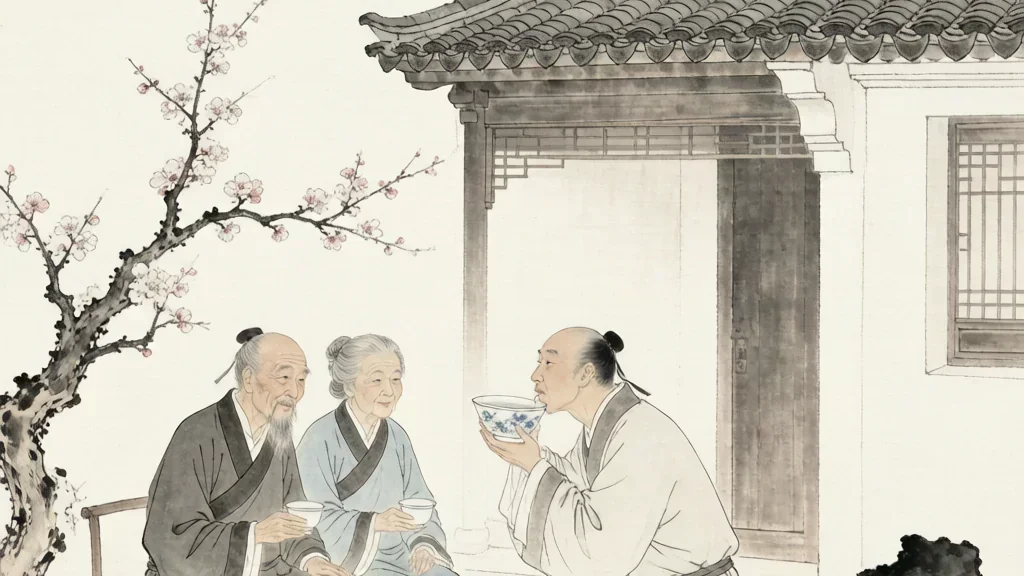
Filial piety, known in Chinese as xiao (孝), is the virtue of respect, care, and devotion toward one's parents and ancestors, and it stands among the oldest and most influential ethical ideals of Chinese civilization. More than a private family feeling, xiao has been a foundation of social order, a subject of classic texts, and a measure of a person's character for over three thousand years. To understand filial piety is to understand how Chinese culture weaves the family into the very fabric of morality, politics, and the continuity of generations.
Definition and Early Roots
The character xiao is traditionally explained as combining "old" (lao) above "child" (zi), picturing a child supporting an elder—an image of care across generations. The virtue appears in the earliest Chinese writings, including the Book of Songs and the Book of Documents, where good rulers and good sons are praised together, implying that family devotion and political virtue spring from the same root.
In the Zhou dynasty, ancestor veneration was already central to religious and political life. The living owed the dead continued remembrance through rites, sacrifices, and the preservation of the family line. Filial piety thus joined everyday care for parents with a solemn duty toward ancestors stretching back through the generations.
By the time of Confucius, xiao had become a cardinal human excellence. Confucius taught that a person who is filial at home will naturally be loyal and responsible in public life, so the family was the first school of citizenship.
Filial Piety in the Confucian Tradition
The Analects records many of Confucius's sayings on xiao. He insisted that merely feeding one's parents is not enough; even dogs and horses are fed. What makes the relation filial is the attitude of reverence and joy in serving them. A son should also be careful of his body and conduct, since these are gifts from the parents and dishonoring them is itself a form of unfilialness.
Confucius's disciple Zengzi became especially associated with the teaching of filial piety, and later tradition attributed to him the classic known as the Xiaojing, or Classic of Filial Piety. That short text presents xiao as the root of all virtue and the starting point of education, linking it explicitly to loyalty to the ruler.
Mengzi (Mencius) further developed the natural basis of filial love, arguing that even a newborn infant knows to pity and care, and that the love of parents is among the "four beginnings" of moral feeling planted in human nature. For the Confucians, filial piety was neither forced nor optional but the most immediate expression of our social birth.
The Classic of Filial Piety
The Xiaojing is a compact dialogue, largely between Confucius and Zengzi, that became one of the most widely circulated texts in imperial China, recited by children and inscribed for the public. It opens with the claim that the body, hair, and skin are received from parents and must not be damaged—establishing self-care as a filial duty.
The text then extends filial piety upward: a commoner practices it by serving parents; an official by serving the ruler with the same loyalty; the sage-king by bringing peace to all under heaven so that every family can be cared for. In this way xiao becomes the thread connecting the household to the empire.
Notably, the Xiaojing also grants the son a moral standing: if a parent errs, the child should remonstrate respectfully, not blindly obey. This qualification shows that classical filial piety included the courage to correct, balanced by deep respect.
Filial Piety and the Family Structure
In the traditional Chinese family, filial piety structured daily life. Sons were expected to support aging parents, to live near them when possible, and to carry on the ancestral rites after their death. Daughters, upon marriage, owed primary devotion to the husband's family, a pattern that reflected the patrilineal organization of society.
The virtue also governed mourning. The prescribed period of mourning for a parent was three years (loosely observed as twenty-seven months), during which an official might leave office and a son would withdraw from normal pleasures. This extended grief was taken as the natural measure of gratitude for the years of a parent's care in infancy.
Respect extended beyond the living. Keeping the family genealogy, tending graves, and making seasonal offerings sustained the bond with ancestors. Through these acts, the individual understood himself as a link in a chain longer than his own life.
The Twenty-Four Filial Exemplars
A later popular work, the Ershisi Xiao or "Twenty-Four Filial Exemplars," compiled in the Yuan dynasty, told stirring stories of extraordinary devotion: a son who lay naked on ice to melt it for carp his mother craved, another who entertained his parents by dressing as a child, and one who sacrificed his own son during famine to feed his mother. These tales spread xiao widely among ordinary people.
The collection shows both the appeal and the danger of the ideal. The stories inspire tenderness and gratitude, yet some encourage extreme, even self-destructive acts that later critics found unreasonable. They reveal how a gentle virtue could be pushed toward rigid demand.
Still, as folk literature the Exemplars shaped popular imagination for centuries, teaching children through vivid narrative that devotion to parents was the heart of being human. Their influence can be seen in operas, prints, and household wall charts across East Asia.
Filial Piety and Politics
Confucian political theory treated the family as the model for the state. The ruler was "the father and mother of the people," and a son's loyalty (zhong) to the ruler paralleled his filiality to the father. Good government, on this view, was simply large-scale family care.
This linkage had practical effects. Imperial law protected parents' authority and punished unfilial conduct severely; at the same time, it occasionally allowed a son to shield a father who had broken the law, on the theory that exposing him would violate the deeper bond. The tension between legal duty and family loyalty was a recurring dilemma in Chinese jurisprudence.
The state also promoted xiao as stability policy. By honoring aged subjects and publicizing exemplars of filial conduct, rulers encouraged a population orderly at home and therefore easier to govern. Filial piety was, in this sense, both a private sentiment and a public institution.
Criticism and Modern Changes
Filial piety has not escaped criticism. The May Fourth reformers of the early twentieth century attacked "filial tyranny," blaming rigid family authority for suppressing individuality and blocking national renewal. They mocked the extreme Exemplars and called for freer relations between the generations.
Legal and social change further eroded the old structures. The Republican and later reforms weakened patrilineal law, raised the status of women, and shifted care for the elderly toward public institutions and pensions rather than sole reliance on sons. Urban life and migration scattered families across cities and provinces.
Yet xiao did not vanish. Surveys and daily life show that respect for parents remains strong in Chinese societies, even when expressed in new forms—regular phone calls, financial support, concern for health—rather than co-residence and three-year mourning. The feeling outlasted the old institutions that carried it.
Filial Piety Today
In contemporary China and the Chinese diaspora, filial piety survives as a living, if flexible, value. Laws in some regions formally require adult children to visit and support aging parents, reflecting official worry about the care of a rapidly aging population. Family reunions at Spring Festival remain the great annual expression of filial and ancestral ties.
Modern writers often distinguish a "healthy" filial piety—gratitude, care, and respect—from a "toxic" version that demands blind obedience or the sacrifice of the self. This echoes the classical qualification that a good child remonstrates with a mistaken parent rather than submitting to harm.
For students of Chinese culture, xiao remains a key that unlocks much else: the weight of family obligation, the reverence for elders, the continuity of the lineage, and the way private virtue and public order have been imagined as one. To know filial piety is to know a civilization's sense of time, debt, and love.
❓ Frequently Asked Questions
What is filial piety in Chinese culture?
Filial piety (xiao) is respect, care, and devotion to parents and ancestors. It has been a foundation of family life, morality, and political order for over three thousand years.
What does the Classic of Filial Piety teach?
The Xiaojing presents xiao as the root of all virtue, links care for parents to loyalty to the ruler, and teaches that one should respectfully remonstrate if a parent errs.
Why were the Twenty-Four Filial Exemplars important?
This Yuan-era collection spread the ideal through vivid stories of devotion, shaping popular culture, though some tales encouraged extreme acts later critics found unreasonable.
How did filial piety connect to politics?
Confucian theory treated the ruler as "father and mother of the people," so loyalty to the state paralleled filial devotion, and the family was seen as the model for good government.
Is filial piety still practiced today?
Yes, though in adapted forms such as financial support, regular contact, and festival reunions, alongside laws in some regions requiring children to care for aging parents.
Did Confucians demand blind obedience?
No. Classical texts taught respectful remonstrance: a good child corrects a mistaken parent rather than submitting to harm, balancing obedience with moral courage.