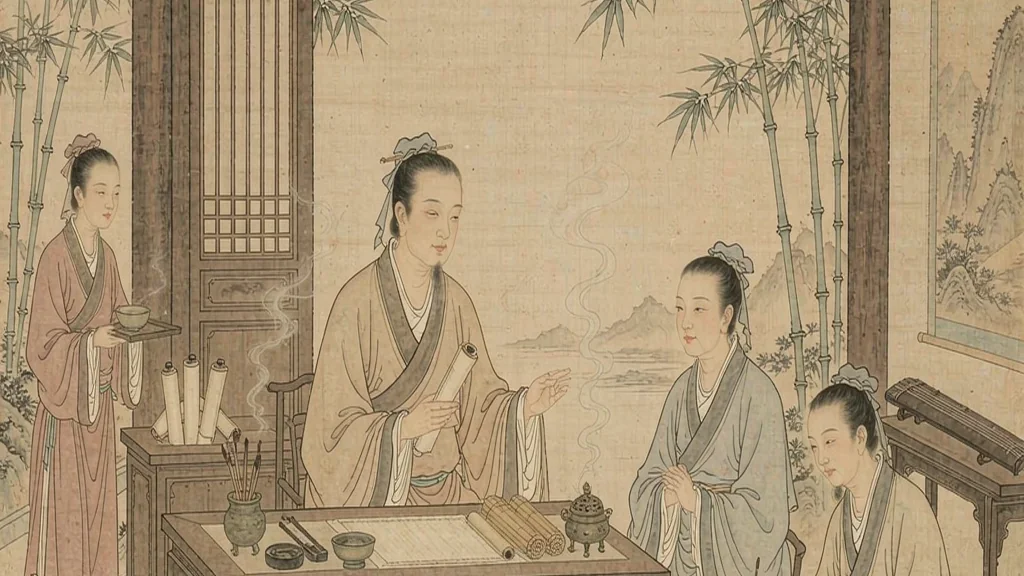
New Text Confucianism (jinwen jingxue) designates the study of the Confucian classics as they were reconstructed after the Qin book-burnings and written down in the contemporary Han clerical script. Transmitted first orally by surviving scholars, these versions nourished the officially sponsored Confucianism of the Western Han. Distinctive for its reliance on the Gongyang Commentary, its openness to portents and prophecy, and its reformist political temperament, New Text learning later clashed bitterly with the Old Text school and enjoyed a dramatic revival in the late imperial reform movement.
Recovery After the Qin Fires
When the Qin suppressed the old feudal literati and burned many books, Confucian learning survived among scholars who had memorised the classics and among a few hidden manuscripts. Under the Han, these men dictated the texts, which scribes recorded in the clerical script of the day.
Because that script was "current" (jin) rather than archaic, the texts became known as "New Text." Their authority rested on a chain of living memory rather than on ancient graphs.
The Gongyang Commentary
The heart of New Text exegesis was the Gongyang Commentary on the Spring and Autumn Annals. Unlike the more historical Zuo Commentary favoured by Old Text scholars, Gongyang read the Annals as a cipher of Confucius's hidden judgments on rulers.
This "subtle words and great meanings" (weiyan dayi) method treated the classic as a constitutional manual, encoding principles of righteous succession, punishment of usurpers, and the unity of the realm under moral authority.
Portents and the "Subtle Words"
New Text scholars were keenly interested in anomalies—eclipses, comets, floods—as Heaven's warnings to the ruler. Dong Zhongshu, the school's great systematiser, argued that the sovereign's virtue or vice was reflected in the natural order.
This "interaction of Heaven and humankind" (tianren ganying) gave the classics a political edge: a calamity was a rebuke, and reform was the proper response. Prophecy and statecraft were thus woven together.
Dong Zhongshu and Imperial Confucianism
Dong Zhongshu is the towering figure who shaped New Text thought into the ideology of the Han state. He proposed aligning the realm's institutions with cosmological categories and elevating Confucian learning above the "hundred schools."
Under his influence the Han court established the Confucian classics as the core of the imperial academy, creating the examination-and-orthodoxy system that would define China for two millennia.
Weft Texts and Apocrypha
A striking offshoot was the production of chenwei—"apocrypha" or "weft" texts—that paired the canonical "warp" classics with revealed, often prophetic, supplements. These flourished especially in the later Han and blurred scripture with omen lore.
Orthodox critics later condemned the weft texts as spurious, but they show how far New Text cosmology was willing to go in linking cosmos, kingship, and fate.
The Clash With Old Text
As Old Text manuscripts surfaced and gained scholarly prestige, a contest opened over which versions and commentaries were authentic. Old Text partisans mocked New Text prophecy as superstition and favoured steadier ritual scholarship.
For centuries the two traditions jostled within the academy. New Text retained strength through the Gongyang line, but Old Text gradually captured the standard canon by the Tang.
The Late-Qing Revival
In the nineteenth century the reformer Kang Youwei resurrected New Text learning as a weapon for change. He read the Gongyang Commentary as a charter for institutional reform and progress, not just ritual orthodoxy.
Kang went further, controversially claiming the Old Text classics were forged by Liu Xin—a claim that reignited the ancient controversy as a live political debate on the eve of the empire's fall.
Why New Text Mattered Politically
New Text Confucianism was never merely academic; it was a theory of legitimate power. By binding the ruler's conduct to Heaven's signs, it gave officials a sanctioned language for remonstrance and reform.
This activist temper—using the classics to demand change—is what distinguishes it from the more conservatively philological Old Text school, and what made it attractive to modern reformers.
Reading New Text Today
The best entry is the Gongyang Commentary and the writings of Dong Zhongshu, approached not as dry exegesis but as political theology. The portent language reads oddly now, but its core claim—that power is answerable to a moral cosmos—still resonates.
Studying New Text also clarifies how flexible Confucianism was: the same canon could underwrite both imperial stability and radical reform, depending on who interpreted it.
The Gongyang Theory of Historical Judgment
At the centre of New Text exegesis lay a distinctive theory of history. The Gongyang Commentary taught that Confucius, denied the office to reform the world directly, encoded his judgments in the bare entries of the Spring and Autumn Annals, distinguishing the "new" from the "old," rewarding the righteous and condemning the usurper. Later New Text scholars such as He Xiu systematised this into a three-stage scheme of historical evolution toward a unified, peaceful realm.
This made the classics not a record of the past but a blueprint for the future, a constitution written in miniature. The activist implication was clear: the scholar's task was to decode the master's intent and apply it to present reform. No other school read the classics with quite this constitutional urgency.
New Text and the Reform of the Examinations
Because New Text learning shaped the Han academy, it also shaped who passed into office. The Gongyang Commentary and the portent theory entered the curriculum and the expectations of candidates, so that a degree-holder was fluent in the language of Heaven's warnings. When Dong Zhongshu's vision became orthodoxy, the examination hall effectively tested a candidate's grasp of New Text political theology.
The later rise of Old Text therefore reshaped not only scholarship but recruitment itself, as the Tang canon shifted the texts officials had to master. The New Text-Old Text contest was thus fought on the most practical ground imaginable: the syllabus by which the empire chose its rulers.
The political weight of the curriculum meant that a shift in favoured commentary could alter the temper of an entire official class. When New Text waned and Old Text rose, the men entering government were trained less in portent and reform and more in steady ritual and philology. The classroom was thus a quiet engine of state, and the dispute a struggle over the empire's future personnel as much as its past texts.
❓ Frequently Asked Questions
What is New Text Confucianism?
It is the study of classics recovered orally after the Qin and written in Han clerical script, emphasising the Gongyang Commentary and portent-based politics.
Who was Dong Zhongshu?
He was the Western Han thinker who systematised New Text learning, linked Heaven and the ruler, and helped make Confucianism the state orthodoxy.
What is the Gongyang Commentary?
A reading of the Spring and Autumn Annals that finds hidden moral judgments by Confucius, used by New Text scholars as a guide to legitimate rule.
How did it differ from Old Text?
New Text favoured oral tradition, prophecy, and reform; Old Text favoured ancient manuscripts, philology, and steadier ritual scholarship.
Why was it revived in the Qing?
Kang Youwei reinterpreted New Text learning as a charter for institutional reform, turning an ancient exegetical dispute into modern politics.
Does the school survive today?
As a living tradition it faded, but its methods and reformist spirit are studied and occasionally invoked in modern debates about Confucian political thought.