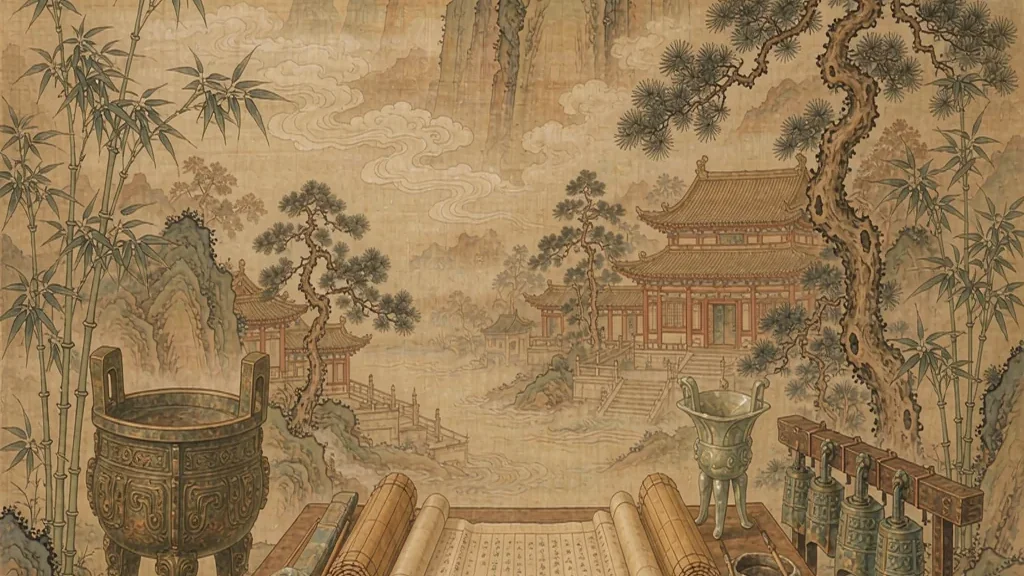
The Confucian classics (rujia jingdian) are the canon of texts venerated by the Ru tradition from the Han dynasty onward as the authoritative expression of the sage-kings' and Confucius's teaching. Growing from the early "Five Classics" to the "Thirteen Classics" and, in everyday study, the "Four Books," this body of literature shaped Chinese education, government, and family life for two thousand years. To understand the classics is to understand the script by which imperial China read its own civilisation.
The Five Classics
The earliest core was the "Five Classics": the Classic of Poetry (Shijing), the Classic of Documents (Shujing), the Rites (Liji and related ritual texts), the Spring and Autumn Annals (Chunqiu), and the Changes (Yijing). Each was thought to preserve a facet of antiquity's wisdom.
The Poetry taught feeling and propriety through song; the Documents preserved speeches of early rulers; the Rites encoded ceremony; the Annals gave a moral chronology; the Changes revealed cosmic pattern. Together they formed a complete curriculum of the cultivated person.
The Poetry and the Documents
The Shijing collects some three hundred poems of court, folk, and sacrificial life, valued for the "rectification" of feeling they trained. Confucius reportedly said that through the Poetry one learns the names of birds, beasts, and plants—and, more importantly, how to speak and feel rightly.
The Shujing gathers alleged proclamations and counsels from mythic and early dynastic rulers, modelling the rhetoric of virtuous authority. Both texts were memorised by every schoolboy in the exam system.
The Rites and the Annals
The ritual classics—especially the Liji—spelled out the ceremonies, family duties, and social gradations that Confucians believed held society together. Ritual was not etiquette but the grammar of a humane order.
The Chunqiu, a terse chronicle of Lu, was expounded through commentaries (Zuo, Gongyang, Guliang), each finding in its brevity a coded moral judgment. The Annals thus became the seedbed of classical exegesis.
The Yijing (Changes)
The Yijing began as a divination manual of hexagrams built from broken and unbroken lines, later furnished with appended philosophical commentaries (the "Ten Wings"). It bridged cosmology and ethics, showing how change itself follows principle.
Though the most oracular of the classics, it became central to Neo-Confucian metaphysics, supplying the image of ceaseless generative transformation that thinkers from Zhou Dunyi onward elaborated.
The Four Books
In the Song dynasty, Zhu Xi elevated four shorter texts—the Analects, Mengzi, Great Learning, and Doctrine of the Mean—into the "Four Books" as the essential introduction to the classics. Henceforth the exam system tested these first.
This reordering shifted emphasis from archaic state documents to personal cultivation and the words of Confucius and Mencius, making the tradition more inward and pedagogical.
The Thirteen Classics
Later scholarship consolidated the expanding commentarial literature into the "Thirteen Classics," adding texts such as the Zuozhuan, the Book of Filial Piety, and the Erya dictionary. This was the mature canon taught and printed in imperial academies.
The Thirteen represent the classic plus its authorised explanations—a reminder that in China the "text" always included its interpretive tradition.
Exegesis and the Academy
Because the classics were brief and ancient, commentary was unavoidable. Generations of scholars produced ever-growing glosses, and mastery meant navigating Old Text versus New Text, Han versus Song readings.
The imperial academy and local schools drilled the canon relentlessly; to be "learned" (ru) was, concretely, to know these books. They were the ladder into office and respect.
The Classics and the State
From the Han, the classics underwrote the civil service examinations, so that the content of the canon was also the content of government recruitment. What the literati studied, the empire administered by.
This fusion of text and power gave the classics unmatched cultural authority—and made them a target when later reformers wanted to change China, as in the New Culture Movement.
Modern Fate of the Canon
In the twentieth century the classics were attacked as obstacles to modernity, then later revived as cultural heritage. Today they are studied as literature, philosophy, and history rather than as state doctrine.
Their survival as living reading confirms their depth: whatever one thinks of their politics, they remain a uniquely sustained conversation across two millennia of Chinese thought.
How to Begin Reading
New readers should start with the Analects and Mengzi for accessible moral reflection, then sample the Poetry for its humanity, before approaching the more technical Rites and Changes.
The classics reward patience: they are less a system to be mastered than a library to be revisited, each return revealing how later China read its own foundations through them.
The Classics in Daily and Family Life
Beyond the examination hall, the classics saturated ordinary family life. The "Book of Filial Piety" and the "Doctrine of the Mean" supplied the language in which households taught respect, moderation, and the duties between generations. Children learned to recite passages at home long before they entered school, and moral tales drew their examples from the Documents and the Annals.
In this way the canon was not only a state instrument but a vernacular ethics, rehearsed at the dinner table and at the ancestral altar. Its sayings became proverbial, so that even villagers who never sat an exam absorbed the classics' values through repetition and example rather than through commentary.
The Classics and Later Transmission Abroad
The Confucian canon travelled with Chinese culture across East Asia. In Korea, Vietnam, and especially Japan, the same Five Classics and Four Books became the core of learned education, copied, printed, and annotated in local scholarly traditions. The Vietnamese and Korean examination systems, like the Chinese, rested on classical mastery.
This regional spread made the classics a shared civilizational text for the whole Sinographic world, read from the same editions and debated through the same commentaries. To study the Confucian classics is therefore to study not only China but a millennium-spanning literary republic that stretched far beyond any single dynasty's borders.
The classics also fed the arts of letter-writing, painting, and calligraphy, whose practitioners quoted them to lend weight and elegance to personal expression. A scholar's brushwork or a friend's epistle might invoke the Documents or the Poetry to make a point, so that the canon lived not only in halls of state but in the intimate literacy of everyday refinement. The texts thus became a shared poetic resource as much as a moral code.
❓ Frequently Asked Questions
What are the Confucian classics?
They are the canonical texts venerated by the Ru tradition, growing from the Five Classics to the Four Books and the Thirteen Classics.
What are the Five Classics?
The Poetry, Documents, Rites, Spring and Autumn Annals, and Changes—each preserving a facet of ancient wisdom.
What are the Four Books?
The Analects, Mengzi, Great Learning, and Doctrine of the Mean, elevated by Zhu Xi as the core exam curriculum.
How did the classics shape government?
They supplied the content of the imperial examinations, so what literati studied was how the empire recruited its officials.
What is the Yijing's role?
It began as a divination text and became a metaphysical source for Neo-Confucian ideas of ceaseless transformation.
Are the classics still read today?
Yes, as philosophy, literature, and heritage, though no longer as state orthodoxy; they remain a living part of Chinese culture.