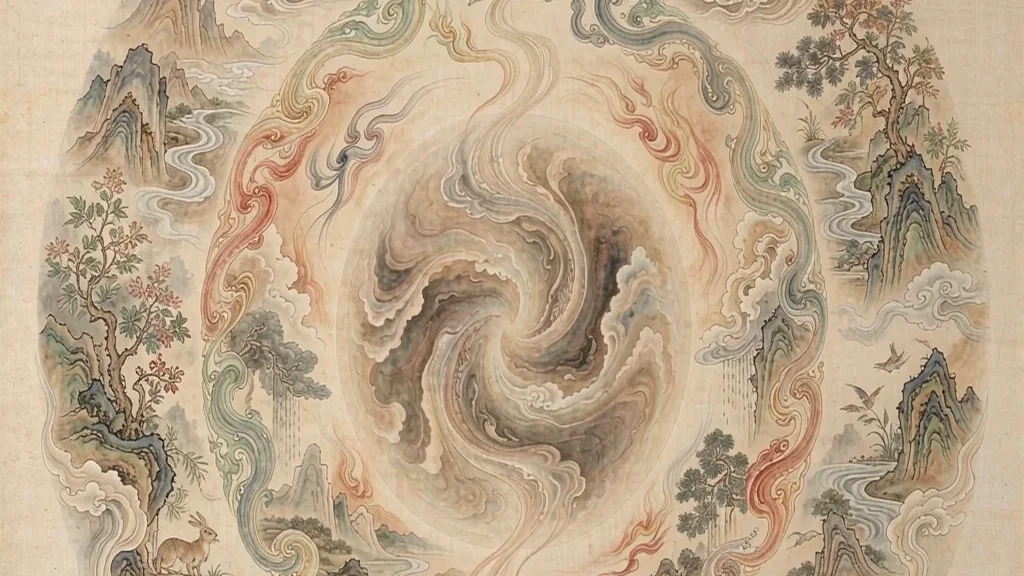
The Yijing, or Book of Changes, is among the most ancient and most puzzling classics of Chinese civilization. Part divination manual, part philosophy text, it presents a cosmos in perpetual motion, encoded in sixty-four hexagrams built from stacked broken and unbroken lines. Across more than two millennia, rulers, scholars, and ordinary people have consulted it for guidance, while philosophers from Confucians to Daoists have read into it a profound teaching about change, moderation, and the interdependence of opposites. Its cosmology—of cyclical transformation, of qi flowing through images, and of the human mind as a participant in the unfolding of events—remains a cornerstone of Chinese ways of seeing the world.
Origins and Layers of the Text
Tradition credits the Yijing's making to several culture heroes: Fu Xi who drew the eight trigrams, King Wen who named the sixty-four hexagrams during his imprisonment, and the Duke of Zhou who composed their line statements. The Confucian philosopher Confucius is said to have added the "Ten Wings," the commentaries that turned an oracle into a book of wisdom.
Modern scholars see a longer evolution. The core hexagram names and judgments likely formed by the late Western Zhou, growing out of milfoil-divination practice. The commentaries (the "Wings") are later, mostly Warring States and Han compositions reflecting classical philosophy.
Thus the Yijing is a stratifié text: an archaic divination core wrapped in increasingly reflective interpretation, which is precisely why it can serve both as a fortune-telling tool and as a metaphysical treatise.
The Structure: Lines, Trigrams, Hexagrams
The basic unit is the line: a solid yang line (—) and a broken yin line (--). Three lines stacked make a trigram (gua); eight trigrams combine pairwise into sixty-four hexagrams, each six lines long, representing a situation or phase of change.
Each hexagram has a name, a judgment (tuan), and six line statements that describe the shifting condition of each position from bottom to top. Some hexagrams also carry image-statements (xiang) likening the hexagram to a natural scene—water over fire, thunder under the mountain—and drawing a moral.
Reading the Yijing means attending to the particular lines that are "changing" in a cast, because change is the whole point: a situation is never fixed but always becoming its opposite or successor.
Change as the Fundamental Principle
The book's Chinese name, Zhouyi or Yijing, announces its subject: yi means "change." The cosmology it teaches is one of incessant transformation. Day becomes night, growth yields to decay, fortune turns to misfortune, and the wise person flows with the current rather than resisting it.
The famous "Great Commentary" says that "change is the gateway whereby the inexhaustible is made actual." Because everything moves in cycles, the consulter is taught not fatalism but responsiveness: recognize the phase you are in, and act accordingly while the moment is ripe.
This dynamic view contrasts with static ontologies. For the Yijing, being is process; to exist is to be changing, and wisdom is timing—knowing when to advance and when to withdraw.
Yin-Yang and the Cosmos in the Hexagrams
Though the Yijing predates the full yin-yang terminology, its line logic is the ancestor of that cosmology. The unbroken and broken lines are already yang and yin, and the hexagrams display their interplay—balance, excess, transition.
The two "primordial" hexagrams, Qian (pure yang, heaven) and Kun (pure yin, earth), open the sequence as the parents from whom the other sixty-two arise. Their statements praise the creative power of heaven and the receptive yielding of earth, a cosmic polarity that structures all later thought.
Through the commentators, the Yijing became the scriptural base for the whole yin-yang and Five-Phase worldview, linking divination to natural philosophy.
The Ten Wings and Confucian Readings
The "Ten Wings" (Shiyi) are commentaries that reinterpret the oracle morally and metaphysically. They include the "Great Commentary" (Dazhuan), the "Treatise on the Trigrams," and essays on the judgments and images. Together they elevate the text into a guide for self-cultivation.
Confucians read the Yijing as a book of careful conduct: each line warns of danger in excess and blesses restraint and centrality. The middle lines of a hexagram are often auspicious because balance is virtuous; the extremes are perilous because they invite reversal.
For the Confucian tradition, consulting the Changes was less about predicting the future than about examining one's heart and aligning action with the dao of the moment—a practice of ethical reflection.
Daoist and Cosmic Interpretations
Daoists heard in the Yijing a hymn to natural spontaneity. The image-statements frequently say "hence the superior person" should model a virtue on a natural pattern, echoing the Daoist attunement to the way things are.
In later esoteric Daoism and alchemy, the hexagrams became maps of the body and the cosmos, with the breathing of yin and yang visualized as internal circulation. The sequence of hexagrams was even read as a calendar of the year's energies.
The Yijing thus served as a shared symbolic bank that both Confucians and Daoists could draw upon, one reason it attained canonical status above nearly every other classic.
The Yijing as Divination
Practically, the Yijing was and is consulted by casting—traditionally with yarrow stalks, later with coins. The procedure generates a hexagram plus, often, a second "changed" hexagram showing where the situation is heading, and the reader interprets the judgments.
The divinatory act is not understood as mechanical fate but as a focusing of attention. The scholar Shao Yong and others built elaborate diagrams mapping the hexagrams to time and space, turning consultation into cosmology.
For ordinary users across the centuries, the book offered not certainty but a structured prompt for deliberation—a way to externalize a dilemma and see it reframed in archetypal terms.
Influence on Science, Art, and Letters
The Yijing's binary line structure fascinated early European thinkers; Gottfried Leibniz saw in the broken and unbroken lines a foreshadowing of his binary arithmetic, though the historical link is loose. Its diagrams influenced Chinese mathematics, music theory, and medicine.
Painters and poets invoked its imagery of mountain and water, thunder and wind, to convey the living motion of nature. The "river chart" and "luo writing" numerological diagrams attached to it seeded Chinese cosmological mathematics.
In literature, allusion to a hexagram's situation became a refined way to comment on politics or fate, so deeply was the book woven into elite literacy.
Modern Reception and Scholarship
In the twentieth century the Yijing was sometimes dismissed by iconoclasts as superstition, yet it also drew serious philosophical interest in the West as an example of correlative thinking. Scholars such as Joseph Needham discussed its place in Chinese science's holistic outlook.
Today it is studied both as an ancient divination practice and as a source of ecological, process-oriented philosophy that resonates with modern systems and complexity theory. Its emphasis on cyclic change and relational balance speaks to contemporary concerns about sustainability.
Whether opened for guidance or read as philosophy, the Book of Changes endures as a uniquely Chinese meditation on the one thing it insists is constant: change itself.
❓ Frequently Asked Questions
What is the Yijing?
The Yijing, or Book of Changes, is an ancient Chinese classic combining divination with philosophy, built from sixty-four hexagrams of yin and yang lines.
How is it structured?
Eight trigrams of three lines combine into sixty-four six-line hexagrams, each with a name, a judgment, and six line statements.
What is its core idea?
Its core idea is change: reality is perpetual process, and wisdom lies in timing action to the phase of the moment.
Is it only for fortune-telling?
No. Though used for divination, its commentaries make it a guide for ethical reflection and cosmological understanding.
How did Confucians read it?
They stressed balance, centrality, and restraint, reading the hexagrams as lessons in virtuous conduct.
Why is it still important?
Its process-based, relational cosmology informs Chinese medicine, art, and thought, and attracts modern interest in holistic philosophy.