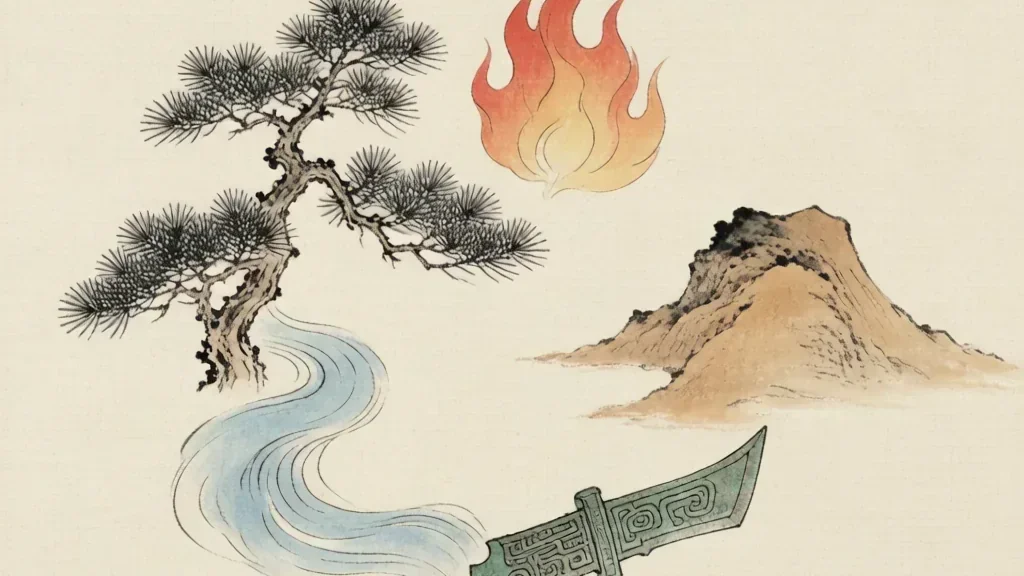
The Five Elements, known in Chinese as wuxing (五行)—usually given as wood, fire, earth, metal, and water—form a framework in traditional Chinese thought for understanding how things in the cosmos relate, transform, and succeed one another. More than physical substances, the five phases are modes of energy and change, used to organize medicine, the calendar, music, astrology, and statecraft. Alongside yin-yang, the Five Elements is one of the two great classificatory systems through which classical China made sense of a world in constant motion.
What the Five Elements Are
The term wuxing is better translated "five phases" or "five movements" than "elements," since xing means "to move, to act." Wood, fire, earth, metal, and water are not static building blocks like the Greek elements but dynamic states in a cyclical process of generation and transformation.
Each phase has associated qualities: wood is sprouting and soft, fire is blazing and upward, earth is nourishing and central, metal is contracting and downward, water is penetrating and downward-storing. These qualities let the system classify almost anything—seasons, directions, colors, organs, emotions, even dynasties.
The earliest clear statement appears in the Warring States period, especially in the "Great Plan" (Hong Fan) chapter of the Book of Documents, which lists the five as water, fire, wood, metal, and earth with their tastes and natural signs.
The Cycle of Generation and Control
The phases relate through two main cycles. In the generating (sheng) cycle, wood feeds fire, fire makes earth (ash), earth bears metal, metal carries water (as condensation), and water nourishes wood—a circle of mutual support.
In the controlling (ke) cycle, wood parts earth (roots), earth dams water, water quenches fire, fire melts metal, and metal cuts wood—a circle of mutual restraint that keeps any phase from dominating. Health and harmony depend on these cycles staying in balance.
This double relationship is the system's cleverness: nothing is simply good or bad; each phase both supports and checks others. Disorder arises when generation fails or control becomes oppression, a pattern applied equally to bodies and to states.
The Elements and the Seasons
Wuxing maps neatly onto the year's rhythm. Wood belongs to spring, the time of growth; fire to summer, of fullness and heat; metal to autumn, of harvest and decline; water to winter, of storage and rest. Earth occupies the center and the late-summer transition, the pivot between seasons.
This correspondence let agricultural societies time their labor to the cosmic cycle. Rulers, too, were advised to change policies with the seasons: spring for mercy and planting, autumn for judgment and gathering—aligning human affairs with the phase in ascendancy.
Music and color followed the same logic. Each phase had a corresponding note, color, and even grain, so that a properly ordered court would tune its rituals to the season's phase, keeping heaven, earth, and man in step.
Five Elements in Chinese Medicine
Traditional Chinese medicine uses the five phases to organize the body's systems. Each phase corresponds to an organ pair, a tissue, an emotion, a taste, and a sense: wood to liver and gall bladder, fire to heart and small intestine, earth to spleen and stomach, metal to lungs and large intestine, water to kidneys and bladder.
Disease is interpreted as imbalance among the phases—for example, "wood overacting on earth" might describe liver energy disturbing the spleen, producing digestive trouble. Treatment seeks to strengthen the weak phase or soften the overbearing one, restoring the generating and controlling cycles.
The system also guides diagnosis by observation: a sallow complexion might point to earth-phase imbalance, a reddish face to fire. In this way wuxing is not abstract cosmology but a working clinical map taught to physicians for centuries.
Five Elements and Yin-Yang
Wuxing and yin-yang are complementary, not rival, systems. Yin and yang describe the polar, alternating quality of any process; the five phases describe its fivefold developmental structure. Together they give a rich grammar for change.
Each phase contains yin and yang aspects. Wood, for instance, has a yin expression (soft growth) and a yang one (upward thrust); water has still yin depths and active yang currents. The two systems are layered so that any phenomenon can be placed on both axes at once.
Medical and cosmological texts routinely combine them: a condition might be diagnosed as "yang excess in the fire phase," showing how the frameworks interlock. Neither alone was considered sufficient to explain the world's complexity.
Five Elements in Astrology and Destiny
In Chinese astrology, each year is assigned one of the five phases and one of the twelve animals, producing a sixty-year cycle. A person's "element" is thought to color temperament and compatibility: a "fire" person is said to be warm and impulsive, a "water" person calm and adaptable.
The system also entered fengshui and the selection of auspicious days, where the phase of a proposed action had to harmonize with the phases of the time and place. Builders might avoid earth-breaking in a conflicting phase, seeking alignment with the flow of qi.
Although such practices are not scientific, they show the depth of the framework: wuxing offered a total vocabulary for timing and relationship, used by ordinary people as well as specialists.
Political and Historical Uses
Perhaps the most famous political use is the "Five Virtues" (wude) theory, by which a dynasty's legitimacy was linked to a phase. The Zhou claimed fire, the Qin claimed water (which conquers fire), and later dynasties identified their phase by the control or generation cycle, often changing color rituals and even the calendar to match.
This gave the succession of dynasties a cosmic rhythm: each rose under its phase, flourished, and was replaced by the phase that overcame it. The theory reassured subjects that even rebellion could be part of an orderly cosmic sequence.
Emperors thus performed elaborate ceremonies keyed to their dynasty's phase, wearing its color and facing its direction. Wuxing was, in this sense, a technology of legitimacy as much as a natural philosophy.
Five Elements in Everyday Culture
The framework saturates daily life. The five flavors—sour, bitter, sweet, pungent, salty—map to the phases and guide diet; the five directions include the center; the five colors (green, red, yellow, white, black) appear in festival decoration and clothing.
Martial arts and crafts assigned techniques and materials to phases. Even cuisine balances the five flavors in a meal to keep the body's phases in tune, a culinary echo of the medical system.
Because the scheme is so flexible, it survived every dynasty and remains a living part of Chinese cultural literacy. To know the five phases is to hold a key that unlocks medicine, festival, food, and cosmology at once.
Modern Perspective
Today wuxing is studied as a sophisticated early system of relational thinking rather than as physical chemistry. Its value lies in modeling processes, feedback, and balance—ideas that resonate with modern systems and ecological thought.
Within traditional medicine and practices, the five-phase logic continues to be taught and applied, though increasingly alongside biomedical approaches. Many practitioners treat it as a useful organizing metaphor rather than a literal mechanism.
For the cultural learner, the Five Elements offers a window into a worldview that prefers relationship over substance, cycle over stasis, and balance over dominance—a vision of reality as an endless, self-regulating dance of phases.
❓ Frequently Asked Questions
What are the Five Elements in Chinese thought?
Wuxing are five phases—wood, fire, earth, metal, water—understood as dynamic modes of energy and change rather than static substances, used to classify and relate phenomena.
What is the difference between generating and controlling cycles?
The generating cycle shows phases nurturing one another (wood feeds fire, etc.); the controlling cycle shows them restraining one another (wood parts earth, etc.), keeping balance.
How are the Five Elements used in medicine?
Each phase corresponds to organ pairs, emotions, tastes, and tissues; illness is read as imbalance among phases, and treatment restores the generating and controlling cycles.
How do the Five Elements relate to yin-yang?
They are complementary: yin-yang describes polar alternation, wuxing describes fivefold development. Together they give a full grammar for change and are often combined.
Did dynasties use the Five Elements?
Yes. The "Five Virtues" theory linked each dynasty to a phase for legitimacy, with matching colors, directions, and calendars; the Qin claimed water to conquer Zhou's fire.
Are the Five Elements still relevant?
They remain part of traditional medicine, diet, and cultural literacy, and are valued today as a relational, systems-oriented way of thinking about balance and change.