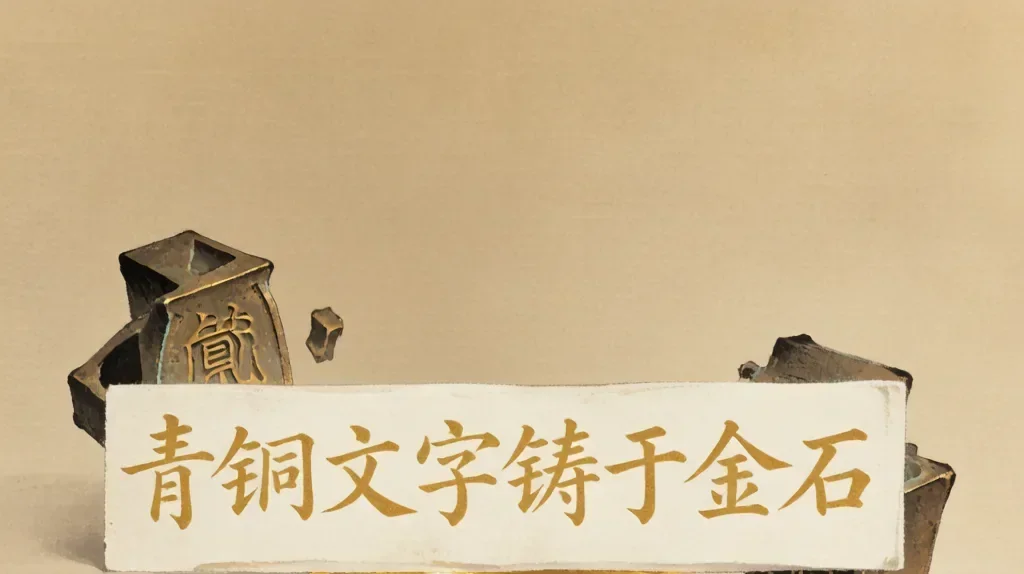
Bronze inscriptions (金文, jīnwén), often called "metal script," are Chinese characters cast or engraved on ritual bronze vessels from the Shang and Zhou dynasties onward. They represent a crucial stage in the evolution of Chinese writing — later than oracle-bone script and earlier than the seal script that followed. Because bronzes were made for worship, commemoration, and display of status, their inscriptions record ancestors, appointments, gifts, and treaties, giving modern readers some of the oldest continuous glimpses of Chinese language and society. This article explains the script's form, content, and legacy.
What Bronze Inscriptions Are
When scholars say "bronze inscription," they mean the Chinese writing found on ceremonial bronze vessels — especially the wine cups, food containers, and bells of the Shang and Zhou elite. The characters were usually cast into the metal using clay molds, though some later pieces were engraved after casting. The term jīnwén literally means "metal writing."
These inscriptions sit between the earliest known Chinese script (oracle-bone) and the standardized seal scripts of the Qin. They therefore document a long, formative stretch of the written language as it grew from pictographic roots toward more fixed, abstract forms.
How the Characters Were Made
Most early bronze inscriptions were cast, not scratched. Artisans impressed characters into a clay model of the vessel; the raised or sunken writing was then reproduced in bronze when molten metal filled the mold. This method gives bronze script its rounded, solid, and often plump look, quite different from the thin incisions on bone.
Because casting allowed thicker strokes, bronze characters tend to be fuller and more balanced than their oracle-bone predecessors. The lines curve gently and the overall feel is monumental, matching the weighty objects they adorn.
Content and Purpose
Bronze inscriptions typically recorded who made a vessel, for whom, and why. A common theme is filial piety: a descendant casts a vessel to honor an ancestor and pray for the family's continuing blessing. Others note royal gifts of land, office, or horses, or commemorate a military or diplomatic event.
Such texts are invaluable to historians. Where oracle bones mostly preserve royal divination, bronze inscriptions preserve a broader record of kinship, law, economy, and belief among the Zhou aristocracy, often in passages of real narrative.
Visual Style and Structure
Compared with the angular bite of oracle-bone script, bronze script is rounder and more self-contained, with characters arranged neatly within imagined squares. Strokes are even and substantial, and many signs still echo the objects they depict — vessels, people, animals — though already moving toward convention.
Over the centuries the style changed. Shang and early Western Zhou inscriptions can be brief; later Zhou examples grow long and orderly, with hundreds of characters on a single vessel, showing the script's maturing discipline.
Bronze Inscriptions and Seal Script
Bronze script is the direct ancestor of great seal script (大篆, dàzhuàn), which in turn gave rise to small seal script standardized under the Qin. Calligraphers therefore study bronzes to see the "prehistory" of seal writing and to understand how forms were simplified and regularized later.
The connection explains why bronze-style characters feel both ancient and orderly. They are old enough to show pictographic origins yet stable enough to read as a coherent system — a bridge between picture and script.
Role in Later Calligraphy
From the Song dynasty onward, the study of ancient bronzes and stone steles — the "metal-and-stone" (jinshi) field — became a scholarly passion. Rubbings of bronze inscriptions fed the taste for archaic, weighty calligraphy, influencing masters who wanted to escape the sweetness of later styles.
In the Qing dynasty especially, interest in bronze and stele models helped spark a calligraphic reform, as writers imitated the squared, carved authority of ancient script. The Yangzhou Eccentrics and later epigraphers drew directly on this well.
Reading and Studying Bronzes Today
Modern study combines rubbing, photography, and computational comparison to read and date inscriptions. Specialists match a vessel's style and wording to known reigns, building a timeline of language change. Museums worldwide display such vessels, and facsimiles let learners trace the characters by hand.
For the casual reader, bronze inscriptions offer a tangible link to the Chinese past: words made in metal three thousand years ago, still legible, still teaching. They remind us that Chinese writing is among the longest continuously used systems on earth.
Bronzes as Family Heirlooms
Many inscribed bronzes were made to be kept, not buried. A vessel cast to honor an ancestor might stay in a family hall for generations, a physical pledge of continuity between the living and the dead. When such objects later entered the ground with their owners, they preserved not just metal but language across millennia, sealed against weather and time.
Modern archaeology has recovered huge hoards of inscribed bronzes, and the rubbings made from them let scholars and students handle the script without touching the fragile originals. Each vessel is thus both a document and a relic, letting us hear individual voices — a gift, a warning, a prayer — spoken in metal three thousand years ago and still clearly readable to us today.
From Rubbing to Study
Because bronzes are rare and fragile, scholars have long relied on rubbings to study and share their inscriptions. By laying damp paper over the vessel and pressing ink across it, the raised or recessed characters transfer as a crisp negative image. A good rubbing captures every stroke while leaving the metal untouched, letting a text travel far from its object.
These rubbings became prized in their own right, collected, mounted, and annotated by connoisseurs through the centuries. They turned a single vessel into a portable library of ancient writing and fed the whole field of epigraphy. Today high-quality photographs complement rubbings, but the rubbing remains the classic bridge between the bronze in a museum case and the student's desk, a quiet technology that has carried ancient voices across more than a thousand years of study.
❓ Frequently Asked Questions
What are bronze inscriptions?
They are Chinese characters cast or engraved on Shang and Zhou ritual bronzes, also called "metal script" (jīnwén).
Were they carved or cast?
Most were cast into clay molds, which gives them thick, rounded strokes unlike incised bone writing.
What did they say?
They recorded ancestry, royal gifts, appointments, treaties, and prayers — rich evidence of early society.
How do they relate to seal script?
Bronze script evolved into great seal script and then small seal script, so it is the ancestor of seal writing.
Why are they important to history?
They preserve narrative records of Zhou aristocracy beyond divination, aiding the study of language and society.
How are they studied now?
Through rubbings, imaging, and comparison, scholars date vessels and trace how the written forms changed.