Seal Script
篆书 · 945 words
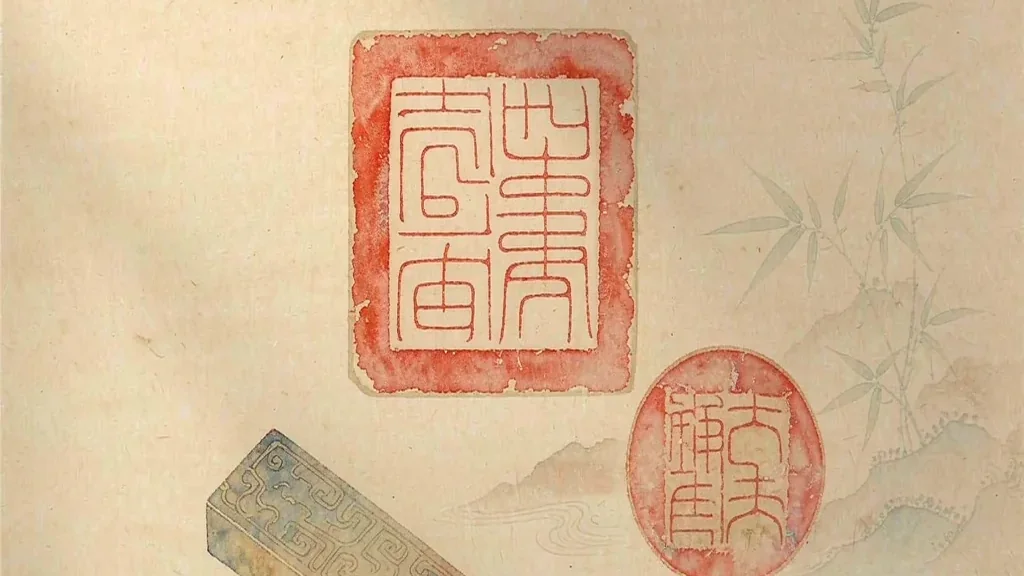
If one script above all others symbolizes the antiquity and dignity of Chinese calligraphy, it is seal script (篆书, zhuàn shū). Its sinuous, symmetrical lines and balanced proportions evoke a world of ancient ritual and imperial order. Seal script was the first consciously standardized writing system in Chinese history, imposed by the first emperor of a unified China. It survived the fall of the Qin dynasty to become the script of choice for seals, signet rings, and formal monuments for two thousand years. Even today, when a Chinese artist signs a painting, the crimson seal impression is almost invariably carved in seal script — a living link to the script of the Qin dynasty.
The Qin Unification and the Standardization of Writing
When Qin Shihuang conquered the last of the Warring States in 221 BCE, he inherited a kingdom that used multiple writing systems. The various states had diverged significantly from the common Zhou script, and characters for the same word might look completely different from one region to another. For the universal empire that the First Emperor envisioned, this diversity was unacceptable.
The emperor's chancellor, Li Si (李斯), undertook the monumental task of standardizing the writing system. He abolished the regional variants and promulgated a single official script, now called small seal script (小篆, xiǎo zhuàn). Li Si himself composed several model inscriptions, carved on stone stelae erected at sacred mountains throughout the empire. These stelae — of which only fragments survive today — established the canonical form of seal script that would be emulated for two millennia.
The Formal Structure of Small Seal
Small seal script is characterized by balanced, symmetrical forms composed of even, sinuous lines of uniform thickness. The structure is upright and stately, with characters occupying an implicit rectangular space that is slightly taller than it is wide. Curves are smooth and continuous, requiring a steady hand and controlled brushwork. The overall impression is one of monumental calm — each character stands like a small monument.
Compared to earlier scripts, small seal regularized the number and position of strokes within each character. While oracle bone and bronze scripts allowed considerable variation, small seal fixed a standard form for each character that was then taught throughout the empire. This standardization was the foundation of all later Chinese writing. The radicals (偏旁, piān páng) that organize Chinese dictionaries today were essentially established in Li Si's reform.
Large Seal and the Older Forms
Seal script is conventionally divided into large seal (大篆, dà zhuàn) and small seal. Large seal refers to the pre-Qin scripts of the Zhou dynasty, including bronze inscriptions and the script used on the Stone Drums (石鼓文, shígǔ wén) — ten drum-shaped stone blocks inscribed in the seventh century BCE. The Stone Drum script is the direct ancestor of small seal and has been admired by calligraphers since the Tang dynasty as a bridge between the archaic and the classical.
The relationship between large and small seal is one of simplification and regularization. Small seal eliminated variant forms, standardized the direction of strokes, and imposed a consistent size and proportion on all characters. What was lost in vitality and variety was gained in clarity and universality — a trade-off that the First Emperor, as a ruler, was entirely comfortable making.
Seal Script After the Qin
Although small seal was the official script of the Qin dynasty, it did not long survive the dynasty's fall as a practical writing system. The clerical script (隶书), which was faster to write, soon replaced it for everyday and administrative use. By the Han dynasty, seal script was primarily used for ceremonial purposes: the titles of stone stelae, the inscriptions of bells and tripods, and — most enduringly — personal seals.
The art of seal carving (篆刻, zhuàn kè) emerged as a separate discipline. Because seal script was the only script considered appropriate for a seal, every educated Chinese person from the Han onward encountered seal script whenever they authenticated a document or signed a letter. This kept the script alive even when it was no longer used for practical writing. Through the seal-carving tradition, seal script remained a living calligraphic form practiced by artists and scholars.
The Qing Revival of Seal Script
Seal script experienced a major revival during the Qing dynasty (1644–1912), driven by the rise of the epigraphic school (碑学, bēi xué). Calligraphers like Deng Shiru (邓石如), Wu Rangzhi (吴让之), and Wu Changshuo (吴昌硕) made seal script central to their practice. Deng Shiru in particular transformed seal script by reintroducing the subtle variations in stroke width that had been lost in the mechanical, even-line style of later copybook tradition. He studied the stone drums and early Han seals, and his work infused seal script with a new vitality.
Wu Changshuo took the revival even further, developing a personal seal-script style of extraordinary power. His brushwork is rough, vigorous, and deliberately crude — the opposite of the polished elegance that had dominated seal script for centuries. By embracing the imperfections of ancient stone inscriptions, Wu created a seal script that felt ancient and contemporary at the same time. His influence on twentieth-century calligraphy was immense.
Learning Seal Script Today
Seal script is typically the last of the major scripts that a calligraphy student learns, after mastering clerical, regular, and running scripts. The discipline of drawing even, symmetrical strokes requires exceptional brush control. The student must also learn the archaic character forms, which differ significantly from modern standard characters. Many modern Chinese speakers cannot read seal script without special study.
Despite these difficulties, seal script remains popular among calligraphy enthusiasts. Its meditative quality — the slow, deliberate pace required to draw each stroke — appeals to those who find the faster scripts too hurried. Seal script competitions are held regularly, and contemporary calligraphers continue to innovate within this ancient tradition. The script of the First Emperor still has the power to command attention and respect.
Why Seal Script Still Matters
Though no one writes daily correspondence in seal script, the form remains woven into Chinese visual life. Every painting and scroll closes with a crimson seal carved in seal script, so the script of the Qin dynasty still authenticates the art of the present. Beyond seals, contemporary calligraphers exhibit dedicated seal-script works, competitions are held, and the Qing revival's emphasis on lively, varied lines keeps the tradition from feeling like a museum piece. Its even, balanced strokes also appeal to beginners who want a meditative entry into brush control before tackling faster scripts. Most of all, seal script is the root: the radicals and proportions standardized by Li Si's reform underpin every later script, so to study it is to meet the grammar of Chinese writing at its source, a living link to the first unified empire.
Frequently Asked Questions
Chinese Vocabulary
篆书 — : Seal script: the formal, balanced script used for seals and ceremonial inscriptions.
小篆 — : Small seal script: the standardized writing system imposed by the Qin dynasty.
大篆 — : Large seal script: pre-Qin scripts including bronze and Stone Drum forms.
石鼓文 — : Stone Drum inscriptions: ten drum-shaped stones inscribed with large seal script, dating to the 7th century BCE.
篆刻 — : Seal carving: the art of carving characters into stone or other materials to create personal seals.
李斯 — : Li Si, the Qin chancellor who standardized the small seal script across the empire.
偏旁 — : Radical, the component parts whose positions were fixed in Li Si's standardization.
碑学 — : The epigraphic school of the Qing dynasty that revived seal and stele scripts.
Fun Facts
- Qin Shihuang's standardization destroyed almost all pre-Qin texts, making the stone-drum inscriptions among the only surviving examples of large seal script.
- The earliest known Chinese dictionary, the Shuowen Jiezi (说文解字), compiled by Xu Shen in 121 CE, uses small seal as its head entries.
- The seal script character for 'horse' (马) retains a clear pictographic trace of a horse's mane and tail that is entirely lost in the modern form.
- Wu Changshuo, the great Qing reviver, developed a deliberately rough and vigorous seal-script style that turned the imperfections of ancient stone into a new kind of beauty.
- Deng Shiru reintroduced subtle changes in stroke width to seal script, correcting the mechanical evenness of later copybooks and reviving the script's vitality.
- The ten Stone Drum inscriptions are so admired that scholars from the Tang onward copied them as a bridge between archaic bronze forms and the classical small seal.